

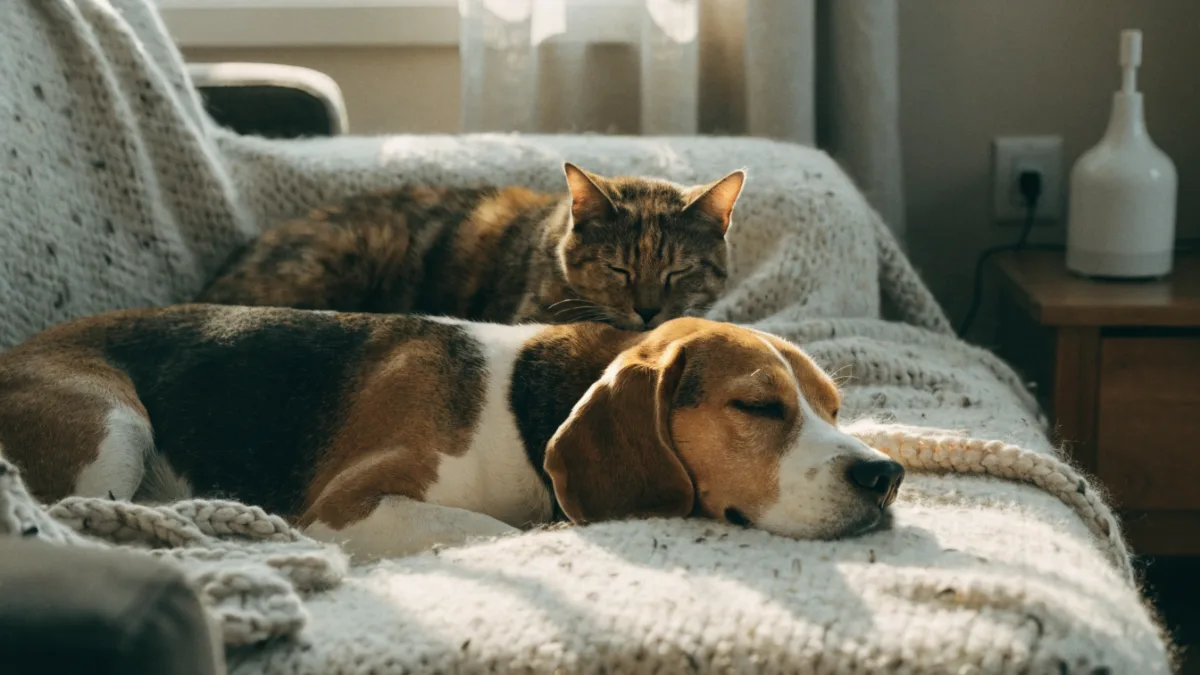
Picture this: it’s 2:00 AM, a summer thunderstorm rolls in, and your dog is suddenly tearing the baseboards off the wall. Or maybe you just moved to a new apartment, and your cat has decided the only acceptable bathroom is the middle of your living room rug. When our pets panic, we panic. We want to fix it immediately.
I used to tell clients to just “wait it out” or rely entirely on behavioral training. I was wrong. While training is the foundation of a well-behaved pet, you can’t reason with a brain that’s flooded with adrenaline. That’s where synthetic pheromones come in. Products offering calming pheromones for pets have flooded the market over the last few years, and for good reason. They aren’t sedatives, and they aren’t drugs. They are invisible safety nets. Let’s break down exactly how they work, when to use them, and why they are entirely species-specific.
The Science of Scent: Why You Can’t Smell a Thing
If you’ve ever plugged in a diffuser and thought, “Is this even doing anything?” because you can’t smell it, you aren’t alone. Humans rely heavily on vision and hearing. Dogs and cats navigate the world through their noses.
Pheromones are chemical signals. When a dog or cat detects one, they don’t actually smell it the way they smell a piece of bacon. They process it through a highly specialized receptor located in the roof of their mouth, called the vomeronasal organ (or Jacobson’s organ). You might have seen your pet do this weird thing where they slightly open their mouth, curl their lip back, and stare off into space. That’s called the Flehmen response. They are basically directing scent molecules up into that organ to decode the message.
These scent messages bypass the logic centers of the brain and go straight to the emotional core. They tell an animal, “You are safe. You belong here.”
Synthetic pheromones mimic these exact chemical signals. They are entirely odorless to humans, meaning they won’t stink up your living room. But more importantly, they are strictly species-specific. A dog pheromone has absolutely zero effect on a cat, and vice versa. If you have both a stressed dog and a stressed cat, you’ll need separate products. You must use feliway for cats and adaptil for dogs. Mixing them up is like trying to use a PlayStation disc in an Xbox.
Adaptil for Dogs: Recreating the Nursery
Let’s talk about the dog side of things. Adaptil for dogs works by mimicking the Dog Appeasing Pheromone (DAP). Here’s the cool part: this is the exact pheromone a mother dog secretes from her mammary area three to five days after giving birth. It is nature’s way of telling the helpless puppies, “Stay close, the world is okay.” The beauty of the science is that this pheromone continues to comfort adult dogs of all ages.
I saw this firsthand with a client who had a pandemic-puppy Border Collie mix. The dog was practically glued to her side for two years. When the owner finally had to go back to the office, the dog began destroying the crate and howling for eight hours straight. We introduced an Adaptil collar—ideal for on-the-go or continuous, whole-body anxiety—along with crate training. The pheromone took the sharp edge off the panic. It gave the dog the breathing room to actually process the training we were doing.
You’ll want to look into Adaptil if your dog struggles with:
- Loud noises: Thunderstorms, fireworks, or construction.
- Separation anxiety: The classic “my owner left the house” meltdown.
- Travel and vet visits: The spray version is fantastic for spot-treating the inside of a car or a carrier right before a stressful trip.
- Crate training: Helping a new puppy view the crate as a den rather than a prison.
The dog isn’t drugged. They are still active, alert, and ready to play. The pheromone simply lowers the background noise of their anxiety.
Feliway for Cats: Drawing the Borders
Cats are a whole different beast. Where dogs look to their pack leader for security, cats look to their territory. If a cat feels their territory is secure, they are relaxed. If their territory is threatened or changes, they panic.
When a cat feels safe in your home, they do that incredibly cute thing where they rub their cheeks on the corners of your furniture, your doorframes, and even your shins. They aren’t just being affectionate. They are depositing feline facial pheromones. They are drawing invisible borders that tell their brain, “I own this, and it’s safe here.”
Feliway for cats is a synthetic copy of this exact facial pheromone. When you plug it in, you are artificially marking the house as “safe” for them. This is why it is an absolute game-changer for newly adopted cats or when moving to a new home. Instead of hiding under the bed for three weeks, they often explore much faster.
Cats are also notorious for peeing outside the litter box or shredding the corner of your couch. We usually view this as bad behavior. The cat views it as an emergency communication system. They are stressed, so they are leaving their own scent markers to make themselves feel better. By providing Feliway, you are doing the scent-marking for them, which often stops the destructive behavior in its tracks.
Managing Multiple Cats
If you have a multi-cat household, things get a bit more complicated. Introducing a new pet, a new baby, or even rearranging the living room furniture can trigger turf wars. For this, Feliway makes a specific Multicat formula. Instead of the facial pheromone, this mimics the harmony pheromones produced by a mother cat to keep her kittens from fighting. It helps create a chill vibe in tense households. They’ve also recently released Feliway Optimum, a next-generation formula that targets a broader range of feline stress signals, combining the benefits of the classic line into one vial.
How to Actually Use These Products
If you decide to try synthetic pheromones, placement is everything. The oils and pheromones are heavier than air, meaning they will fall as they disperse. Don’t plug a diffuser in right next to the ceiling or behind a heavy couch.
Here are the best practices I’ve learned over the years:
- Plug it low: Find an open outlet near the floor in the room where your pet spends the most time.
- Give it time: Diffusers take about 24 hours to build up enough scent molecules in a room to actually work. If you plug one in five minutes before the Fourth of July fireworks start, you’re too late.
- Change it monthly: The liquid runs out. Mark your calendar and swap the vial every 30 days.
- Don’t cover the scent: Try not to plug them in directly next to heavy air fresheners or strong candles. You want the animal’s vomeronasal organ focused on the pheromone, not your vanilla plug-in.
Real Talk: Managing Your Expectations
Here is where I have to be brutally honest. Synthetic pheromones are not a magic cure-all. There is a lot of debate in the veterinary and behavior world about their efficacy, and I’ve seen plenty of pet owner forums where people complain they did absolutely nothing.
Why does this happen? First, every pet has different receptor sensitivity. Some dogs and cats simply don’t respond to the synthetic signals as strongly as others. Second, and most importantly, pheromones are an adjunctive therapy. They are meant to be used alongside behavioral modification and training.
If your dog has severe separation anxiety, Adaptil will lower their stress threshold from a 10 to an 8. But it won’t teach them how to be alone. You still have to do the training. If your cat is spraying because a stray cat is hanging out outside your window, Feliway will help, but you also need to block the visual trigger.
There is also the “Placebo-by-Proxy” effect. Some skeptics argue that because the pheromones are odorless to us, they don’t actually work on the pets—they just work on the owners. The theory is that you plug in the diffuser, you relax because you feel like you’ve solved the problem, and your pet reads your relaxed body language and chills out. Look, double-blind clinical studies do support that these products work on the animals, particularly in reducing hiding in cats and vocalization in dogs. But there is probably a nugget of truth to the placebo effect. If you are less stressed, your pet will absolutely pick up on that. Either way, it’s a win.
At the end of the day, our pets rely on us to interpret their world. Anxiety is a miserable experience for them. Whether it’s separation panic, a thunderstorm, or a stressful move, giving them a biological cue that they are safe is one of the kindest things we can do. Pair those pheromones with patience, positive reinforcement, and a solid routine, and you’ll be giving your pet the best possible chance to thrive in our human world.