

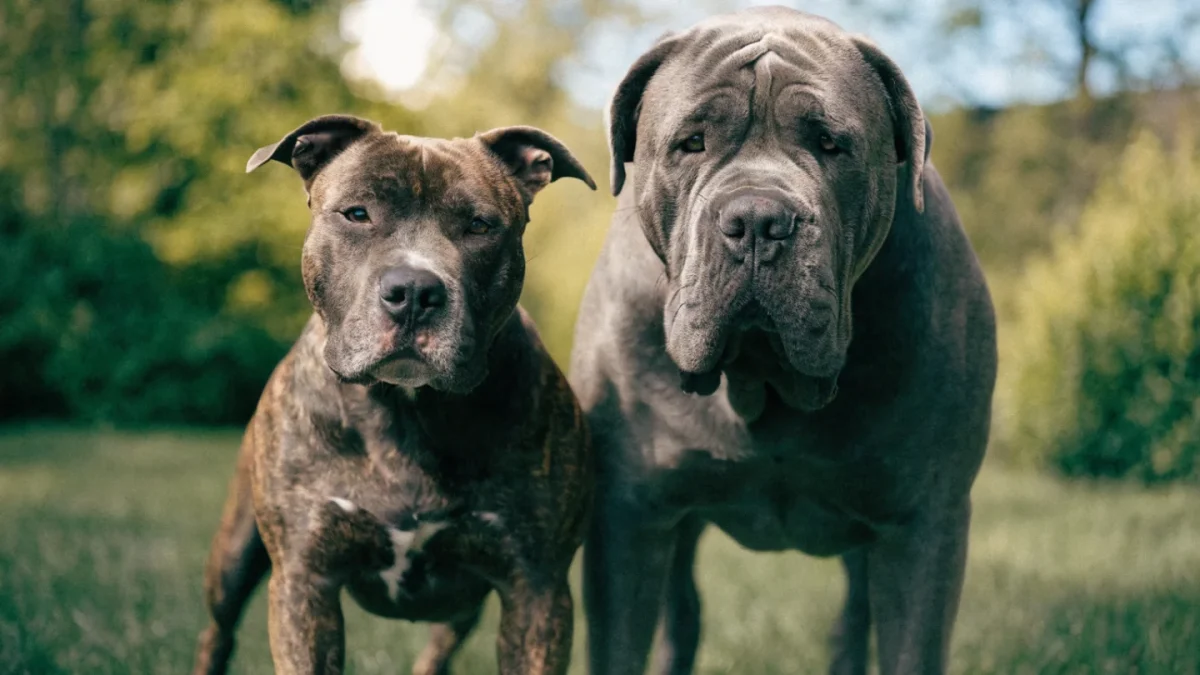
The American Pit Bull Terrier was created in 19th-century Britain by crossing Bulldogs with terriers — the Bulldog's strength with the terrier's agility and tenacity. Immigrants brought these dogs to America, where they became all-purpose farm dogs, family companions, and, regrettably, fighting dogs in operations that exploited the breed's tolerance and drive. The Cane Corso is an ancient Italian mastiff breed descended from Roman war dogs — the canis pugnax — that later served as property guardians, wild boar hunters, and livestock drovers across southern Italy. The breed nearly went extinct by the 1970s before a dedicated recovery effort by Italian breed enthusiasts restored the population.
Two powerful breeds, two very different histories, two entirely different approaches to the world. Both face public perception challenges that require honest discussion.
Size and Build
| Trait | American Pit Bull Terrier | Cane Corso |
|---|---|---|
| Height | 43-53 cm | 58-70 cm |
| Weight | 14-27 kg | 40-50 kg |
| Build | Muscular, athletic, medium-sized | Massive, heavy-boned, broad-chested |
| Head | Broad, medium length | Large, wide, pronounced jowls |
The size difference is dramatic. The Pit Bull is a medium-sized dog — smaller than most people picture, thanks to media portrayals that inflate the breed's dimensions. The Cane Corso is a genuine giant, outweighing the Pit Bull by a factor of two or more. Managing a 50 kg Corso on leash demands physical strength that a 20 kg Pit Bull doesn't require.
Temperament
Here's what most people get wrong about both breeds.
The American Pit Bull Terrier is one of the most people-friendly breeds in existence. Temperament testing data consistently shows Pit Bulls scoring above average in tolerance and sociability with humans. They're affectionate, enthusiastic, and deeply bonded to their families. The breed's historical problem isn't aggression toward people — dogs that bit handlers were culled from fighting lines because they were dangerous to manage. The temperament that survived selection is one that loves humans intensely.
The caveat: Pit Bulls can be dog-selective or dog-aggressive, particularly with same-sex dogs. This is a breed trait rooted in their fighting-dog ancestry. It doesn't mean every Pit Bull is dog-aggressive, but it means the tendency exists at higher rates than in many other breeds, and responsible ownership includes managing introductions and not assuming universal dog-friendliness.
The Cane Corso operates differently. This breed was developed to guard property and hunt dangerous game. Corsos are loyal and affectionate with their family but naturally reserved with strangers. They assess unfamiliar people with a calm, measured watchfulness that can be intimidating — and that's by design. A Corso's guarding instinct is innate, not trained. They don't need encouragement to protect their home; they need guidance about when not to.
With other dogs, Corsos are generally more tolerant than their size suggests, provided they're properly socialized. They're less likely to initiate conflict than a dog-selective Pit Bull, but when a 50 kg guardian breed does escalate, the consequences are proportionally severe.
Both breeds absolutely require early socialization and ongoing training. Neither is suited to passive or first-time ownership. These are strong, confident dogs that need clear leadership from someone who understands working-breed psychology.
Exercise Needs
Pit Bulls need 60 to 90 minutes of daily exercise. They're athletes — muscular, agile, and built for sustained physical activity. Spring pole, flirt pole, weight pulling, hiking, and vigorous fetch all channel their energy productively. A Pit Bull without exercise becomes destructive and anxious.
Cane Corsos need 45 to 60 minutes. Despite their size, they're not high-energy dogs. They're powerful but not hyperactive. Moderate walks, training sessions, and mental enrichment satisfy them. Corsos under age two have more energy and need structured outlets, but adult Corsos are generally content with moderate daily activity.
Grooming
Both breeds have short coats and are low-maintenance groomers.
Pit Bulls have smooth, glossy coats that shed lightly to moderately. Weekly brushing is sufficient. They're clean dogs that don't develop strong odor between baths.
Cane Corsos have short, dense coats with a light undercoat that sheds moderately. Weekly brushing manages shedding. The facial folds (less pronounced than in English Bulldogs but present) need occasional cleaning. Corsos can drool, particularly after drinking or in warm weather — not excessively, but enough to notice.
Health Concerns
Pit Bulls face hip dysplasia, allergies and skin conditions (the breed is prone to environmental and food allergies), patellar luxation, thyroid disease, and congenital heart defects. Demodectic mange occurs at elevated rates in young dogs. The breed is generally robust and long-lived for its size. Average lifespan: 12 to 16 years.
Cane Corsos are predisposed to hip dysplasia, elbow dysplasia, bloat (a life-threatening emergency in deep-chested breeds), cherry eye, entropion, and idiopathic epilepsy. Cardiac issues, particularly dilated cardiomyopathy, are documented in the breed. As with many giant breeds, the Corso's lifespan is shorter. Average lifespan: 9 to 12 years.
The lifespan gap is significant. A Pit Bull may give you 14 to 16 years. A Corso is more likely to give you 10 to 11. For another perspective on the Corso, see our Cane Corso vs Rottweiler comparison.
Living Situation
Pit Bulls adapt well to most living environments, including apartments, provided exercise needs are met. They're house dogs that want to be close to their people. They handle heat better than many breeds but are sensitive to cold due to their short coat.
Cane Corsos need more space. Their size alone makes apartment living challenging, and they benefit from secure yard access. A Corso needs room to move indoors and a property to monitor — giving them a "territory" satisfies their guardian instinct.
Both breeds need secure fencing. Both should be leashed in public. Neither breed gets the benefit of the doubt from strangers — fair or not, public perception of both breeds demands responsible management.
Who's the Right Fit
The Pit Bull suits an experienced owner who wants an athletic, affectionate, people-oriented dog and can manage dog-selectivity through controlled introductions and responsible socialization. You'll deal with public perception issues, but the dog behind the reputation is remarkably loving.
The Cane Corso suits someone who wants a calm, powerful guardian breed and has the space, experience, and physical presence to manage a giant-breed dog with strong protective instincts. You need to be comfortable with a dog that takes the security of your home seriously and requires lifelong training reinforcement.
Neither breed is for casual ownership. Both reward dedicated, knowledgeable handlers with extraordinary loyalty. For more breed matchups, see our breed comparisons guide. For a complete profile of the Cane Corso covering its Roman canis pugnax ancestry, near-extinction and recovery, and current breed standards, the Cane Corso complete breed guide provides the full reference. For an honest account of the American Pit Bull Terrier's history, temperament testing data, and responsible ownership requirements, the American Pit Bull Terrier breed guide covers the breed in full.