

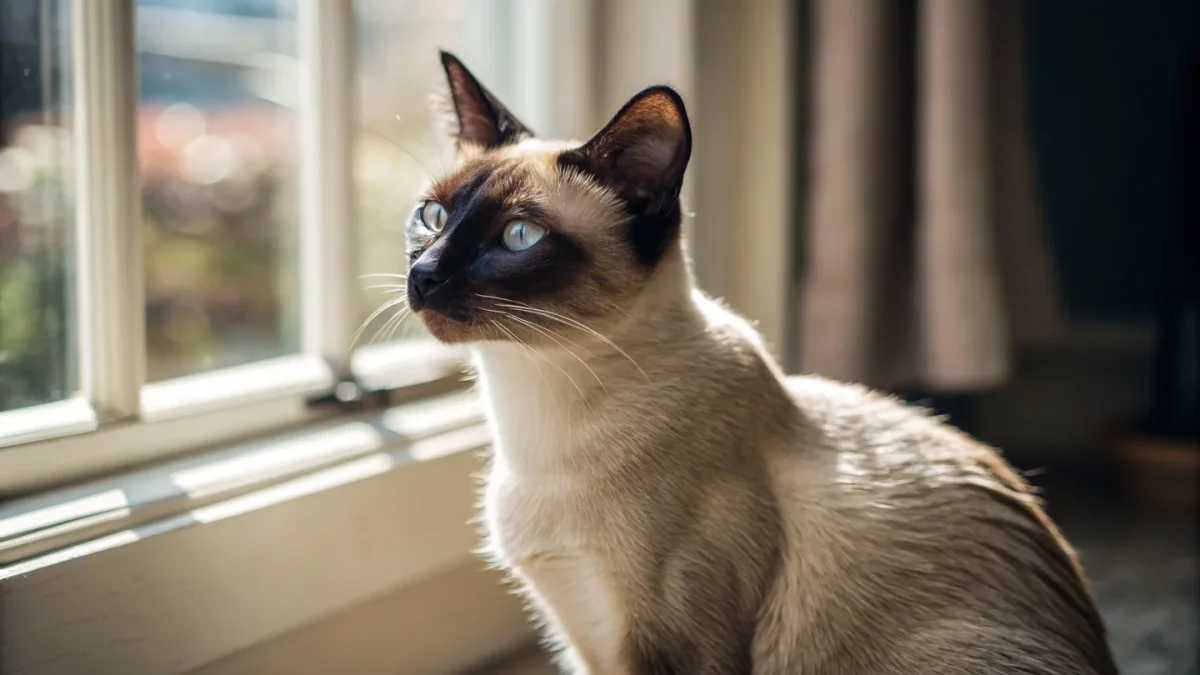
Why does a Siamese cat have a dark face and pale body? The answer is elegant: temperature. The gene controlling pigment production in pointed cats produces an enzyme that is temperature-sensitive — it works in cool environments and switches off above a certain threshold. The body's warm core stays pale; the cool extremities (face, ears, paws, tail) develop full pigmentation.
This is one of the more satisfying explanations in animal genetics: the pattern you see on the outside is a direct readout of the temperature map of the cat's body surface.
For broad context on how this fits into cat coat genetics, the cat coat color genetics primer covers the full picture. The cat breed categories overview covers the breeds that carry this trait.
The Mechanism in Detail
The colorpoint pattern results from a specific allele (variant) of the gene encoding tyrosinase (TYR), the enzyme responsible for melanin (pigment) production — geneticists designate it cs (c^s), a symbol that's held since the 2005 study that first mapped the mutation.
In cats carrying two copies of this allele (homozygous colorpoint), the tyrosinase enzyme is heat-labile: it denatures (loses function) above approximately 33°C (91°F) — researchers have pinned that threshold down, not just estimated it.
The body's surface temperature is not uniform:
- Core body temperature: 38-39°C in healthy cats — too warm for enzyme function. Result: little to no pigment produced. The fur grows pale or white.
- Extremities (face, ears, paws, tail): significantly cooler due to proximity to air and reduced blood flow. Result: enzyme functions normally. Full pigment develops.
Why Pointed Kittens Are Born White
Pointed kittens emerge from the womb uniformly pale. During gestation, kittens are maintained at uniform maternal body temperature — warm throughout, above the enzyme threshold. No localized cool zones exist. No point pigmentation can develop.
After birth, as the kittens are exposed to ambient temperature and their extremities cool, the tyrosinase enzyme begins functioning in those cooler areas and point pigmentation gradually appears over the first weeks and months of life.
This also explains why adult colorpointed cats develop darker points if kept in cold environments, and why their points may lighten slightly in very warm environments — the pattern is dynamic, not fixed. The change is subtle in adults, but the mechanism is always active.
Colorpoint Colors: Same Gene, Different Pigment
The point color is still subject to all the other color genes acting on whatever pigment is produced in the cool zones. The base colorpoint allele doesn't specify color — it specifies distribution. The actual color at the points depends on:
- Seal point: Full black/brown eumelanin in the points
- Blue point: Seal + dilute gene = muted blue-grey points
- Chocolate point: Reduced eumelanin density + colorpoint
- Lilac point: Chocolate + dilute = pale pinkish-grey points
- Flame/Red point: Orange gene expressing in the points
- Cream point: Flame + dilute = cream points
- Tortie point: Orange and non-orange mosaic in the points (females only)
Which Breeds Carry the Colorpoint Allele?
The colorpoint allele is present across multiple breeds, not just the Siamese:
- Siamese: Essentially defined by the colorpoint gene in the modern breed — the Siamese breed profile covers the full historical development and the range of point colors recognized today
- Ragdoll: Always colorpointed — the pattern is breed-defining
- Birman: Colorpointed with the addition of white gloves
- Balinese: Longhaired Siamese — same gene, longer coat
- Himalayan: Persian type with colorpoint gene
- Tonkinese: Carries a mix of colorpoint and solid alleles, producing the distinctive "mink" pattern (intermediate between fully pointed and solid)
- Burmese: Carries a different allele of the same gene (called Burmese restriction, or c^b) that produces a similar but less extreme distribution of pigment — darker at extremities, lighter at core, but with less contrast than full colorpoint
The Tonkinese: The Intermediate Case
The Tonkinese deserves special mention because it illustrates the gene's allele behavior clearly. Tonkinese cats are typically heterozygous — one colorpoint allele (c^s) and one Burmese restriction allele (c^b). The result is a "mink" pattern: more pigmented than a full Siamese, more muted than a full Burmese, with an intermediate body color. Aqua or blue-green eyes are characteristic of this heterozygous combination.
This is codominance — both alleles express simultaneously in the heterozygote, producing an intermediate phenotype rather than one fully dominating the other.