

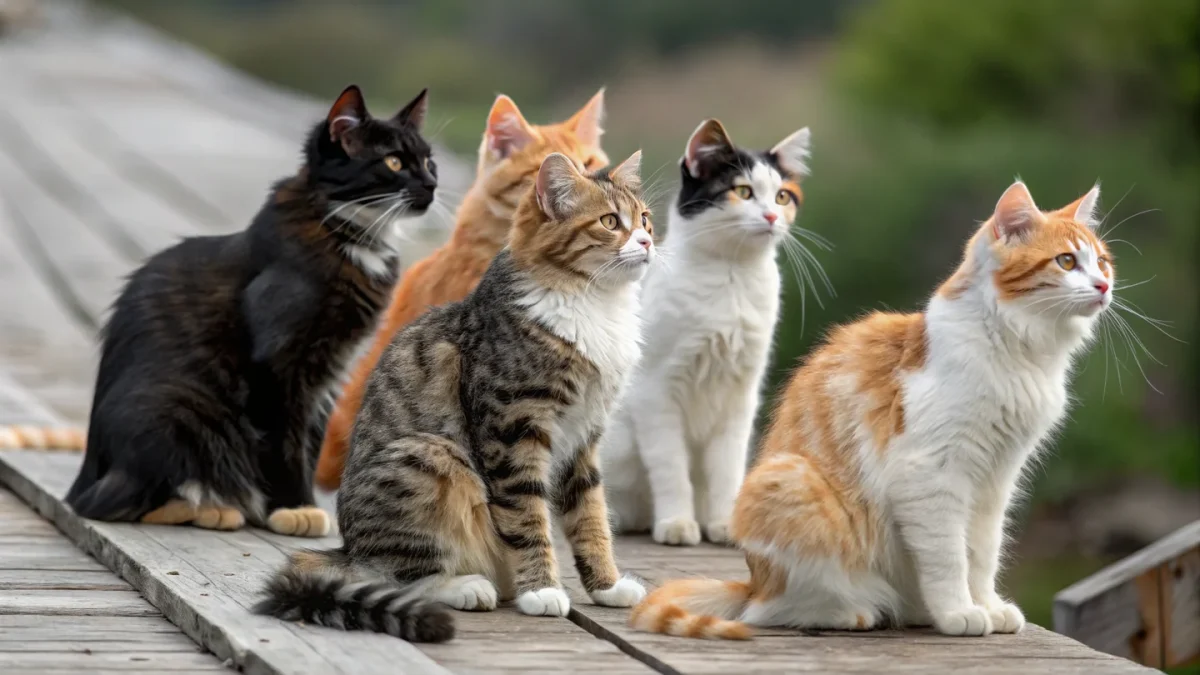
A calico cat is a walking genetics lesson. The orange, black, and white patches that define her aren't random — they're the visible result of X-chromosome inactivation, a cellular process that operates independently in each skin cell during early development. Understanding why calicos are almost always female, why orange cats are predominantly male, and why tabby stripes form at all takes you into genuinely fascinating biological territory.
This article covers the major genetic systems controlling cat coat color and pattern at an accessible level — enough to explain what you see, without requiring a genetics degree to follow.
The cat breed categories and genetics article covers how these traits distribute across recognized breeds. For a practical illustration of how many distinct outcomes these gene interactions produce, Persian coat colors and patterns documents the breadth of recognized color classes within a single breed.
The Two Base Pigments
Cat coat color starts with two pigment types:
- Eumelanin: Produces black to brown colors. The density and expression of eumelanin creates the range from black to chocolate to cinnamon.
- Phaeomelanin: Produces orange to cream colors. The expression of phaeomelanin creates orange, red, and cream in cats.
Every color in a cat's coat is a variation or combination of how these two pigments are produced, modified, or suppressed.
The Orange Gene: Why It's Sex-Linked
The gene controlling orange versus black coat expression (denoted O in cat genetics) is located on the X chromosome. This is the central fact that explains most of what's interesting about cat color.
Female cats have two X chromosomes; males have one X and one Y.
- A female with O on both X chromosomes: orange/ginger
- A female with O on one X and non-orange on the other: calico or tortoiseshell (the cells that activate each X produce different colors in patches)
- A male with O on his single X: orange
Because males have only one X chromosome, they can only be orange OR non-orange — not a mix of both. This is why calico and tortoiseshell cats (which require both colors) are almost exclusively female. A male calico would require XXY chromosomes — a real but rare occurrence, documented in roughly 1 in 3,000 male cats with calico or tortoiseshell coloring, and such individuals are generally sterile.
The Agouti Gene and Tabby Patterns
The vast majority of cats carry the tabby pattern at a genetic level — even solid-colored cats often carry unexpressed tabby genes. The agouti gene (A) controls whether individual hairs are banded (agouti, producing tabby) or uniform (non-agouti, producing solid color).
When the agouti gene is expressed, each hair has alternating bands of pigment and pale color — this banding creates the typical tabby pattern. Cats with two copies of the recessive non-agouti gene (aa) have solid-colored coats.
Four tabby patterns are recognized, each controlled by different modifier loci:
- Mackerel: Narrow vertical stripes — the "wild-type" tabby pattern, produced by the dominant Tm allele at the Taqpep gene.
- Classic (blotched): Bold swirled patterns on the sides; controlled by the recessive Tb allele at that same Taqpep locus
- Spotted: Spotted appearance — the spots are modified mackerel stripes, produced by one or more additional modifier loci that researchers have mapped to specific chromosome regions without yet pinning down the exact causal gene
- Ticked: Individual hairs banded with no visible stripes on the body — the Abyssinian's distinctive coat. Produced by the Ticked allele (T^a)
The Colorpoint Pattern: Temperature-Sensitive Expression
The colorpoint pattern — darker extremities against a lighter body, as seen in Siamese, Ragdolls, and Birmans — results from a temperature-sensitive allele of the tyrosinase gene (TYR), denoted cs at what geneticists call the C locus.
The enzyme responsible for pigment production in colorpointed cats is inactivated above a certain body temperature threshold. The core body stays warm = pale. The extremities (face, ears, paws, tail) stay cooler = full color develops. This is why colorpointed kittens are born white — they spend gestation at uniform body temperature — and develop their points over the first weeks of life.
Color in the points is still subject to the other color genes: a Siamese with the orange gene and seal point pattern would have red/flame points. A blue point Siamese has the density-reducing dilute gene expressing in the points.
Coat genetics is not the only area where breed-specific gene variants produce measurable differences. For an illustration of how genetic variants in specific breeds affect protein production rather than color — including Siberian Ch1/Ch2 variants studied for their link to allergen output — the science of cat allergen genetics covers the research in detail.
Dilute and Other Modifiers
The dilute gene reduces eumelanin and phaeomelanin expression:
- Black + dilute = blue/grey
- Chocolate + dilute = lilac/lavender
- Orange + dilute = cream
Dominant white and white spotting were long treated as separate genes, but modern genetics has folded them into the same gene, KIT — two different retroviral insertions at what's now unified as the W locus. The dominant white allele (Wd) produces entirely white cats and carries a real deafness risk, particularly paired with blue eyes: homozygous dominant white cats are reliably deaf, while heterozygotes have roughly a coin-flip chance. White spotting (the Ws allele, at that same locus) produces bicolor and tuxedo patterns in heterozygotes and heavily white cats in homozygotes.
FAQ
Why are orange cats more often male?
Because the orange gene is on the X chromosome. Males have one X and one Y — their single X determines their coat color. A male with O on his X is orange throughout. Females need O on both X chromosomes to be fully orange; otherwise they're calico or tortoiseshell where the orange and non-orange cells create patches.
Can two black cats have an orange kitten?
If both parents carry the right genetics, yes — though it requires a recessive orange gene to be present in the mother's genetics. A black female cat who is heterozygous (carrying orange on one X chromosome but expressing black due to the other X) can pass orange to sons.
What makes a cat's coat white with another color?
White spotting (the S gene) determines the distribution of white in a bicolor or tuxedo cat. The dominant white gene (W) creates entirely white cats. These are different genetic mechanisms even though both produce white areas.