

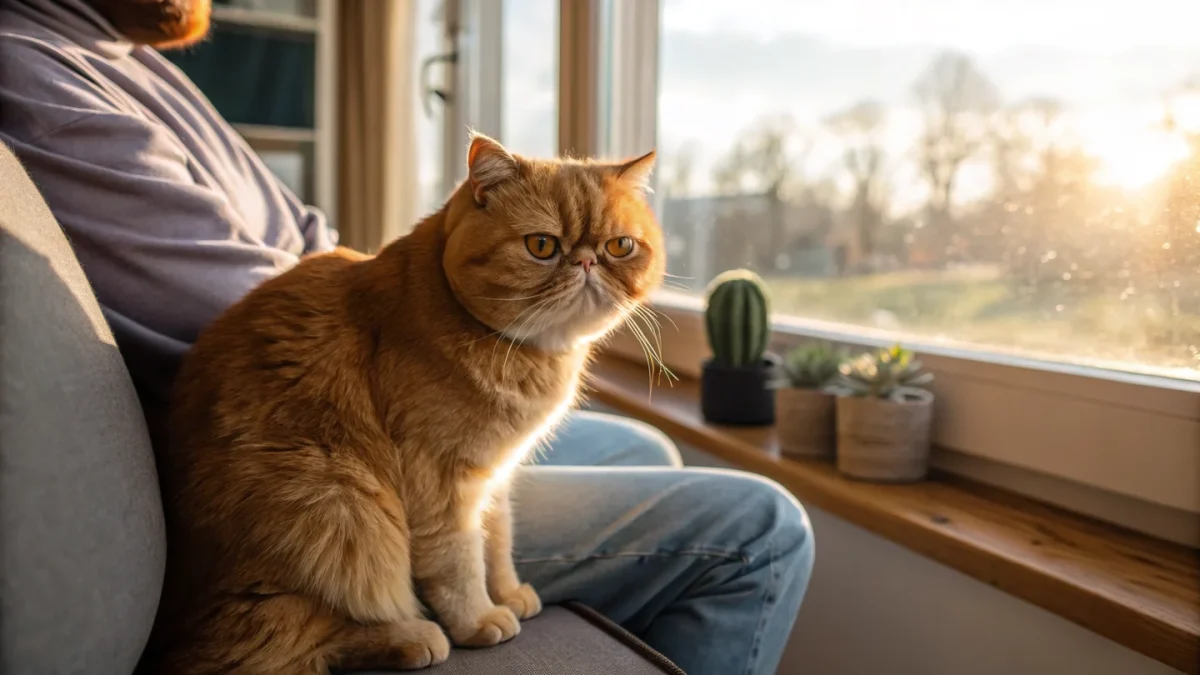
The Persian's personality is, by broad consensus, one of the most pleasant in the cat world: calm, gentle, deeply loyal, and content with the quiet rhythms of indoor life. The challenge for prospective owners has always been the coat — the Persian's long, flowing double coat requires daily grooming to prevent matting, a commitment that puts some otherwise willing people off.
The Exotic Shorthair solves this. For the complete breed background, the Exotic Shorthair's complete breed guide provides full context. What's relevant here is that the Exotic Shorthair inherits the Persian's personality essentially wholesale — the calm, the gentleness, the devoted attachment — in a package that requires substantially less grooming work. The temperament is not a simplified version of the Persian's; it's the same temperament with a different coat attached.
The Calm Baseline
"Calm" is the word that comes up first in any honest description of the Exotic Shorthair, and it's accurate in ways that go beyond just "this cat doesn't run around much."
The Exotic Shorthair's calm extends to its emotional responses. Loud noises cause less distress than in more reactive breeds. Household disruptions — visitors, moved furniture, changed routines — register but don't destabilize. Children are tolerated with genuine patience rather than wary forbearance. The breed's composure feels constitutional rather than trained.
This doesn't mean they're affectless. Exotic Shorthairs are clearly engaged with their environment — they watch activity with bright, attentive eyes, they respond to their names with visible recognition, they register when their person leaves and when they return. But they process all of it from a place of underlying steadiness that makes them remarkably easy to live with.
The contrast with high-strung breeds is instructive. A Devon Rex left alone for the afternoon will have opinions about it. An Oriental Shorthair will vocalize those opinions extensively. An Exotic Shorthair will wait, comfortably, and be genuinely pleased when you return — without the drama.
Affection Without Demanding
The Exotic Shorthair is affectionate in a way that most people experience as just right: present, warm, and reciprocal without being constant or demanding.
They seek physical contact reliably — lap time, proximity while sleeping, the casual shoulder-brush that cats use to maintain bond connection. They'll follow their people from room to room with mild interest, checking in rather than demanding engagement. They purr at low provocation and with sustained commitment.
What they don't do is vocalize incessantly, wake their owners at 3 AM to demand play, or transform a momentarily empty lap into an emergency. The affection is available and consistent, but the register is quiet.
For people who've lived with more demanding breeds, this quiet affection can initially read as indifference. It isn't. An Exotic Shorthair that sits in the same room as its person and watches them peacefully is expressing contentment and connection, not disinterest. The expression is just lower-key than some people have been calibrated to read.
Play: The Unhurried Style
Exotic Shorthairs do play — particularly as kittens, when there's genuine athletic enthusiasm — but their approach to play is different from high-energy breeds.
A wand toy session with an Exotic Shorthair typically looks like this: considered observation of the toy, a few deliberate swipes, possibly a brief burst of actual pursuit, and then a decision that adequate entertainment has been achieved and rest is preferable. The Devon Rex equivalent of this session would involve twenty minutes of acrobatics and a destroyed feather attachment.
This isn't a deficiency. It's a different play style that suits different people. The Exotic Shorthair is the cat for someone who wants to offer enrichment and play without being required to conduct marathon engagement sessions. Fifteen minutes of gentle wand play, a puzzle feeder, and some independent toy batting is sufficient for most adult Exotics.
What they do maintain through adulthood is genuine responsiveness to play when offered. They don't become completely sedentary with age; they simply calibrate their activity level to the low-effort end of the spectrum rather than the high-effort one.
The Quiet Voice
Exotic Shorthairs are among the quieter breeds. They communicate through presence and expression far more than through vocalization. The meow that exists is soft and rarely deployed — occasionally at feeding time, occasionally in greeting, rarely as a demand.
This is not the same as having nothing to say. Exotic Shorthairs communicate through their large, expressive round eyes, through the quality of their purring, through where they position themselves in a room and whether they're facing toward or away from their person. Owners who learn to read these signals describe the Exotic Shorthair as expressive — just in a register that requires attention rather than volume.
For people in apartments with thin walls, or for households where quiet matters — young children napping, work-from-home calls — this is a practical advantage that shouldn't be undervalued.
Social Preferences and Household Dynamics
The Exotic Shorthair is not a one-person cat in the way that some breeds are. They distribute their affection across the household with reasonable equity, have an easier time with strangers than more cautious breeds, and adapt to changes in household composition without obvious distress.
They're good with gentle children — patient, tolerant, and not easily spooked into scratching or fleeing. The caveat is the "gentle" part: the Exotic Shorthair's rounded eyes are physically vulnerable, and rough handling or accidental poking represents a real risk. Supervision with very young children is responsible management, not overcaution.
With other cats, Exotics are generally easygoing. They don't initiate territory disputes and don't assert themselves at other cats' expense. Their low-conflict personality makes them good candidates for multi-cat households, though they can be somewhat overwhelmed by very active breeds that want to play constantly.
With dogs: usually fine, provided the dog's energy level and prey drive are compatible. The Exotic Shorthair's composure means they don't panic-flee from dogs, which is actually the behavior that most activates prey-chasing in dogs. A calm introduction and a dog that respects the cat's signals usually produces a workable cohabitation.
The Persian Comparison in Practice
People often ask: if the Exotic Shorthair and the Persian have the same personality, why choose one over the other?
The honest answer is mostly about grooming commitment. Those who want to understand the Persian temperament in its original long-coated form will find the emotional character essentially identical — the grooming requirement is what differs. The Persian coat, maintained properly, requires significant daily time investment — careful combing, mat prevention, eye area cleaning, and periodic bathing. Many owners find this deepens their bond with the cat and don't experience it as a burden. Others find it genuinely overwhelming to sustain long-term.
The Exotic Shorthair's plush but short coat needs twice-weekly attention rather than daily, plus the eye and face cleaning that the flat-faced anatomy creates regardless of coat length. If you want the Persian personality without the Persian's grooming requirements, the Exotic Shorthair delivers that clearly.
If you find the grooming relationship valuable and the Persian coat beautiful on its own terms, the Persian's coat is actually the right choice for you, and the Exotic Shorthair would feel like a compromise.
Temperament and the Brachycephalic Context
One thing worth naming directly: the Exotic Shorthair's calm temperament may in some cases reflect genuine contentment, and in other cases may reflect the fatigue or discomfort that brachycephalic features can cause. A cat whose breathing requires sustained effort at rest is not going to be as active as a cat that breathes easily.
This doesn't invalidate the Exotic Shorthair's temperament as a genuine characteristic — it is genuinely a calm breed, independent of its respiratory anatomy. But owners should have the cat's breathing assessed by a veterinarian familiar with brachycephalic breeds so they can distinguish "temperamentally calm cat" from "cat whose activity is limited by airway restriction." The distinction matters for the cat's wellbeing.
What This Breed Is For
The Exotic Shorthair is for households that want warmth and consistent companionship without high energy demands, vocal disruption, or complex social requirements. They fit quiet adults, families with calm older children, multi-pet households with compatible animals, and anyone who wants a cat that is present and affectionate but doesn't make its needs the dominant feature of your home.
They're one of the most forgiving breeds for owners who are less experienced with cats, partly because their emotional and physical needs are clear and manageable, and partly because their patience means mistakes in handling or routine are less likely to result in behavioral escalation.
The right Exotic Shorthair owner understands that the health management requirements are real — the eye care, the breathing awareness, the veterinary follow-up — and accepts those as part of the arrangement. In exchange, they get a cat that will share their home with a quiet, steady devotion that is genuinely one of the more pleasant experiences the cat world offers.