

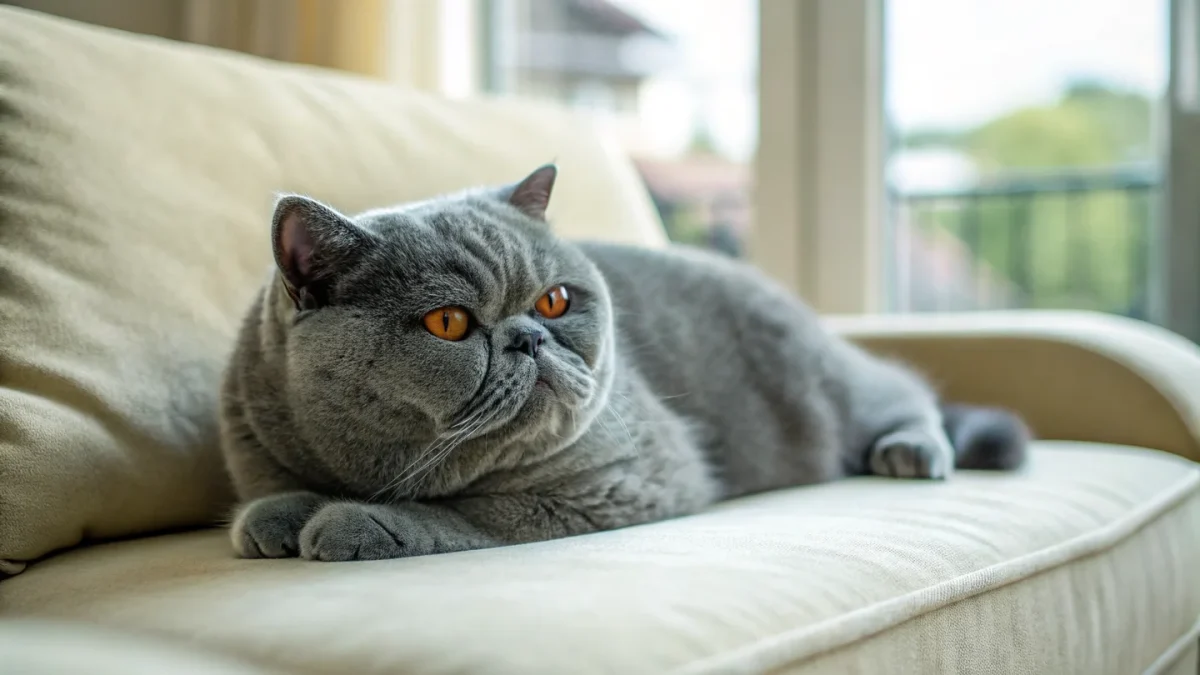
In the late 1950s, an American Shorthair breeder named Carolyn Bussey crossed her cats with a silver Persian to improve coat texture and introduce the Persian's eye color. She wasn't attempting to create a new breed — she was trying to improve an existing one. The resulting kittens, however, were striking enough to attract attention, and over the following decade, other breeders deliberately pursued the Persian-American Shorthair cross. By 1966, the Cat Fanciers' Association recognized the result as its own breed: the Exotic Shorthair.
The exotic shorthair cat breed has become one of the most popular pedigreed cats in the world, partly because it solves what many potential Persian owners identify as their main barrier: the coat. The Persian's demanding double coat requires daily grooming to prevent matting — it's a genuine commitment. The Exotic Shorthair delivers the same round, flat-faced, teddy-bear appearance and the same calm, affectionate personality in a coat that needs only twice-weekly attention. If the Persian is a beautiful vintage car that requires intensive maintenance, the Exotic Shorthair is the same car with modern components under the hood.
There's a significant caveat, and I'll address it directly: the flat face comes with real health consequences. The Exotic Shorthair is a brachycephalic breed, and that means breathing difficulties, eye problems, and dental crowding are not rare complications — they're predictable features of the anatomy that owners must manage proactively. More on that shortly.
Origins: The Persian Shortcut
The Exotic Shorthair's development was American-driven and, initially, somewhat controversial within the cat fancy. Persian breeders objected to using their cats in outcrosses that would dilute the Persian lines. American Shorthair breeders objected to introducing Persian traits that would compromise the American Shorthair standard.
The solution was to establish the Exotic Shorthair as a distinct third breed, which satisfied neither objection entirely but created room for the cross to continue under its own identity. The breed standard was written to describe the Persian body type and face — the flat muzzle, the round head, the large round eyes — in a coat that was short rather than long. Subsequent breeds contributed to the gene pool beyond just Persians and American Shorthairs, including Burmese and Russian Blues in the early decades, though modern Exotic Shorthair breeding relies primarily on Persian outcrosses to maintain the type.
The Exotic Shorthair today is genetically very close to the Persian. Many registries allow Exotic-to-Persian breeding. Kittens from Exotic parents can be longhaired if both parents carry the recessive longhair gene — these individuals are often registered as "Exotic Longhair" rather than Persian, though the practical distinction is subtle.
Physical Characteristics
The Exotic Shorthair's appearance is the Persian's — translated into a shorter coat.
Body: Cobby — short, rounded, stocky, and low to the ground. Substantial bone structure and broad chest. Deceptively heavy for their apparent size. Males typically weigh 9-14 pounds; females 7-11 pounds.
Head: Large, round, and set on a short, thick neck. The face is flat — the forehead, nose, and chin should be in vertical alignment according to the breed standard. The nose leather sits high, and the muzzle is very short and broad.
Eyes: Large, round, and set far apart. Brilliant copper or gold is standard in most color varieties; blue in white-coated individuals; green in silver and golden varieties.
Coat: The defining departure from the Persian. Short to medium in length, standing away from the body (rather than lying flat) due to the dense undercoat. Plush and thick — described in breed standards as "brush-like." Much easier to maintain than the Persian's long coat, but not minimal. The dense undercoat means seasonal shedding is real.
Colors: The same range as the Persian — solid, tabby, bicolor, colorpoint (Himalayan pattern), silver, golden, shaded, smoke, and calico variations.
Temperament: The Persian Personality
The Exotic Shorthair inherits the Persian's emotional disposition almost wholesale. These are calm, composed cats that prefer a predictable environment and quiet companionship to high stimulation and chaos. They're affectionate but not demanding — they'll seek out their people for contact and purr through extended lap sessions, but they don't vocalize constantly or follow relentlessly.
"Sweet" is the word that comes up most often in descriptions of the breed. The Exotic Shorthair is genuinely gentle, patient with children who treat them appropriately, and consistently devoted without being clingy. They're less active than most breeds and comfortable with indoor apartment living at a low energy level.
They're not entirely sedentary. Exotic Shorthairs do play, particularly as kittens, and they enjoy interactive toys and gentle engagement. But their play style is unhurried — a batting at a toy rather than a full-body tackle. The difference between an Exotic Shorthair at play and, say, a Devon Rex at play is roughly the difference between table tennis and competitive badminton.
What Most People Get Wrong About the Exotic Shorthair
The most significant misconception is that brachycephalic features are purely cosmetic. They are not. The flat face is an anatomical restructuring that has real consequences for how these cats breathe, eat, drink, and maintain their eyes.
Some owners see noisy breathing — snoring, raspy exhales, audible effort at rest — as a charming quirk. It isn't. Stridor (noisy breathing at rest) in a brachycephalic cat is a signal that the airways are narrowed enough to create turbulence. It warrants veterinary assessment, not acceptance. Brachycephalic obstructive airway syndrome (BOAS) exists in cats as well as dogs, and some Exotic Shorthairs benefit from surgical intervention to widen the nares (nostrils) or address other obstructive features.
Second misconception: the "low-maintenance coat" is sometimes overstated. The plush, dense undercoat sheds seasonally and requires twice-weekly brushing to prevent the thick dead coat from building up. It's dramatically easier than a Persian coat, but "low-maintenance" relative to the Persian is not the same as "low-maintenance" in absolute terms.
Third: people expect the same flat-faced difficulty in eye care that Persian owners experience. The good news is that Exotic Shorthairs generally have slightly less extreme facial flattening than modern show Persians, which means somewhat less tearing and debris accumulation. The bad news is that eye issues are still real — the prominent eyes can be prone to entropion (eyelid rolling inward), ulceration, and discharge that requires regular attention.
Health: The Brachycephalic Conversation
I want to be direct here because the Exotic Shorthair's health picture is genuinely more complex than most breed guides acknowledge.
Brachycephalic obstructive airway syndrome (BOAS): The flat face compresses the soft tissue structures of the nasal passages, throat, and windpipe. Narrow nostrils, an elongated soft palate, and a narrow trachea can create breathing restriction ranging from mild (a little snoring) to severe (exercise intolerance, open-mouth breathing, heat sensitivity). Owners should know the signs and have cats assessed by a vet familiar with brachycephalic breeds.
Eye problems: The large, prominent eyes — combined with the shallow eye sockets — are vulnerable. Corneal ulcers, epiphora (chronic tearing), blocked nasolacrimal ducts, and entropion all appear with meaningful frequency in this breed. Daily eye wiping is a management practice, not a luxury. Any change in eye appearance — cloudiness, redness, increased discharge — deserves prompt attention.
Dental crowding: The compressed muzzle creates less jaw space for the same number of teeth. Crowded teeth accumulate tartar faster, which means periodontal disease is a real concern. Regular dental cleanings and home dental hygiene matter more for brachycephalic breeds than for most.
Polycystic kidney disease (PKD): Inherited from Persian lines. Caused by a dominant gene; a DNA test identifies carriers. Responsible breeders test all breeding cats and do not breed PKD-positive individuals. Always ask for PKD-negative test results before acquiring an Exotic Shorthair kitten.
Hypertrophic cardiomyopathy (HCM): Present in the breed at rates inherited from Persian lines. Echocardiogram screening of breeding cats is standard responsible practice.
The cumulative picture means that Exotic Shorthair ownership involves more routine veterinary management than many other breeds. This is a knowable cost, not a surprise — but it should be factored honestly into the decision to own one.
Grooming
The Exotic Shorthair's coat is genuinely easier than the Persian's — twice weekly brushing handles most of the grooming requirement. A slicker brush or metal wide-toothed comb reaches the dense undercoat. During spring shedding (which can be substantial given the coat density), daily brushing for several weeks prevents a buildup of dead coat that would otherwise end up on everything you own.
Eye care: Daily. The shallow eye sockets and tearing that comes with the anatomy means gentle wiping with a soft damp cloth keeps the fur below the eyes from staining and prevents the moisture from creating skin irritation. This is non-negotiable.
Nose cleaning: The folds around the flat nose accumulate debris. A gentle wipe with a cotton ball keeps the area clean and prevents skin irritation in the fold.
Ear cleaning: Monthly or as needed. The cat's broad head means the ears are set lower than in many breeds, but wax accumulation is normal and manageable.
Dental hygiene: More important here than in most breeds. Introduce teeth brushing gradually as a kitten — adult cats that have never been exposed to it are much harder to start with.
Living With an Exotic Shorthair
Activity level: Low to moderate. These cats are content with indoor life, don't require high-stimulation environments, and adapt well to apartments. They're not a good match for owners who want an active play partner; they're an excellent match for quieter households or for owners who want affectionate but calm company.
Heat tolerance: Poor. The compressed airway creates real heat sensitivity. These cats should not be in hot, humid conditions, and they need access to cool areas in warm weather. Air conditioning matters more for brachycephalic breeds than for most.
Children: Good with older children who are calm and gentle. Their patience makes them accessible to families, but their breathing vulnerabilities mean rough handling should be avoided.
Other pets: Generally tolerant. The Exotic Shorthair's low-conflict personality means they coexist peacefully with other cats and appropriate dogs. They're not fighters or assertive territory holders.
The Right Owner for an Exotic Shorthair
The Exotic Shorthair is right for someone who genuinely wants a quiet, affectionate, present companion — a cat that will sit in the same room, appreciate contact on its own terms, and be consistently gentle and devoted.
It's not right for someone who underestimates the health management commitment. The eye wiping, the dental attention, the veterinary monitoring of breathing — these are real and recurring obligations. The flat face that makes these cats visually distinctive is also the source of health challenges that don't go away.
The right Exotic Shorthair owner understands both sides of that equation and accepts them openly. For that person, this breed offers something genuinely special: a calm, beautiful, deeply loyal companion that will share your home gracefully and ask for warmth in return.
Frequently Asked Questions
Are Exotic Shorthairs healthy cats?
They can live long, comfortable lives with attentive care, but they carry breed-specific health risks that require management: brachycephalic airway issues, eye problems, dental crowding, PKD, and HCM. Buying from breeders who test for PKD and HCM reduces some of these risks. The respiratory and eye concerns are structural and lifelong.
What is polycystic kidney disease in Exotic Shorthairs?
PKD is an inherited condition where cysts develop in the kidneys, progressive over time. It's common in Persian-derived breeds. A simple DNA test identifies carriers; responsible breeders test all breeding cats and should provide documentation that breeding stock is PKD-negative.
How does the Exotic Shorthair differ from the Persian?
The Exotic Shorthair has a short, plush coat instead of the Persian's long, flowing double coat. Personality is nearly identical — calm, affectionate, quiet. Grooming needs are much lower. The face is usually slightly less extreme in flatness than modern show Persians, though this varies significantly between breeding lines.
Do Exotic Shorthairs snore?
Many do. Some level of respiratory noise is common due to the compressed anatomy. Mild snoring is typical; loud, labored breathing or open-mouth breathing at rest warrants veterinary evaluation for BOAS.
How long do Exotic Shorthairs live?
Well-cared-for individuals typically live 10-15 years. The health challenges associated with their conformation can shorten lifespans in severely affected individuals, which is why responsive veterinary care throughout the cat's life matters.