

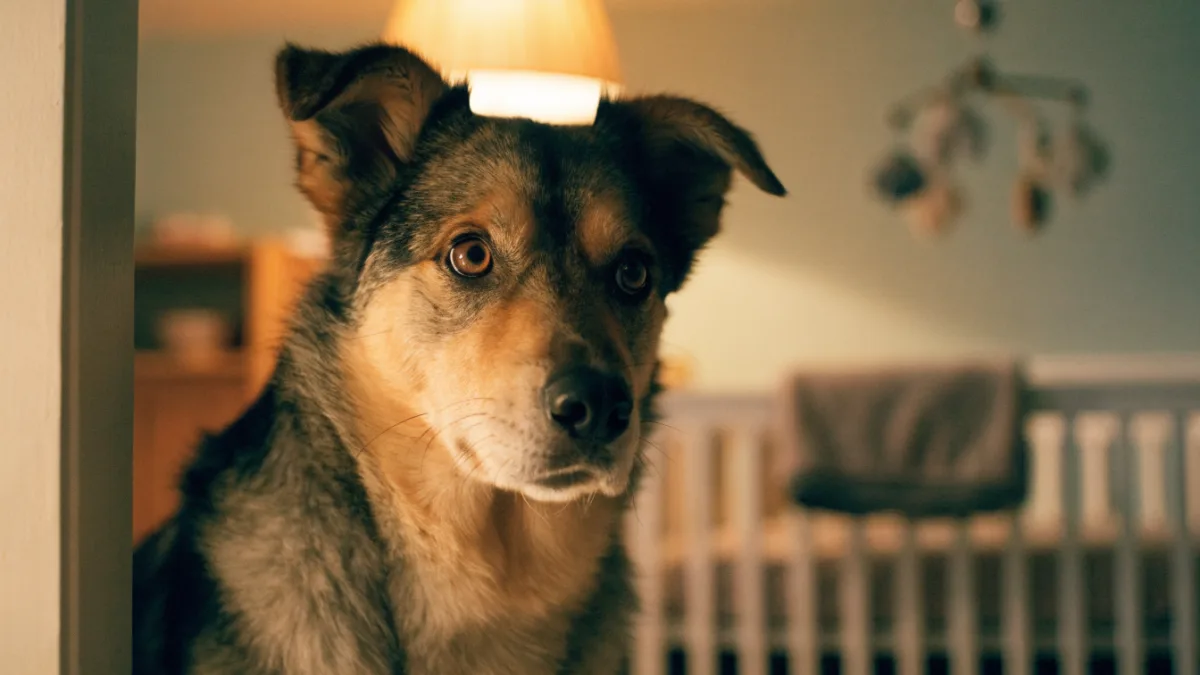
Let me tell you about a couple I worked with last year — Sarah and Marcus. They had a German Shepherd named Klaus who’d been their whole world for four years. Klaus was a good dog, but he’d never met a child. Not once. When Sarah found out she was pregnant, they did what most people do: nothing, for a while. They figured they’d deal with it when the baby came. Six weeks before her due date, they called me in a panic because Klaus had started growling at the stroller they’d just assembled in the living room. The stroller. Not even a real baby. Just the wheels and the fabric and the smell of new plastic.
Here’s the thing that nobody tells you about bringing a baby home to a reactive dog or an anxious cat: the problem isn’t the baby. It’s the everything else. The sounds, the smells, the shifts in routine, the weird new furniture, the sudden chaos where there used to be quiet. If you wait until the baby arrives to start preparing your pet, you’re already behind. Way behind. The sweet spot for starting this process is two to three months before your due date, and honestly, even earlier is better. Here’s how to actually do it.
The Two-to-Three Month Window: What You’re Actually Doing
Most people think “preparing the pet” means letting them sniff a blanket. That’s a nice start, but it’s like dipping your toe in the ocean and calling yourself a swimmer. What you’re really doing during those two to three months is systematically desensitizing your pet to an entire sensory revolution.
A new baby introduces what animal behaviorists call an overwhelming number of novel stimuli. Translation: your dog or cat is about to experience a barrage of new sights, sounds, and smells that they’ve never encountered, and their brain needs time to process all of it as “normal” rather than “threat.”
Sound Desensitization
Start playing baby cry recordings at low volume while your dog eats dinner or your cat gets treats. I’m not talking about cranking it up on day one — start at a volume where it’s barely perceptible, and over weeks, gradually increase it. The goal isn’t to flood them with the sound. It’s to make the sound boring. Predictable. Associated with good things happening.
Don’t forget the mechanical sounds. That baby swing you registered for? Turn it on. The white noise machine. The bouncer that plays tinkling lullabies. Every single one of these things is a potential trigger for an anxious animal, and every single one can be neutralized with a few weeks of low-stakes exposure.
Smell Desensitization
This one surprises people. Start wearing the baby lotion, the diaper cream, the gentle laundry detergent you’ll use on onesies. Let your dog smell these scents on your skin so they become part of your normal scent profile. When the baby arrives smelling like those same products, your dog’s brain files it under “familiar” instead of “intruder.”
Setting Nursery Boundaries Before There’s a Nursery
Here’s where I see people mess up constantly. They set up the nursery, let the dog wander in and out freely for weeks, and then suddenly — baby arrives — and the dog is locked out. From the dog’s perspective, they just lost access to a room for no clear reason. That breeds frustration, and frustration in reactive dogs can escalate fast.
Instead, decide before the baby comes what the rules are, and enforce them immediately.
For Reactive Dogs: The Boundary Line
I worked with a reactive Labrador named Daisy whose owners set up a boundary line — literally a piece of painter’s tape on the floor — at the nursery doorway. For two months before the baby arrived, Daisy learned that her job was to lie on her mat just outside that line. Not because she was banished. Because she had a job. Dogs, especially reactive dogs, do better when they know exactly what’s expected of them.
The key here is that you’re not punishing the dog for wanting to be near you. You’re teaching an alternative behavior that’s incompatible with hovering. “Go to your mat and settle” becomes the default response to nursery activity. By the time the baby arrives, the boundary isn’t new. It’s just Tuesday.
Some trainers call this a “no-fly zone.” Whatever you call it, the principle is the same: the dog never crosses that threshold without an explicit invitation. And for a reactive dog, those invitations should be rare and highly controlled during the early weeks.
For Anxious Cats: Voluntary Access and Escape Routes
Cats are a different animal — literally. Where dogs often want to be in the middle of everything, anxious cats want the option to leave. If the nursery becomes a space they can’t escape from, that’s a problem.
Set up elevated spaces — a cat tree, a high shelf, a cleared closet top — both inside and outside the nursery. The cat should always have a path up and away. And let the cat explore the nursery on their own terms. Don’t carry them in. Don’t force them to investigate the crib. Open the door and let them choose.
Now, the debate. Some people swear cats should never be in the nursery because of the old worry about cats smothering infants. The reality is more nuanced. Supervised access during the day, with the door closed at night, works well for many families. Crib tents — the mesh ones that meet safety standards — provide a physical barrier without fully banishing the cat. But here’s what I’d push back on: don’t make the decision based on fear. Make it based on your individual cat’s behavior and your own comfort level. A cat who’s never shown interest in enclosed spaces probably isn’t going to suddenly start sleeping in the crib. A cat who loves warm, enclosed spots? Maybe keep the door closed.
The Big Day: Introduction Strategy
Okay. The baby is here. You’re exhausted. You’re emotional. Your partner is running on fumes. Now you need to walk through your front door and introduce your reactive dog to a tiny human. Here’s how to not blow it.
Parent-First Greeting
The single best tactic I’ve seen for reactive dogs is the parent-first introduction. Here’s how it works: Mom comes inside without the baby. Dad (or a trusted friend or family member) stays outside or in the car with the baby. Mom greets the dog. Lets them get the wiggles out. Lets them sniff, circle, do whatever they need to do to process that their person is home.
Why does this matter? Because a reactive dog who’s been alone for three days while you’re at the hospital is carrying a massive load of pent-up energy and anxiety. If you walk in carrying a baby, all that energy gets directed at the baby. Not good. Burn off the excitement first. Wait until the dog is calm — actually calm, not just tired — and then bring the baby in.
Now, there’s a real debate here about whether the birthing parent should handle the introduction at all. Postpartum exhaustion is no joke, and dogs are incredibly sensitive to their humans’ emotional states. If Mom is running on two hours of sleep and running high on anxiety hormones, the dog will pick up on that and match it. In some cases, having the non-birthing partner handle the initial introduction makes more sense. There’s no universal right answer. Do what makes sense for your family, but factor in the emotional state of whoever’s in the room.
The Leash Is Non-Negotiable
During initial introductions, your reactive dog must be on a leash. Period. I don’t care how much you trust them. I don’t care that they’ve never bitten anyone. The leash isn’t a punishment — it’s a safety net. It’s also a communication tool. A loose leash tells the dog “I’ve got this, you don’t need to worry.” A tight leash tells the dog “something’s wrong.” So keep it loose.
And here’s the part that feels counterintuitive: you are not trying to make your dog love the baby. Not on day one. Your only goal is peaceful coexistence. If your dog sniffs the baby’s foot from three feet away and then lies down on their mat, that’s a win. That’s actually a huge win. Don’t push for more. Don’t lure the dog closer with treats. Don’t hold the baby near the dog’s face. Let the dog set the pace, and reward calm behavior — wherever it happens.
When Things Go Sideways
Sometimes, despite your best preparation, the introduction doesn’t go smoothly. Your dog barks. Your cat hides under the bed and won’t come out for two days. Your dog starts resource-guarding the couch when the baby’s nearby. This doesn’t mean you failed. It means you have a reactive animal and you introduced a massive life change. Of course it’s bumpy.
Here’s what I want you to remember: regression is normal, but it shouldn’t be ignored. If your dog shows signs of stress — lip licking, yawning, whale eye, stiffening up, growling — that’s information. Don’t punish the growl. The growl is your dog telling you they’re uncomfortable, and punishing it just teaches them to skip the warning next time. Instead, increase the distance. Move the dog farther from the baby. Go back to mat work. Rebuild the calm.
And if you’re in over your head, call a professional. There’s been a surge in specialized baby-prep consultants and force-free trainers who deal specifically with this scenario. You don’t have to figure it out alone, and there’s no shame in getting help. The rise of online communities like r/reactivedogs has made it easier than ever to find resources and connect with people who’ve been through exactly what you’re going through.
The Long Game
The nursery introduction isn’t a one-day event. It’s not even a one-week event. It’s a months-long process of helping your pet adjust to the new normal. The first three months with a baby at home are going to be chaotic for everyone — you, your partner, your dog, your cat. Routines will shift. Sleep will disappear. Your dog’s daily walk might get shorter. Your cat’s favorite lap might suddenly be occupied.
Be patient. With your pet, yes, but also with yourself. You’re learning to be a parent to a human and a guardian to an animal at the same time, and those two jobs don’t always align neatly. The fact that you’re reading this article two to three months before your due date means you’re already doing more than most people do. You’re thinking ahead. You’re taking your pet’s emotional life seriously. That matters.
Your dog doesn’t need to be your baby’s best friend. Your cat doesn’t need to sleep at the foot of the crib. What they need is to feel safe, to understand the new rules, and to trust that they still have a place in your family. Give them that, and the rest will work itself out — one messy, beautiful, sleep-deprived day at a time.