

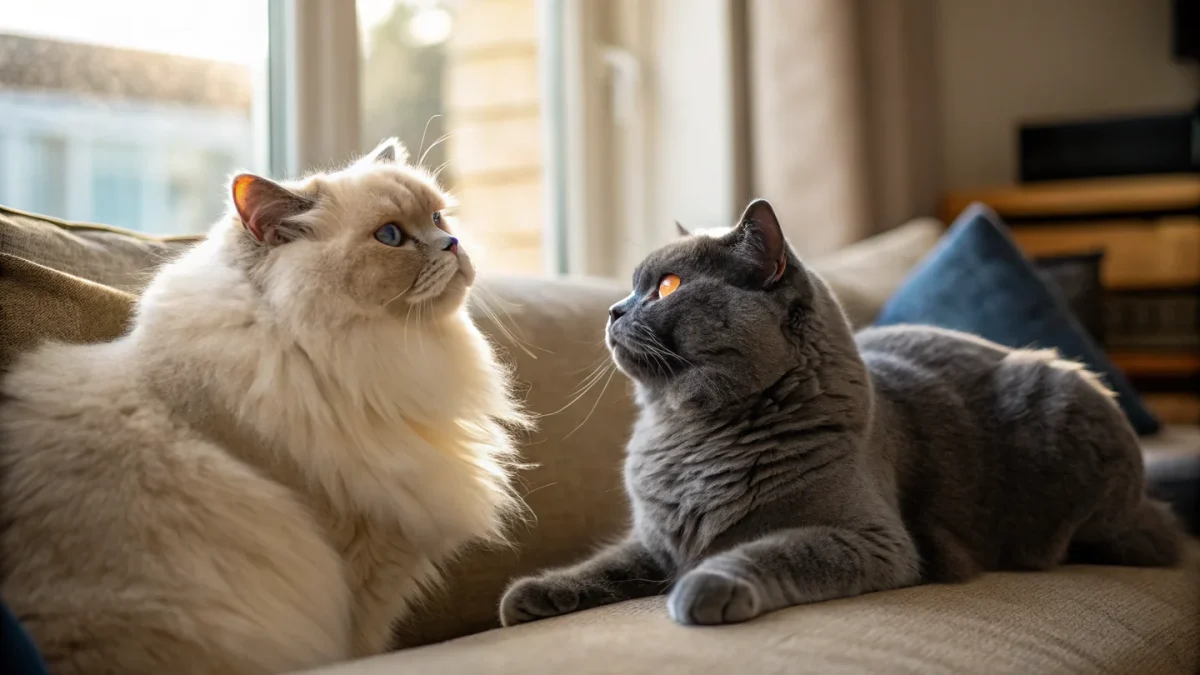
Both are among the most popular cat breeds globally. Both are regularly described as "calm" and "good for families." Both are genuinely gentle animals. If you're comparing these two, the relevant question isn't which is better — it's which better matches what you actually want from a cat.
The cat breed comparison guide explains how to use temperament variables to guide this kind of decision.
Quick Comparison
| Trait | Ragdoll | British Shorthair |
|---|---|---|
| Coat | Semi-long, silky | Short, extremely plush |
| Grooming | 2-3x weekly | Weekly |
| Energy | Low-medium | Low-medium |
| Vocalization | Quiet | Very quiet |
| People-following | High — goes where you go | Low — stays when you leave |
| Handling tolerance | Exceptional | Moderate — on their terms |
| Independence | Low | High |
| Solitude tolerance | Moderate-poor | Good |
| Adaptability | Good | Excellent |
Social Needs: The Main Divide
This is the central difference. Ragdolls orient around people. They follow you from room to room. They settle in whatever room you're in. When you sit, they settle near you or on you. They tolerate being held and picked up with unusual patience — going limp rather than resisting, which is partly the behavior the breed is named for. The Ragdoll breed profile covers color varieties, size, and what the full ownership commitment looks like. They want to be near you most of the time.
British Shorthairs are affectionate but independent. They'll settle near you, join you in the evening, and accept attention warmly — but they manage their own schedule. They don't follow. They don't check on you. When you leave the room, they stay. This isn't coldness — British Shorthairs are genuinely warm — it's a different kind of warmth, one that doesn't need to be adjacent to express itself. The British Shorthair breed profile covers the breed's history, coat colors, and the HCM screening that conscientious breeders conduct.
Grooming Comparison
The Ragdoll's semi-long coat needs brushing two to three times weekly to stay tangle-free and at its best. The British Shorthair's dense short coat sheds significantly year-round — weekly brushing manages this without becoming a welfare issue.
Neither breed requires intensive daily grooming. The Ragdoll's silky coat, interestingly, is somewhat less prone to matting than its length suggests — but regular brushing prevents the buildup that would eventually become problematic.
The Verdict
Choose the Ragdoll if you want a cat that is overtly people-oriented, handles being held and cuddled with unusual patience (excellent for families with children who want a cat they can interact with physically), and brings gentle warmth to the household throughout the day. Be aware they need more consistent company than British Shorthairs — solo days don't suit them well.
Choose the British Shorthair if you want a self-sufficient, calm companion who adapts to varied household rhythms, tolerates solitude better, handles strangers and change well, and brings steady affection without requiring active management of social needs. The British Shorthair is more versatile for households with variable schedules.
Neither is wrong. The Ragdoll is warmer and softer; the British Shorthair is sturdier and more independent. Which of those you'd prefer to come home to every day is the real question.