

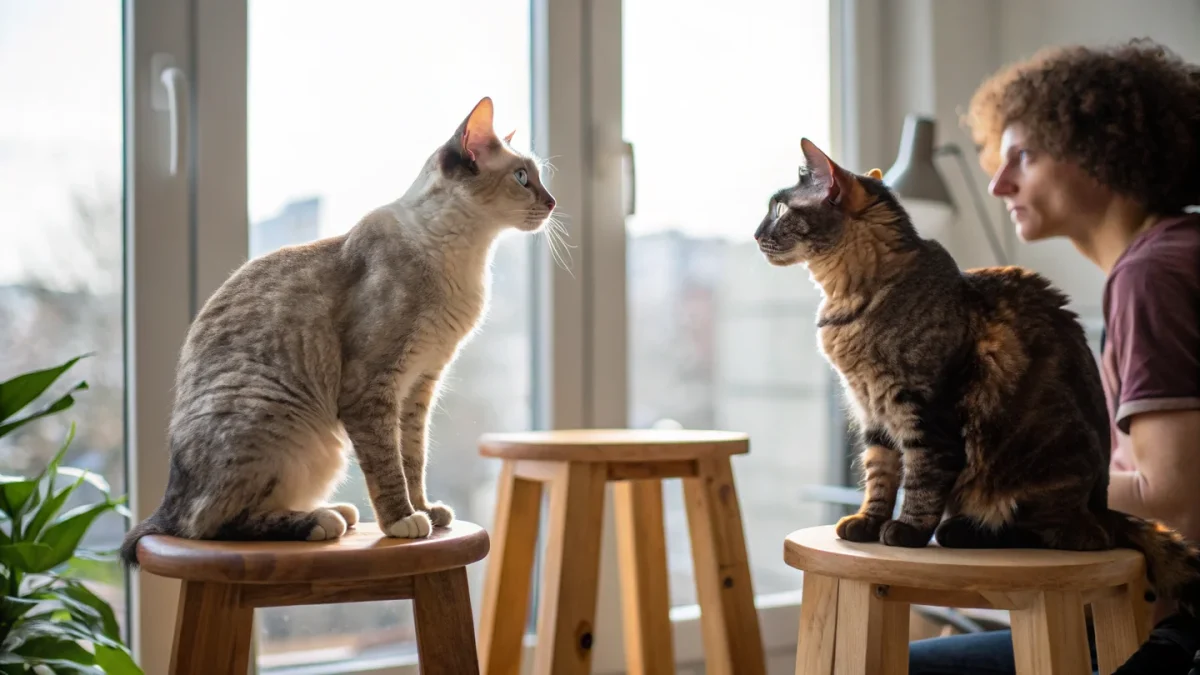
The curly-coated cat breeds offer one of the cleaner illustrations of convergent evolution at the domestic animal level. The same phenotype — a wavy or curly coat — has appeared at least four times independently in the domestic cat population, through different genetic mechanisms, in different countries, within the past 80 years. The Devon Rex breed and its founding gene mutation is one piece of this larger pattern.
Understanding why cats get curly coats requires understanding what hair is, structurally, and which genes control it.
The Structure of a Cat Hair
A cat's coat consists of three hair types:
Guard hairs (primary hairs): The longest, coarsest, and outermost. They form the visible surface of the coat, protect against physical damage, and provide waterproofing. In most cats, they're straight.
Awn hairs (secondary hairs): Medium-length hairs with a distinctive tip. They form the middle layer and contribute to coat texture and insulation.
Down hairs (undercoat): The shortest, finest, and most numerous. Primarily for insulation, they create the fluffy undercoat that keeps cats warm.
The shape of any hair is determined by the geometry of the hair follicle that produces it. A round, symmetric follicle produces a straight hair. An asymmetric, twisted, or structurally irregular follicle produces a curved or wavy hair. The genes that control follicle structure determine whether hair emerges straight or curled.
The Devon Rex Mutation: KRT71
The Devon Rex coat results from a mutation in the KRT71 gene, which codes for keratin 71 — a structural protein critical to the inner root sheath of the hair follicle. The inner root sheath forms a mold around the developing hair shaft; when this mold is abnormal, the hair that emerges is structurally compromised and wavy.
The KRT71 mutation affects all three hair types, but most severely affects the guard hairs, which are the most structurally demanding. This is why Devon Rex guard hairs are fragile — they're not properly formed — and why Devon Rex cats often have thin or sparse areas where guard hairs should be most abundant.
The mutation is autosomal recessive: a cat must inherit two copies of the mutated allele (one from each parent) to express the curly coat.
The Cornish Rex Mutation: A Different Gene
The Cornish Rex coat results from a different mutation entirely. A 2013 genomic study nailed it down: the Cornish Rex coat comes from a confirmed four-base-pair deletion in the LPAR6 gene. What's established is that it is not the same mutation as KRT71.
The Cornish Rex mutation primarily affects the awn hairs and leaves the down coat largely intact. The result is a tight, uniform wave through a complete coat — compared to the Devon Rex's more variable, patchy wave through a sparse coat. The Cornish Rex is structurally softer to the touch, like stroking velvet, because the remaining down coat contributes density even as the awn and guard hairs wave.
The recessive genetics are the same — two copies required to express — but the locus is different. This is why crossing Devon Rex with Cornish Rex produces straight-coated offspring: each parent contributes one copy of its own mutation, but two different mutations at two different loci don't combine to produce either expression.
The Selkirk Rex Mutation: The Dominant Outlier
The Selkirk Rex, which appeared in the United States in 1987 from a shelter cat in Montana, carries a mutation that's genetically unlike either of the above. The Selkirk Rex mutation is autosomal dominant — a single copy is sufficient to produce the curly coat. This is why heterozygous Selkirk Rex cats (one copy of the mutation) still have curly coats, just less tightly curled than homozygous individuals.
The Selkirk Rex mutation affects all three coat layers and produces a coat that's dramatically fuller and thicker than either Devon or Cornish Rex — loose, plush, teddy-bear curls rather than fine waves. A 2013 genome-wide association study mapped the gene responsible to a splice-site variant within KRT71 itself — the same gene behind the Devon Rex, though a completely different mutation with a dominant rather than recessive inheritance pattern. Researchers named the locus SADRE, short for Selkirk Autosomal Dominant Rex.
The Selkirk Rex also carries straight-coated siblings in its litters — because dominant mutations with variable expressivity produce a range of phenotypes.
The LaPerm Mutation: Yet Another Independent Origin
The LaPerm, which appeared in Oregon in the 1980s from a barn cat litter, carries still another independently-arising curly coat mutation. LaPerm cats may carry a sparse, tight curl or a full, soft wave depending on coat length (both long and short variants exist). The specific gene responsible hasn't turned up in published research — it behaves as a dominant trait distinct from the Devon Rex and Cornish Rex mutations, but the exact locus remains unmapped.
Why This Keeps Happening
The repeated independent appearance of curly coat mutations in domestic cats is a product of two factors: the large number of genes involved in hair follicle development (creating many potential mutation sites) and the worldwide domestic cat population size (creating many opportunities for rare mutations to occur and be noticed).
Most genetic mutations that affect coat structure in cats would have gone unnoticed in free-living populations — a slightly wavy-coated working cat would simply join the gene pool unnoticed. The mutations that produced the recognized breeds were noticed specifically because they occurred in contexts where humans paid close attention to feline appearance: breeding catteries (Cornish Rex, Devon Rex), domestic settings with attentive owners (Selkirk Rex, LaPerm), or farm contexts where people recognized the unusual offspring.
For every curly-coated breed that's been formally developed, there are likely multiple naturally-occurring mutations that have appeared and disappeared without being recognized and propagated. The Devon Rex vs Cornish Rex coat comparison in practice shows how different two mutations to the same general trait can look in practice — and the full range of curly coat genetics across breeds amplifies that variation further.