

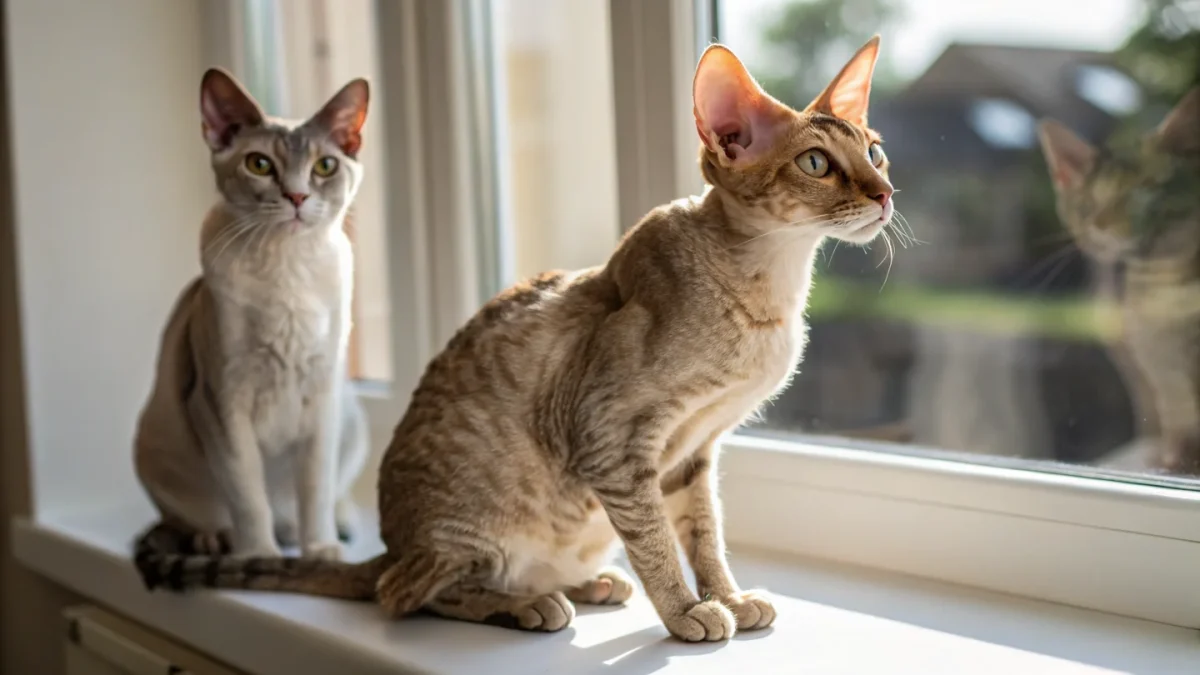
The story of how we know the Devon Rex and Cornish Rex have different genetics is one of my favorite moments in cat breeding history. When Kirlee — the Devon Rex founder cat — was first discovered in 1959, the assumption was that his curly coat was the same mutation already established in the Cornish Rex, which had appeared a decade earlier in the neighboring county. Breeders crossed Kirlee with Cornish Rex females. All the offspring had straight coats.
This wasn't a failure. It was the experimental proof that two independently recessive mutations had appeared in the same county of England within ten years of each other — and that they were completely different genes. The Cornish Rex carried one mutation; the Devon Rex carried another. For the full story of the Devon Rex's origins, Devon Rex full breed history and genetics tells it completely.
This founding difference matters practically, because the two breeds look superficially similar and people comparing them often assume they're choosing between the same cat in two aesthetic variants. They're not.
The Genetic Difference
Devon Rex: Caused by a mutation in the KRT71 gene (keratin 71). This gene produces a structural protein essential for the inner root sheath of hair follicles. When the protein is absent or malfunctioning, hair shaft integrity is compromised, producing the wave. All three hair types are affected — guard hairs most severely, which is why Devon Rex guard hairs are so fragile and why the breed often has thin or nearly bare patches naturally.
Cornish Rex: Caused by a mutation in the LPAR6 gene — a 4-base-pair deletion that truncates the receptor protein before it's fully formed. A 2013 study in PLOS ONE identified the mutation as a recent selective sweep specific to the breed, and later genomic work has reaffirmed it rather than complicated it. LPAR6 sits in a lipid-signaling pathway involved in hair shaft structure — the same broad mechanism linked to woolly-hair conditions in humans. Unlike the Devon Rex mutation, the Cornish Rex mutation primarily affects the awn hairs (the middle layer), leaving the down (undercoat) largely intact. This produces a tight, uniform wave across a complete, soft coat.
Because the mutations are at different loci, they follow standard Mendelian recessive inheritance independently. A Devon Rex crossed with a Cornish Rex produces straight-coated offspring. Two such offspring crossed together would produce kittens with both mutations — and a very unusual coat — but this isn't a breeding practice.
Physical Comparison
| Feature | Devon Rex | Cornish Rex |
|---|---|---|
| Body type | Compact, medium | Long and slender |
| Head shape | Round, broad, pixie-like | Narrow, egg-shaped |
| Ears | Very large, low-set | Large, high-set |
| Coat texture | Wavy, fragile, patchy areas normal | Tight even waves, full coat |
| Coat layers | All layers affected, guard hairs fragile | Down coat largely intact |
| Shedding | Minimal | Minimal |
| Size | Small to medium | Small to medium |
The physical distinction is visible side by side. The Devon Rex has a broader, rounder face with an almost comical pixie quality. The Cornish Rex is longer and more elegant, with a narrow face and higher-set ears that give it a slightly more aristocratic look. The body types reinforce this: Devon Rex is compact, Cornish Rex is streamlined.
Personality Comparison
Both breeds are active, social, and vocal compared to average. But the emphasis differs.
Devon Rex tends toward maximum social engagement — following their person everywhere, greeting at the door, fetch behavior, shoulder-riding. The "part cat, part dog, part monkey" description fits the Devon Rex specifically. They want to be in the middle of things, and they're less able to self-entertain when their person isn't available.
Cornish Rex is also social and active, but carries slightly more independence. They're engaged but not quite as insistent. They're more likely to choose a nearby perch and observe than to require physical contact and direct participation. This is a subtle distinction — both breeds are well above average in social drive — but it's real and reported consistently by owners of both.
Play style: Both breeds are highly active players. The Devon Rex's athletic quality skews toward acrobatics and climbing. The Cornish Rex's longer, more Greyhound-like body is genuinely fast — they sprint and change direction with impressive agility.
Grooming Comparison
The grooming approach differs significantly because of the coat structure difference.
Devon Rex: Requires minimal grooming tools and a light touch. The fragile guard hairs break with aggressive brushing. Rubber glove or dampened hand, used gently, is the standard approach. Occasional bathing to manage skin oil buildup. The sparse coat means skin monitoring matters.
Cornish Rex: The complete, tight-waved coat is more forgiving. It can handle gentle brushing with soft bristle brushes without the breakage risk. The tight waves don't mat in the way long coats can, but they do benefit from regular smoothing. The intact down layer provides more insulation than the Devon Rex coat, so the Cornish Rex, while still cold-sensitive, is slightly more temperature-tolerant.
Which Should You Choose?
If maximum interactivity, the dog-like personality, and the distinctive pixie face appeal to you — Devon Rex.
If you want a slightly more independent but still highly social breed, prefer the elegant elongated body type, or want a more complete coat that's easier to groom — Cornish Rex.
Both are excellent choices for people who want an active, engaged companion. The decision is more about aesthetic preference and fine personality calibration than a practical difference in care commitment.