

The ridge is a dominant mutation. That's the first thing to understand, and everything else follows from it. You need exactly one copy of the duplication on chromosome 18 to produce a ridged dog — which means ridgeless Ridgebacks, dogs without the defining trait the breed is named for, are genetically normal. They carry no copies of the mutation. And the mutation itself, the thing that breeders have selected and concentrated for over a century, is inseparable from a spinal defect called dermoid sinus that occurs in roughly 5–10% of ridged puppies.
One mutation. Two effects. The ridge you selected for, and the neural-tube defect that came along with it. That's the whole story of Ridgeback genetics in two sentences, and it's a story the breed community spent decades trying to work around rather than fully acknowledge.
The 2007 research by Salmon Hillbertz and colleagues that identified the chromosome 18 duplication didn't create this problem — it just gave the breed world a clear molecular picture of what had always been true. The genetics of the ridge and the genetics of dermoid sinus are not separate issues that happen to coexist. They are the same issue, expressed in different tissues.
The Ridge: Molecular Basis
The Duplication
The ridge results from a tandem duplication on chromosome 18 that encompasses several genes, including FGF3, FGF4, FGF19, and ORAOV1 — genes involved in growth factor signaling during embryonic development, as identified in the 2007 study by Salmon Hillbertz et al. published in Nature Genetics. This duplication alters the normal patterning of hair follicle orientation along the dorsal midline, causing hair in the affected region to grow toward the head instead of toward the tail.
The ridge follows an autosomal dominant inheritance pattern. A dog with one copy of the duplication (heterozygous) develops a ridge. A dog with two copies (homozygous) also develops a ridge. A dog with no copies is ridgeless.
Dosage Effect and Dermoid Sinus
The critical finding from the 2007 research was the association between the ridge duplication and dermoid sinus. Dogs homozygous for the duplication — carrying two copies — appear to develop dermoid sinus at higher rates than heterozygous dogs, as suggested by the dosage-dependent pattern observed in the Salmon Hillbertz study. This suggests a dosage effect: more copies of the duplicated region increase the risk of the neural-tube defect.
Dermoid sinus is a tube-like structure extending inward from the skin surface, formed during embryonic development when the neural tube fails to separate completely from the overlying skin. It's classified into five types based on depth, ranging from Grade I (extending only into the subcutaneous tissue) to Grade V (extending to the spinal cord dura mater). Grades IV and V carry the most serious clinical implications, including infection risk and potential neurological damage.
The same genetic event that creates the breed's signature feature also creates its most serious congenital health risk. This is not a coincidence — it's the direct consequence of a single genomic rearrangement affecting embryonic development.
Ridgeless Dogs
Dogs that don't carry the duplication are born without a ridge. They're genetically Rhodesian Ridgebacks in every other respect — same temperament, same build, same athletic capability. Critically, ridgeless dogs cannot develop dermoid sinus, because they don't carry the causative duplication.
The status of ridgeless dogs in the breed is a subject of ongoing discussion. Most breed standards require the ridge, meaning ridgeless dogs cannot be shown in conformation. Some breeders consider ridgeless puppies valuable as companions and breeding stock (when paired with ridged dogs, to reduce homozygous offspring). Others remove them from the gene pool entirely. The Ridgeback breed history traces how the ridge became central to breed identity — a centrality that the genetics of dermoid sinus now complicate.
Wheaten Coat Genetics
The Color Spectrum
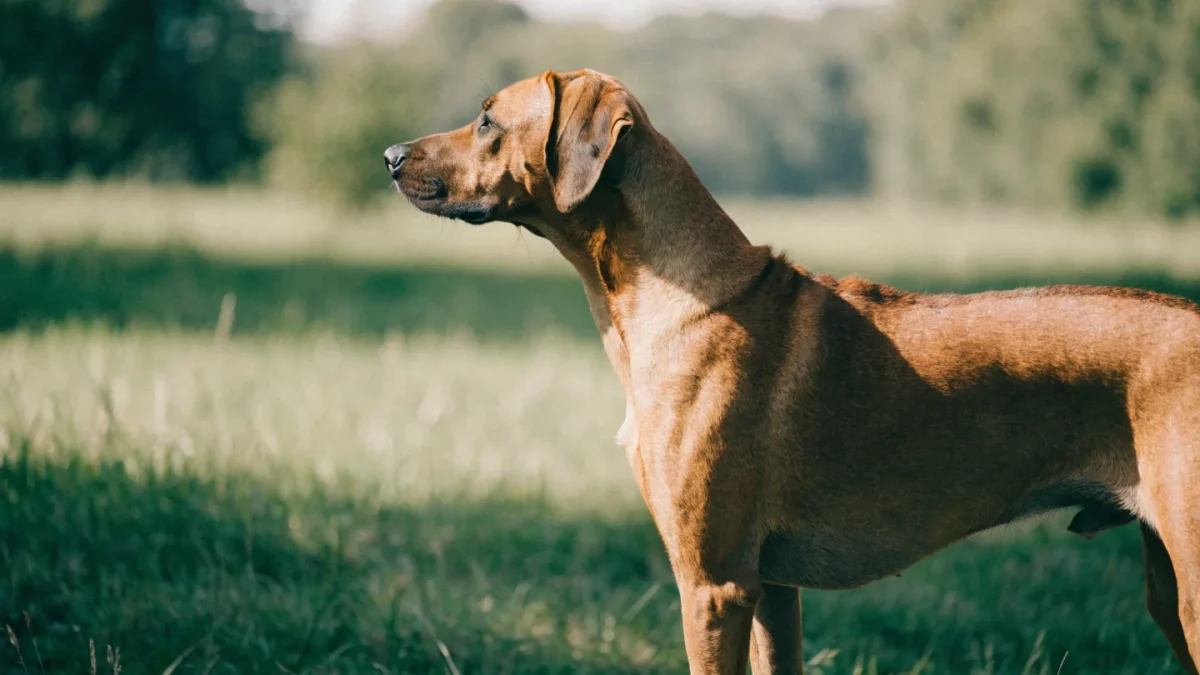
Rhodesian Ridgebacks come in wheaten — a range spanning light wheat to deep red-wheaten. The breed standard describes this as the acceptable color, with a small amount of white on the chest and toes permitted. The wheaten color results from the expression of phaeomelanin (red/yellow pigment) with minimal eumelanin influence.
At the molecular level, the wheaten coat involves the A (agouti) locus, where the Ay (sable) allele allows phaeomelanin-dominant expression across the body. The intensity of the wheaten color — from pale gold to deep reddish-brown — is controlled by modifier genes that affect phaeomelanin intensity, though the specific loci involved in Ridgeback color variation are not fully mapped.
The Black Mask
Many Ridgebacks carry a melanistic mask — darker pigmentation on the muzzle and sometimes around the eyes. The mask is controlled by the EM allele at the E (extension) locus, which is dominant. The mask adds eumelanin to the facial region while the rest of the body expresses phaeomelanin. Not all Ridgebacks display a visible mask — its expression varies with the dog's overall pigment intensity.
Nose Pigment
The Ridgeback breed guide notes that both black and brown (liver) noses occur in the breed. Black nose pigment (B/B or B/b at the B locus) is more common. Brown nose pigment (b/b) is accepted in many standards. The B locus affects nose, paw pad, and eye rim pigmentation — brown-nosed Ridgebacks typically have lighter amber eyes compared to the darker eyes of black-nosed dogs.
Breed-Specific Genetic Conditions
Dermoid Sinus
Covered in detail above. The key points for breeders: screen every litter within the first days of life, understand the dosage-dependent risk associated with homozygous ridge duplication, and recognize that eliminating dermoid sinus entirely would require eliminating the ridge — a trade-off the breed community is not prepared to make.
Hip Dysplasia
Hip dysplasia in Ridgebacks follows the polygenic inheritance pattern seen across most large breeds. Multiple genes contribute to joint laxity and acetabular depth, with environmental factors (nutrition, growth rate, exercise on developing joints) modifying expression. Formal hip evaluation of breeding stock, performed after age two, remains the primary screening tool.
Degenerative Myelopathy
A mutation in the SOD1 gene has been associated with degenerative myelopathy in multiple breeds, including the Rhodesian Ridgeback. The condition involves progressive spinal cord degeneration, typically affecting dogs over eight years of age. A DNA test identifies carriers, at-risk dogs, and clear dogs. The mutation is autosomal recessive — two copies are required for clinical risk, though not all dogs homozygous for the mutation develop clinical disease, as penetrance is incomplete.
Thyroid Disorders
Autoimmune thyroiditis occurs at moderate rates in the breed. Thyroid screening of breeding stock is recommended as part of comprehensive health protocols.
What the Genetics Tell Us
The Ridgeback's genome tells a story shaped by natural selection in one of the world's most demanding environments and human selection for the ridge — a trait whose genetic basis was unknown until 2007. The ridge duplication demonstrates how a selected trait can carry unintended consequences visible only when the molecular mechanism is understood. For breeders and owners alike, the takeaway is that the ridge and its risks are inseparable at the genetic level, and responsible breeding practices are the direct response to what the DNA demands.