

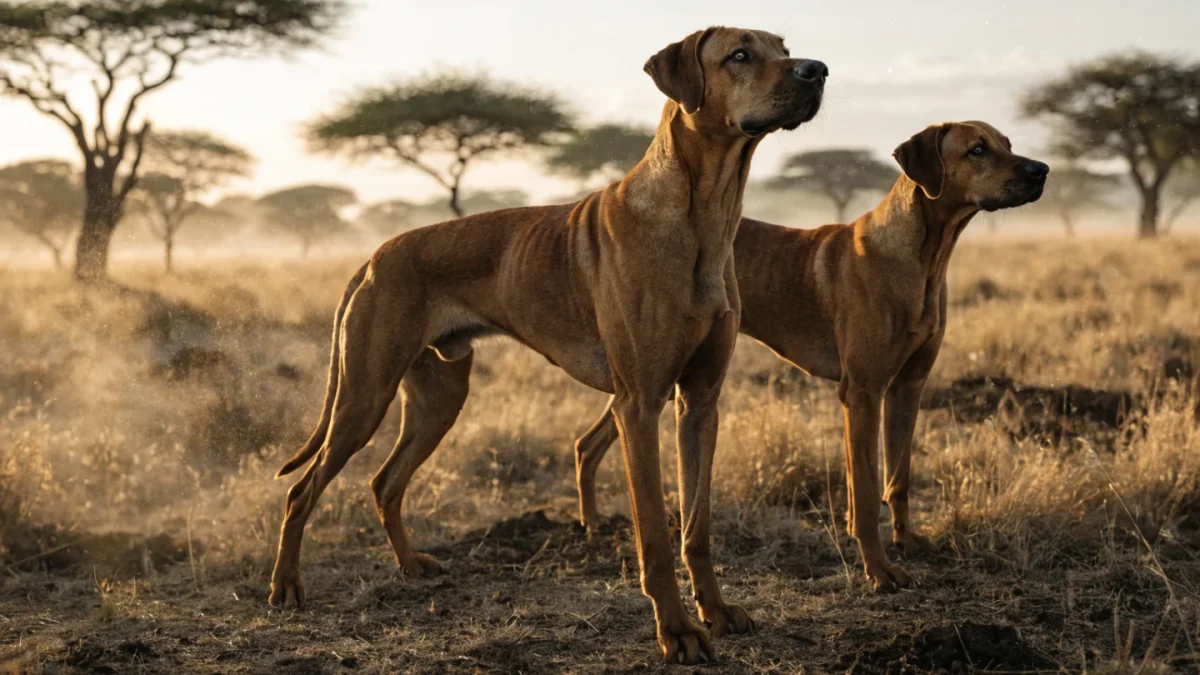
Before the breed had a European name, before it had a breed standard, and before anyone thought to call it a lion dog, the Rhodesian Ridgeback's most important ancestor was already old. The Khoikhoi people of southern Africa kept semi-domesticated dogs with a distinctive ridge of reversed hair along their spines for centuries — possibly millennia — before Dutch settlers arrived at the Cape of Good Hope in 1652. Those dogs were lean, medium-sized, and adapted to conditions that killed European breeds within a generation: extreme heat, sparse water, endemic parasites, and predators that included hyenas, leopards, and lions.
The ridge itself — the single physical trait that would eventually define an entire breed — was already there. Nobody selected for it deliberately. It was simply part of the genetic package that came with dogs tough enough to survive southern Africa.
The Khoikhoi Dogs
What we know about the pre-colonial ridged dogs comes primarily from early European accounts and archaeological evidence rather than from Khoikhoi written records, which don't exist in the Western sense.
Dutch settlers at the Cape described the Khoikhoi dogs as medium-sized, prick-eared animals with a noticeable strip of reversed hair along the spine. The dogs served multiple functions: guarding livestock against predators, assisting in hunts, and providing early warning of approaching threats — both animal and human. They were not pets in the modern sense. They were working animals integrated into a pastoral economy.
These dogs were heat-tolerant, disease-resistant, and remarkably tough. They survived on whatever food was available, thrived without veterinary intervention, and maintained their condition through seasons that would debilitate European breeds. That resilience became the foundation for everything the Ridgeback would eventually become.
The ridge, carried by these indigenous dogs, is a dominant genetic trait that would persist through centuries of crossbreeding — a literal through-line connecting the modern show dog in a suburban backyard to Khoikhoi herding camps that existed before recorded contact.
European Breeds Arrive — and Struggle
Beginning in the mid-1600s, Dutch, German, and later British settlers brought their own dogs to southern Africa. Great Danes, Mastiffs, Bloodhounds, Greyhounds, Deerhounds, and various terriers arrived at the Cape Colony and gradually moved inland as European settlement expanded northward over the following two centuries.
These European breeds had been developed for specific tasks in temperate climates. The Bloodhound could track scent for miles through English rain. The Greyhound could run down hares on open grassland. The Mastiff could guard an estate. But the African environment presented challenges none of them were built for.
Heat was the primary killer. Dogs bred for cold, damp European winters struggled in temperatures that routinely exceeded 35 degrees Celsius. Tsetse flies carried trypanosomiasis. Ticks transmitted biliary fever. Predators — not the foxes and badgers of Europe, but leopards, baboons, and wild dogs — posed threats that no English hunting breed was selected to handle.
The settlers' solution was pragmatic: cross the European dogs with the local ones. The Khoikhoi ridged dogs had already solved the survival problem through centuries of natural selection. Their heat tolerance, disease resistance, and predator awareness compensated for the shortcomings of the imported breeds. The European dogs contributed size, specific hunting aptitudes, and the physical power needed for the settlers' primary use case: hunting big game.
The Crossbreeding Era
Through the 1700s and 1800s, a functional type emerged in the frontier regions of what is now South Africa, Zimbabwe, and Mozambique. These dogs were large — bigger than the original Khoikhoi dogs, thanks to the Dane and Mastiff influence. They could track scent like the Bloodhound crosses, sprint in short bursts like the Greyhound influence suggested, and guard homesteads with the territorial instincts reinforced by Mastiff and terrier heritage.
Many of these crossbred dogs carried the ridge. Not all — the ridge gene is dominant but not fixed, so some offspring were ridgeless. But the ridge became a recognizable marker of dogs from this lineage, and settlers began to associate it with the qualities they valued: toughness, hunting ability, and heat tolerance.
There was no breeding program in the modern sense during this period. Dogs were bred for function, and the test was survival and performance. A dog that couldn't handle the heat, that panicked around dangerous game, or that couldn't pull its weight on a homestead was not bred from. The selection pressure was brutal and effective.
Cornelius van Rooyen and the Lion Hunts
The Ridgeback's mythology centers on one man and one prey animal: Cornelius van Rooyen and the African lion.
Van Rooyen was a big-game hunter operating near Bulawayo in Matabeleland (now Zimbabwe) during the 1870s and 1880s. He maintained a large pack of hunting dogs and was known for his lion-hunting expeditions — dangerous enterprises that required dogs capable of tracking lions through dense bush and keeping them at bay until the mounted hunter could get close enough for a shot.
In approximately 1875, van Rooyen acquired two ridged dogs from the Reverend Charles Helm, a missionary at Hope Fountain Mission near Bulawayo, according to historical accounts preserved in breed histories and the records of the Rhodesian Ridgeback Club. Helm's dogs had been brought up from the Cape Colony and carried the ridge trait. Van Rooyen crossed them with his existing pack of European-type hunting dogs and quickly recognized that the offspring — particularly those carrying the ridge — performed markedly better than his purebred European dogs in both heat tolerance and courage around dangerous game.
Over the following years, van Rooyen refined his pack through selective breeding. The dogs he developed became locally famous for their ability to track lions, then harass and bay the lion — dodging its charges, circling, darting in and retreating — to hold it in place long enough for the hunter to approach. The dogs did not attack lions. They were too intelligent for that. A dog that charged a lion directly was a dead dog. The ones that survived were the ones that maintained a mobile perimeter around the lion, using speed and agility to avoid the cat's lethal strikes while keeping it occupied and stationary.
This distinction — tracking and baying, not attacking — is critical to understanding the breed's temperament. The Ridgeback was never bred to be a fighter. It was bred to be a strategist. As the temperament article explains, that strategic restraint is still the defining quality of the breed's character.
The Breed Standard
By the early 1900s, the ridged hunting dogs of southern Africa had spread across the region but varied considerably in size, shape, and proportion. Some were lean and leggy. Others were heavy and broad. The ridge was the common denominator, but everything else was negotiable.
Francis Richard Barnes, a breeder in Bulawayo, set out to standardize the type. In 1922, he convened a meeting of ridgeback owners and hunters at which they agreed on a written breed standard. Barnes based his standard on the Dalmatian — an unusual choice, but the Dalmatian's athletic build, endurance, and clean lines were the closest European template for the proportions Barnes wanted.
The 1922 standard described a large, muscular, symmetrical dog with a distinctive ridge of hair growing in the opposite direction along the spine. It specified wheaten color in various shades, a deep chest, moderate bone, and the temperament description that still holds: "dignified, without aggression or shyness."
The South African Kennel Union (now the Kennel Union of Southern Africa) accepted the breed in 1926 under the name Rhodesian Ridgeback — "Rhodesian" because the breed's most famous development occurred in Southern Rhodesia, and "Ridgeback" for the obvious reason.
International Recognition
The breed spread slowly beyond southern Africa through the mid-twentieth century. Ridgebacks arrived in Britain in the 1930s but didn't gain significant traction until after World War II. The breed reached the United States around the same period, with the first American registrations occurring in the early 1950s. The AKC recognized the breed in 1955.
Recognition by major registries came gradually. The breed found a niche among owners who valued its combination of athleticism, low-maintenance coat, and quiet temperament. It never achieved the mass popularity of retrievers or German Shepherds — a fact that breed enthusiasts generally consider a good thing, given the health and temperament problems that overbreeding has caused in those more popular breeds.
By the 1980s and 1990s, the Ridgeback had established stable breeding populations across North America, Europe, and Australasia. Show lines and hunting/working lines began to diverge, as happens in almost every breed that transitions from working function to companion and show roles.
The Name Question
The breed carries the name of a colonial state — Southern Rhodesia — that was renamed Zimbabwe in 1980 following independence. Whether the name "Rhodesian Ridgeback" should be changed has been debated periodically within the breed community and beyond. The name remains, largely because renaming an internationally recognized breed involves complex logistics across dozens of kennel clubs, and because no alternative has gained sufficient consensus.
The historical irony is that the breed's most important genetic contributors — the Khoikhoi ridged dogs — predate European colonialism in southern Africa by centuries. The dogs that gave the Ridgeback its defining feature were African long before anyone named Rhodes set foot on the continent.
What the History Tells Us
The complete Ridgeback breed guide covers the modern implications of this history in detail. The summary is that the breed's temperament, physical structure, and behavioral tendencies are not arbitrary. They were forged by specific environmental pressures — African heat, dangerous game, frontier conditions — that selected for a very particular combination of traits: endurance over speed, strategy over aggression, calm assessment over reactive impulse.
Every Ridgeback that lies quietly on a suburban couch, watching the room with half-closed eyes, is running software written on the African veldt. The hardware has been refined for a century of show breeding and companion placement, but the operating system is still the one that van Rooyen's dogs used to track lions through Matabeleland. Understanding that history is the first step to understanding the breed.