

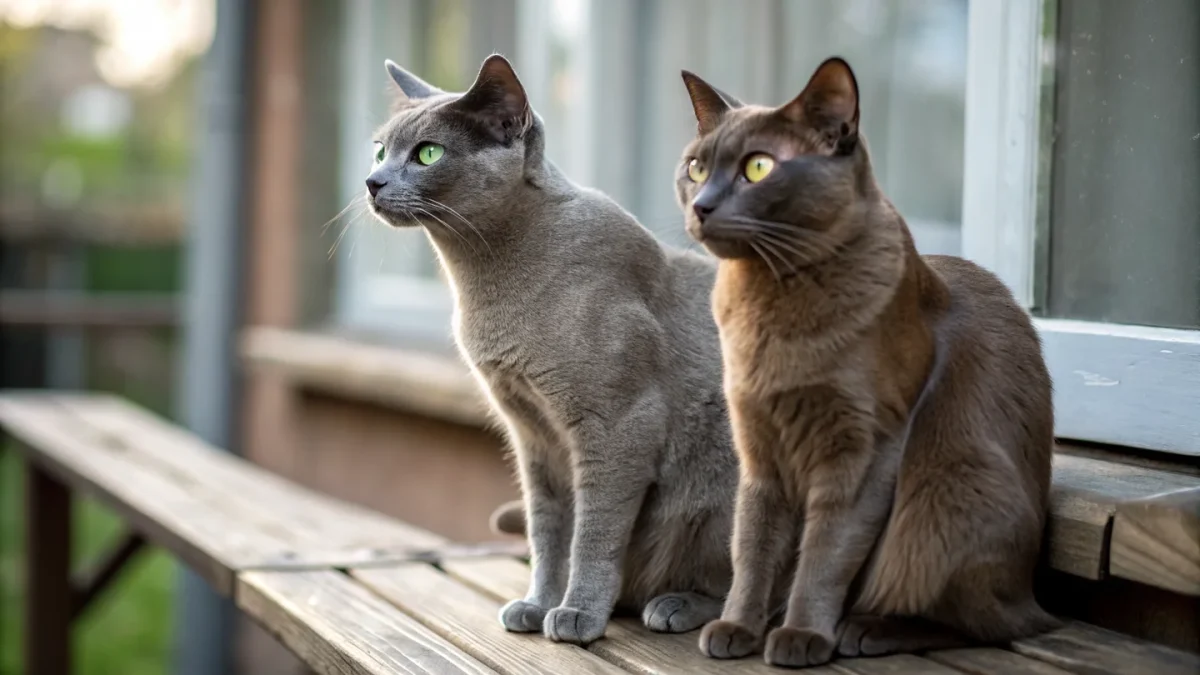
Two short-haired, medium-sized, affectionate breeds — but one will retreat when the doorbell rings and the other will sprint toward it. The Russian Blue and the Burmese are often considered as alternatives for people who want a devoted, manageable companion, but they deliver that devotion in completely different styles.
The cat breed comparison guide provides the broader framework for thinking through these differences.
Quick Comparison
| Trait | Russian Blue | Burmese |
|---|---|---|
| Coat | Short, double-layer, silvery-blue | Short, fine, satin-like, several colors |
| Grooming | Minimal | Minimal |
| Energy | Low-medium | Medium-high |
| Vocalization | Quiet | Moderate to vocal |
| Social with strangers | Shy, cautious | Very friendly — approaches everyone |
| Household routine | Prefers predictability | Adaptable |
| Independence | Moderate-high | Low — craves company |
| Solitude tolerance | Moderate | Poor |
The Russian Blue: Loyalty With Selectivity
The Russian Blue is devoted to its household without extending that devotion automatically to the wider world — the Russian Blue breed profile covers the hypoallergenic claims, grooming needs, and origins in full. Visitors find the cat absent for the duration of their stay. New situations prompt cautious observation rather than eager exploration. The world outside the core family is treated with reserved assessment.
Within the household, the relationship is warm and relatively low-drama. Russian Blues learn routines and preferences, notice small changes, and offer gentle affection that doesn't overwhelm. They're suited to quieter, more stable households. They need predictability in their environment to feel comfortable.
The vivid green eyes against the blue-grey coat make the Russian Blue one of the more visually striking shorthaired breeds. The double coat produces a slightly plush texture and moderate shedding seasonally.
The Burmese: Social Without Reservation
The Burmese greets everyone. Visitors get the same enthusiastic investigation as family members. New people are approached with interest, not caution. The social drive extends to other animals — Burmese generally get along well with other pets, often seeking them out.
The origin of the modern Western Burmese breed traces to a single cat — a small brown female named Wong Mau, brought to the United States in the 1930s and bred systematically to establish the breed. The Burmese breed profile covers the Wong Mau founding history, color varieties, and the health considerations specific to this breed. The compact, muscular body and the outgoing personality were hallmarks from those early foundation animals.
Burmese are more energetic than Russian Blues — more likely to initiate play, more likely to follow you actively around the house, more likely to voice an opinion about what's happening. They're not at Siamese-level vocalization, but they're communicative.
The significant challenge: Burmese don't do well alone. They need company — either another pet or a person present for most of the day. A Burmese alone for nine hours regularly is a stressed Burmese.
The Verdict
Choose the Russian Blue if you want a calm, loyal companion who is devoted to you and your household without demanding constant engagement, handles moderate solitude better, and brings quiet warmth to a stable environment. Better for: people who enjoy a bond that develops over time, quieter households, owners who work from home part-time.
Choose the Burmese if you want an outgoing, consistently friendly companion who adapts to varied social situations, gets along with everyone, and provides warm, active companionship throughout the day. The Burmese needs more company, but rewards it with genuine warmth. Better for: households where someone is usually home, multi-pet homes, families with children.
The Burmese is more gregarious; the Russian Blue more selective. Neither is wrong — it's a question of which social style fits your household.