

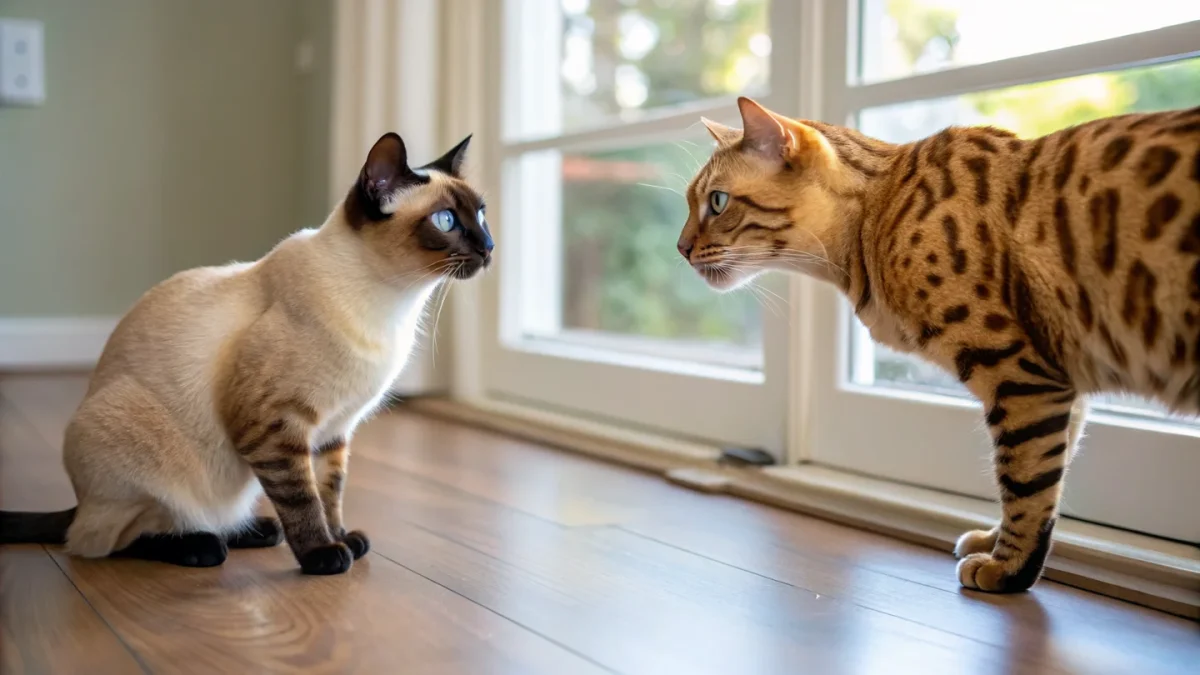
Both breeds are active. Both are intelligent. Both are not for people who want a quiet, low-maintenance cat. That's where the similarities largely end. Choosing between a Siamese and a Bengal without understanding what actually drives each breed is like choosing between a long-distance runner and a sprinter because both are athletes.
For the broader framework on comparing cat breeds, the cat breed comparison framework is useful background.
Quick Comparison
| Trait | Siamese | Bengal |
|---|---|---|
| Energy | High | Very high |
| Activity type | Social, attention-seeking | Physical, hunt-drive |
| Vocalization | Very high — famously talkative | Moderate — chirps, trills |
| Coat maintenance | Minimal | Minimal |
| Independence | Low | Moderate |
| Prey drive | Moderate | Very high |
| Water interest | Variable | Often fascinated with water |
| Best enrichment | Company, conversation, play | Puzzle feeders, climbing, hunting toys |
| Solitude tolerance | Poor | Poor |
The Siamese: Emotional Intelligence, Maximum Vocal
The Siamese is one of the oldest documented cat breeds, and the Siamese breed profile covers the full historical and genetic picture. Here's a correction to something you'll see repeated everywhere: people love saying pointed cats show up in Thai manuscripts from the 14th century. The literary tradition behind that claim — the Tamra Maew, Thailand's cat poems — is believed to trace back to the Ayutthaya period, which does run that far back. But every surviving manuscript dates from after 1767, when the Burmese sacked Ayutthaya and burned most of what came before it. What we actually have is 19th-century paintings and verse describing an older type of cat, not a 600-year-old physical document. Doesn't make the lineage less real — it just means the paper trail is a lot younger than the legend suggests. The modern personality is still the product of a very long, close human association, and it shows: Siamese cats orient around people the way no other breed quite does.
The signature trait is the voice. Siamese cats don't meow in the understated way most domestic cats do — they carry on extended, loud, varied conversations. They have an opinion about the state of the food bowl, about you leaving the room, about the general trajectory of the morning. For some owners, this is one of the breed's defining charms. For others, it is genuinely too much.
Emotionally, Siamese are sensitive. They notice tension in the household, they notice if routines change, and they notice when they're not getting sufficient attention. They want your company, not just your presence.
The Bengal: Athlete in Spotted Clothing
The Bengal is a hybrid breed — domestic cats crossed with Asian leopard cats beginning in earnest in the 1970s and 1980s. Modern Bengals are many generations removed from wild stock, but the heritage shows in the coat (spectacularly spotted or marbled) and in the prey drive (substantial).
What most people underestimate about Bengals is the physical energy. These cats need to run, climb, hunt, and problem-solve. A wand toy once a day doesn't satisfy a Bengal — they need an environment that offers continuous opportunity for physical engagement: tall cat trees, puzzle feeders, interactive toys, supervised outdoor access where possible. The Bengal breed profile covers the hybrid heritage, generation classification, and enrichment setups that actually work. Bengals who don't get sufficient activity redirect that energy in ways that are not appealing: counter-surfing, destroying soft furnishings, opening cabinets.
Many Bengals have a fascination with water — faucets, fish tanks, the bathroom sink. It's endearing until they start tipping their water bowl repeatedly to create a puddle to splash in.
What Most People Get Wrong
About Siamese: People expect a calm, exotic-looking companion and get a cat that has strong opinions, delivered loudly. If you've met a quiet older Siamese, understand that individual variation and age mellow the breed somewhat — but quiet as a default is not the Siamese.
About Bengals: New owners consistently underestimate the physical energy and activity requirements. The wild-cat aesthetic is appealing; the reality of meeting a Bengal's enrichment needs is a commitment that not everyone is prepared for.
The Verdict
Choose the Siamese if you work from home or are home frequently, enjoy a vocal and communicative companion, want a cat that is deeply attached to you specifically, and find a slightly demanding relationship with a pet rewarding rather than stressful.
Choose the Bengal if you have the space and time for significant physical enrichment, love watching athletic cats use their bodies, want a striking-looking animal, and don't mind an exploratory, occasionally mischievous companion. The Bengal is better suited to households with access to outdoor space (safely enclosed) or to owners who invest heavily in indoor enrichment.
If you're gone nine hours daily, neither of these is your breed. Both suffer in solitude. But if you have to pick one for a busy single-person household, the Bengal at least has the independence to occupy itself somewhat — provided the environment is rich enough.