

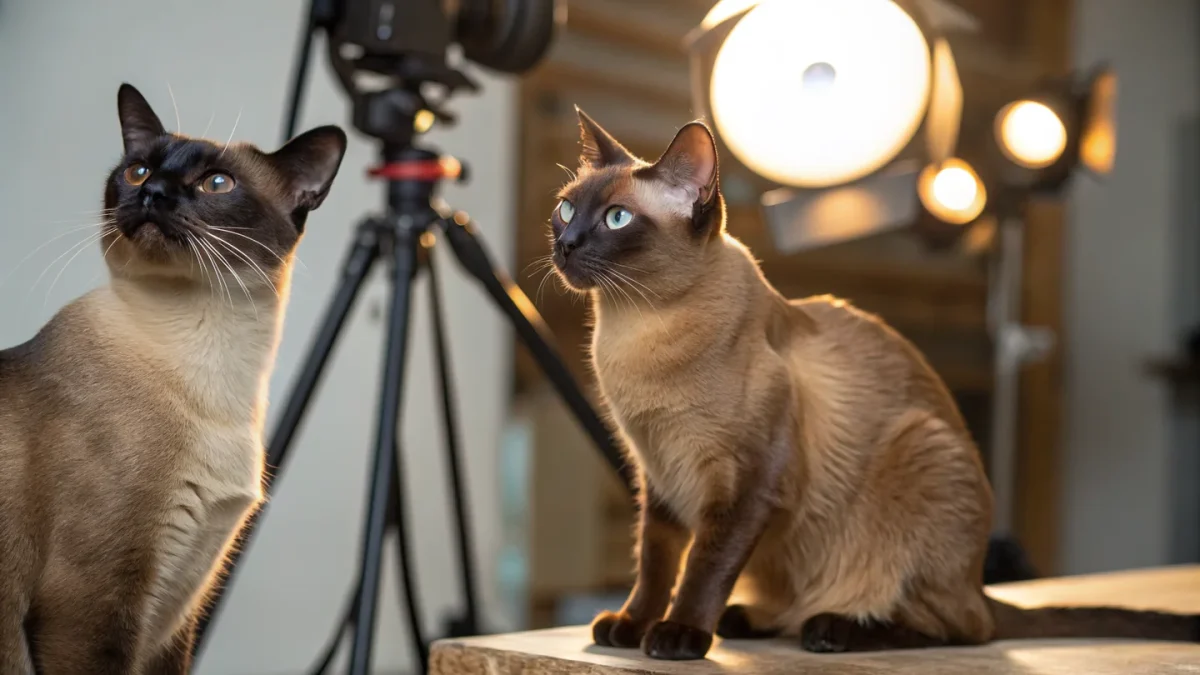
Both are associated with Southeast Asia. Both are people-oriented, active, and social to a degree that makes them unsuitable for low-presence households. That's the genuine overlap. Everything else about these breeds — the voice, the specific nature of the attachment, the coat, the degree of sensitivity — diverges meaningfully.
The cat breed comparison guide provides the framework.
Quick Comparison
| Trait | Siamese | Burmese |
|---|---|---|
| Coat | Short, minimal maintenance | Short, fine, satin-like |
| Energy | High | Medium-high |
| Vocalization | Very high | Moderate |
| Social style | Intensely bonded to specific people | Universally friendly |
| Stranger behavior | Cautious, then attentive | Immediate warm approach |
| Independence | Very low | Low |
| Sensitivity | High | Moderate |
| With other pets | Variable | Excellent |
The Siamese: Depth of Bond
The Siamese is associated with specific people — the full Siamese breed profile covers the breed's ancient history, color points, and vocalization patterns in depth. In a multi-person household, a Siamese typically identifies its primary human and organizes much of its social behavior around that person. Others in the household are liked and interacted with — but the primary bond is distinct.
This makes the Siamese experience feel particularly intimate to the person they've chosen. It also means households with variable people-traffic can see the Siamese become selectively engaged. The voice expresses this selectivity: the Siamese communicates its opinions about access to its preferred person quite clearly.
The Burmese: Warmth Without Selectivity
The Burmese brings the same social drive but applies it to everyone in range. The breed approaches guests with interest rather than caution. They integrate readily with other pets. Their warmth doesn't discriminate based on familiarity.
This makes Burmese excellent choices for households with varied visitors, children, or multiple animals — anywhere that the Siamese's selective attachment might create awkward social situations. The Burmese just likes everyone. It's a simpler, less complicated warmth.
The compact Burmese body is notably solid — these cats are heavier than they look, with a muscular density that surprises people who pick them up expecting a slight animal. The Burmese breed profile covers the founding history, color varieties, and the American vs. European type distinctions in detail.
Shared Needs
Both breeds need company. Neither does well in a home where they're alone for most of the day. Both are active enough to need daily play. Both are vocal communicators, though the Siamese runs considerably hotter in terms of volume and persistence.
The coat needs of both breeds are minimal — short coats with low grooming requirements. A weekly brush is more about bonding than maintenance for either.
The Verdict
Choose the Siamese if you want a deep, specific, mutually intense bond with a cat — one that feels more like a partnership than a pet relationship. The Siamese will choose you, and that's something quite particular. Be prepared for the voice.
Choose the Burmese if you want warm, uncomplicated social warmth that doesn't come with the Siamese's vocal demands and emotional intensity. Better for households with multiple people, frequent guests, or other animals. The Burmese makes more friends; the Siamese makes one very good one.
Neither is the wrong choice — it depends entirely on which style of relationship appeals to you.