

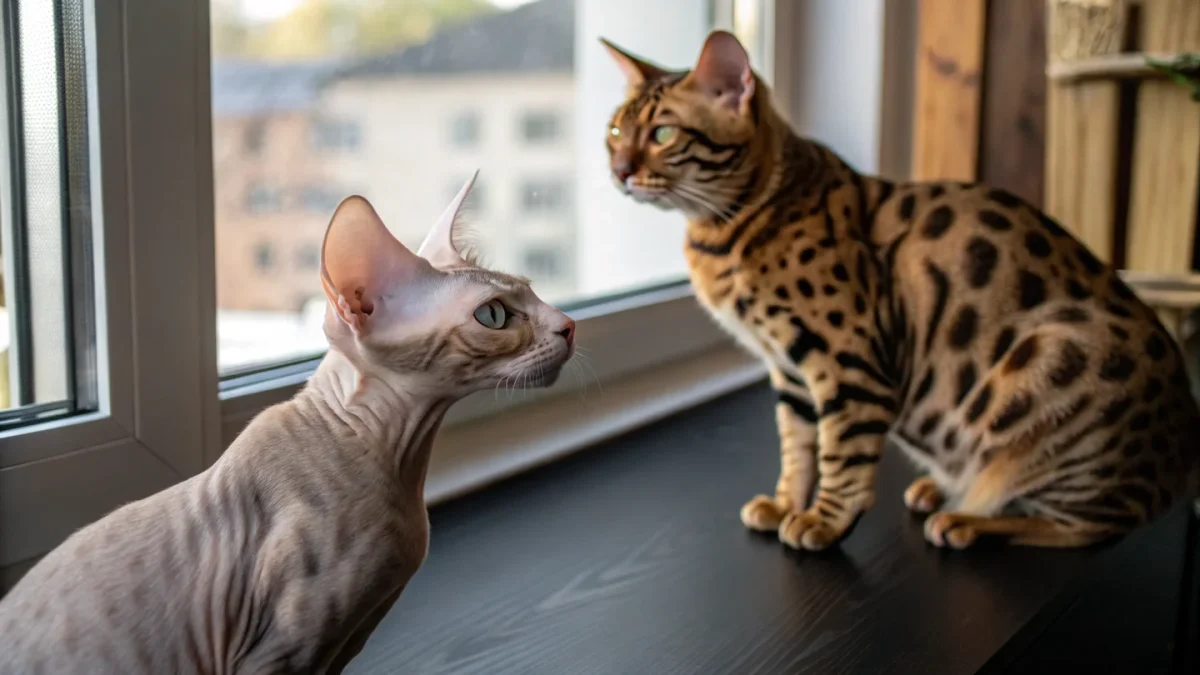
Two breeds, both striking, both demanding, both definitely not for people who wanted something low-key. The Sphynx and the Bengal are often in the same conversation because both require significant owner engagement and both look nothing like a typical domestic cat. But they're demanding in very different directions, and confusing those directions creates a significant mismatch.
The cat breed comparison guide gives the framework for evaluating breeds systematically.
Quick Comparison
| Trait | Sphynx | Bengal |
|---|---|---|
| Coat | Hairless/near-hairless | Short, spotted or marbled |
| Grooming | Weekly baths essential | Minimal |
| Energy | High | Very high |
| Activity type | Social, proximity-seeking | Physical, prey-focused |
| Prey drive | Low | Very high |
| Vocalization | High | Moderate (chirps, trills) |
| Warmth requirement | High — no coat insulation | Normal |
| With small pets | Generally fine | High risk — not recommended |
The Sphynx: Warmth, Closeness, and Volume
The Sphynx wants you. Not near you, not in the same room — on you. They curl under blankets, drape across shoulders, press against any available warm surface. The Sphynx breed profile covers the bathing schedule, temperature requirements, and the full scope of what owning a hairless cat involves. Their hairlessness means their body heat radiates directly, and they feel distinctively warm to the touch. The experience of holding a Sphynx is unlike any other domestic cat.
The personality is extroverted without reservation. Sphynx approach strangers with interest rather than caution, vocalize their needs clearly and often, and insert themselves into household activity. They handle other animals well — they're social enough to appreciate the company. They don't do well with long solo periods.
The weekly bath is the primary maintenance consideration. Without fur to absorb skin oils, oils accumulate on the skin surface, in skin folds, and around the ears. A bathed Sphynx has clean, healthy skin. An unbathed Sphynx smells noticeably and develops skin irritation. This is genuinely non-negotiable grooming.
The Bengal: Activity, Prey Drive, and Spectacle
The Bengal is primarily a physical animal. They move with athletic purpose. They climb to the highest point in any room. They locate every moving thing and assess its suitability as prey. They open cabinets, knock things over systematically to test what falls, and find novel objects deeply interesting.
The coat — spotted or marbled with an iridescent quality that catches light distinctively — is one of the more beautiful coats in the domestic cat world. It requires almost no maintenance, which is fortunate given how much energy is required elsewhere.
Prey drive is real. Small pets (birds, rodents, reptiles, fish) in a Bengal household are at risk. The drive doesn't train out — it's a core behavioral trait. This is a consideration that is often mentioned briefly in breed profiles and deserves more emphasis in practice. The Bengal breed profile covers the hybrid generation system and the enrichment environments that genuinely meet their physical needs.
The Maintenance Difference
This is the clearest practical dividing line. Sphynx require a weekly bath; Bengals require almost no grooming. If bathing a cat weekly sounds manageable to you, it's less daunting than it sounds once the cat is accustomed to it — Sphynx introduced to baths as kittens often tolerate them with minimal drama. But it's real labor that must be budgeted.
Bengal care involves primarily time: interactive play, enrichment setup, monitoring for mischief. The coat is easy; the energy management is not.
The Verdict
Choose the Sphynx if you want maximum physical closeness with a cat, have the discipline for weekly baths, live in a warm enough environment to keep a hairless cat comfortable, and want a highly social, outgoing companion.
Choose the Bengal if you want an athletic, visually spectacular cat, have the space and setup for significant physical enrichment, don't have small pets at risk, and find the challenge of a smart, active, wild-natured animal engaging rather than stressful.
Neither is a background-of-your-life cat. Both require genuine engagement. The question is whether you want to express that engagement through physical closeness and social warmth (Sphynx) or through activity, stimulation, and athletic observation (Bengal).