

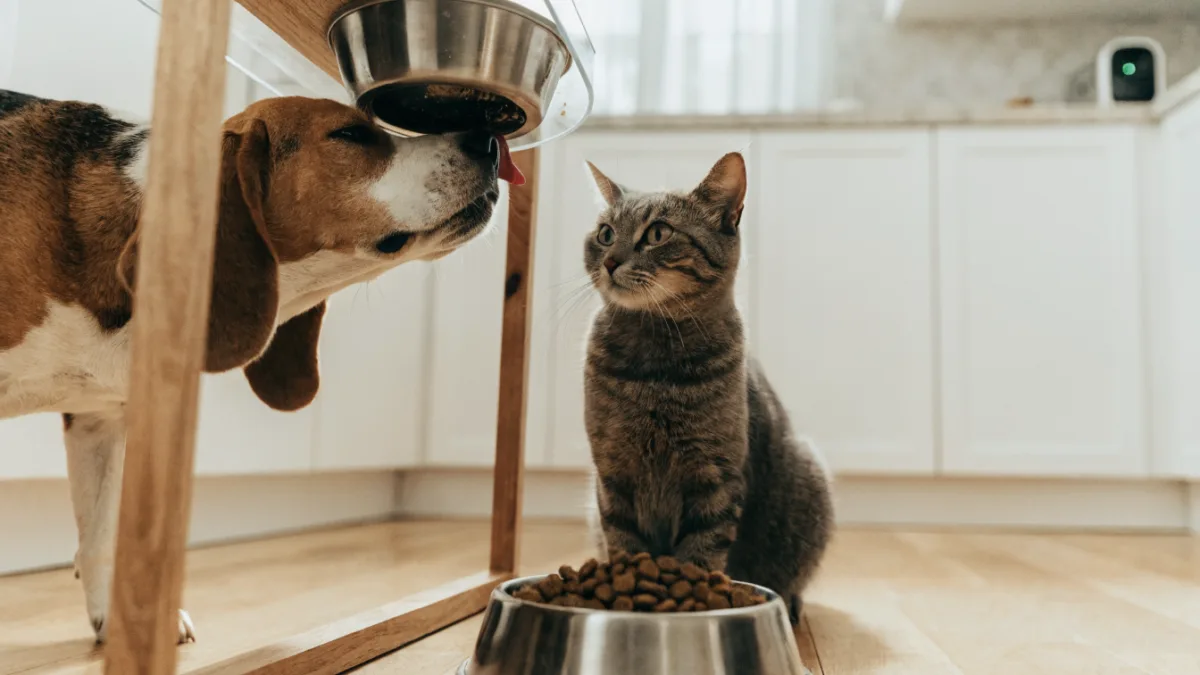
If you’ve ever walked into your kitchen to find your dog shoulder-deep in the cat’s bowl while your cat perches on the counter, casually scooping kibble from the dog’s dish with one paw — congratulations, you’ve officially joined the multi-pet household chaos club. My dog Biscuit treats cat food like it’s forbidden treasure, which, to be fair, it basically is. Cat food is richer, smellier, and apparently infinitely more interesting than whatever perfectly balanced kibble I put in his bowl. Meanwhile, my cat Mochi views Biscuit’s food with the kind of disdain cats reserve for… well, most things. Until 2 AM, when she decides it’s a midnight snack.
This isn’t just a funny quirk, though. Dietary theft in a multi-pet household can genuinely harm your pets. Dogs packing on weight from calorie-dense cat food, cats missing essential nutrients because they’re filling up on dog kibble — it adds up. The good news? There are solutions that actually work, ranging from old-school physical barriers to gadgets that feel borderline magical.
Why Food Theft Is More Than Just an Annoyance
Let’s get the not-so-fun part out of the way first. When a,[1] becomes a daily habit, you’re looking at real health consequences. Cat food is significantly higher in fat and protein than dog food because cats are obligate carnivores — they need meat to survive, and their food reflects that. Dogs, being the opportunistic little vacuum cleaners they are, will happily consume way more calories than they need if given access.
The result? Obesity, upset stomachs, and over time, potential nutritional imbalances. A single stolen bite won’t send your dog to the emergency vet, but regular sneaking can cause [1] which veterinarians take seriously.
On the flip side, cats stealing dog food face a different problem: malnutrition. Dog food lacks taurine, an amino acid cats absolutely must get from their diet. A cat who fills up on dog kibble is eating food that simply cannot sustain them. It’s like a human subsisting on plain rice — filling, but eventually disastrous.
The sneaking usually isn’t malicious. Your dog isn’t trying to be bad, and your cat isn’t scheming. They’re just following their noses to the most interesting smell in the room.
Strategic Home Layouts: Who Eats Where
The most effective way to stop food theft doesn’t involve gadgets or training at all — it involves geography. If you can control access, you solve most of the problem before it starts.
Vertical Space: The Cat’s Natural Advantage
Cats climb. Dogs generally don’t. This simple biological fact is your friend. Elevating your cat’s food on a counter, the top of a washing machine, or a dedicated shelf on a cat tree keeps it out of reach for most dogs. [2] swear by this approach.
But here’s where it gets complicated. If you have a senior cat with arthritis, a kitten who hasn’t mastered jumping yet, or a small and determined dog (looking at you, terrier owners), elevation isn’t foolproof. And then there’s the counter debate — some owners are firmly against having any pet food on kitchen food-prep surfaces, which is… completely reasonable, actually. I tried the counter approach for a while and spent half my life moving Mochi’s bowl before cooking dinner.
Physical Barriers: Gates, Straps, and Cat Doors
This is where things get creative. Baby gates with a small cat-sized opening cut into them, door straps that let a cat slip through while blocking a wider dog, or even installing a small cat door in an interior wall — all of these create a dog-free feeding zone. [3] have shared some impressively inventive barrier setups.
The key is knowing your pets. A determined Border Collie will figure out most latches. A Chihuahua might fit through the same gap as a cat. You have to design your barriers around the specific animals in your home, not a generic “dog versus cat” scenario.
Timing Is Everything: Feeding Schedules That Work
If you’re currently free-feeding — leaving kibble out all day — I understand the appeal. Cats naturally prefer multiple small meals, and free-feeding feels effortless. But in a multi-pet household, an unattended bowl is basically an open invitation for theft.
Synchronized Mealtimes
Here’s what changed everything for me: feeding both pets at the exact same time, in different rooms, and picking up the bowls after 15-20 minutes. When Biscuit is focused on his own meal, he’s not thinking about Mochi’s food. And when Mochi knows her food appears reliably twice a day, she stops grazing and eats properly.
Transitioning away from free-feeding takes patience, especially for cats who are used to grazing. Mochi protested for about a week by yowling at her empty bowl at odd hours. But within two weeks, she’d adjusted to mealtime rhythm, and honestly? It’s made tracking her appetite way easier. Changes in eating habits are often the first sign something’s off with a cat’s health, and scheduled feeding makes those changes obvious.
The Supervision Window
If you’re home during feeding times, you can simply stand there and referee. If you’re not — and most people aren’t home all day — you need a different strategy. Which brings us to…
When Tech Saves Your Sanity
Okay, this is the part where I get a little excited. A microchip pet feeder is one of those inventions that sounds like overkill until you have one, and then you wonder how you survived without it.
These feeders work by reading your pet’s implanted microchip or a small RFID tag on their collar. The food bowl stays covered until the registered pet approaches, at which point the lid opens just for them. When they walk away, it closes. Your dog could sit next to it all day and never get a single kibble.
For households where everyone works outside the home, or where physical barriers aren’t feasible, this is genuinely the most reliable solution. The market for these has expanded significantly — they’re more affordable and dependable than they were even a few years ago. Look for one with a design that’s easy to clean (because food debris will happen), a backup battery option (in case of power outages), and a lid mechanism that won’t trap curious paws.
I won’t pretend they’re cheap. But compared to the cumulative cost of vet bills for an obese dog or a malnourished cat, the math starts looking pretty reasonable.
Training and Enrichment: The Behavioral Layer
Technology and barriers are great, but they work best when paired with basic behavioral expectations. You’re not going to train a cat to leave food alone — that’s just not how cats operate, and honestly, I respect their commitment. But dogs? Dogs can absolutely learn.
The “Leave It” Command
If there’s one obedience skill worth its weight in gold in a multi-pet home, it’s a solid “leave it.” Teaching your dog to disengage from anything — cat food, the cat itself, garbage on the sidewalk — gives you a verbal tool to interrupt theft in progress. This is especially effective when taught during puppyhood, though adult dogs can absolutely learn it too.
I’ll defer to professional trainers for the specifics — my colleague Jake could talk about obedience training for hours. The point is, training gives your dog a framework for making better choices, even when you’re not standing right there.
Food Puzzles as Distraction
Here’s a strategy I didn’t expect to love: food puzzles. These aren’t just trendy enrichment toys — they’re genuinely useful tools for managing multi-pet feeding. A slow feeder or puzzle bowl for your dog makes them work for their food, which slows down eating and keeps them mentally engaged with their own meal rather than eyeing the cat’s.
For cats, puzzle feeders tap into their natural hunting instincts. A cat who’s busy batting kibble out of a puzzle toy isn’t wandering over to investigate the dog’s bowl. It’s enrichment and theft prevention in one. Pet manufacturers are increasingly designing puzzle toys that serve double duty — slowing down fast eaters while making it physically difficult for another animal to sneak a bite.
Finding What Works for Your Home
There’s no single solution that works for every household, because every combination of pets is different. A laid-back older dog and a timid kitten need a totally different setup than two high-energy young animals who treat everything like a competition. Your home’s layout matters too — a small apartment requires different strategies than a sprawling house with multiple floors.
The most effective approach usually combines two or three strategies: maybe a baby gate with a cat opening, scheduled mealtimes, and a microchip feeder for when you’re away. Or elevation for the cat’s food, a solid “leave it” command for the dog, and food puzzles to keep everyone occupied.
And here’s the thing worth remembering: managing a multi-pet household isn’t about achieving perfect control. It’s about setting up systems that make good behavior the easy default. When your cat’s food is inaccessible to your dog, when your dog is satisfied with their own meals, when both pets have their needs met — the sneaking naturally decreases. Not to zero, because animals are endlessly creative and mildly chaotic. But enough that you can stop guarding food bowls like a security guard and actually enjoy life with your weird, wonderful mix of pets.
The real magic of living with both dogs and cats isn’t that they’re so different — it’s watching them figure each other out. The food rivalry? That’s just part of the negotiation.
Sources
- dog eating cat food — cats.com
- Many multi-pet owners on Reddit — reddit.com
- Cockapoo owners on Facebook — facebook.com