

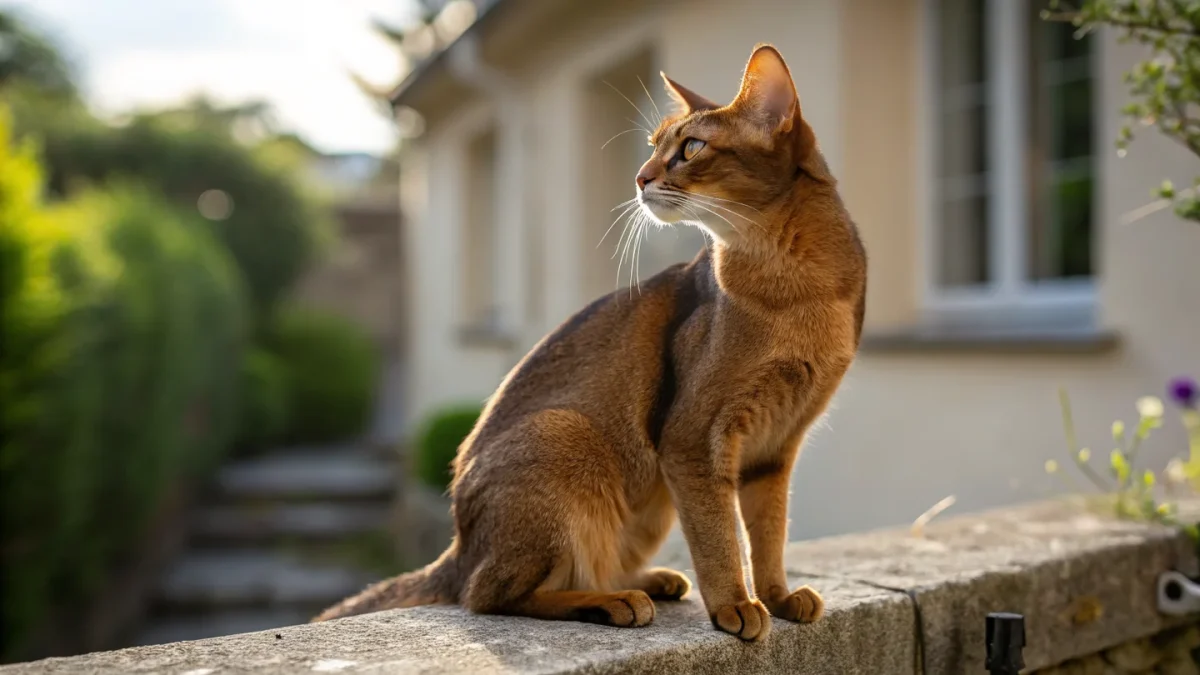
Look at an Abyssinian in sunlight and you see something that ancient Egyptian artists knew well: a cat that doesn't quite look domestic. The coat shifts between warm and cool tones as the animal moves, each hair carrying multiple bands of pigment. It's the pattern found in wild felids from the African wildcat to the Asian leopard cat — not a product of selective breeding for novelty, but a reflection of the domestic cat's deepest genetic heritage.
The Somali cat breed guide covers the breed context; this article is for people who want to understand what's actually happening in the genetics.
What Is Ticking?
Ticking refers to individual hairs that carry alternating bands of dark and light pigment along their length. Each hair has multiple pigmented segments (dark) separated by lighter (agouti) bands. The overall effect on the coat is that there are no solid stripes or spots — just a warm, shimmering base color that appears to glow from within.
The difference from a tabby cat with stripes is at the scale of the individual hair shaft: striped tabbies have some hairs producing solid dark pigment and others producing lighter pigment, creating the visible stripe pattern. Ticked cats have individual hairs banded — the alternation happens within each hair rather than between hairs.
The Agouti Gene (ASIP)
The gene responsible for ticking is the agouti signaling protein gene, typically abbreviated ASIP. It operates by controlling whether and how much eumelanin (dark pigment) is deposited in each hair follicle as the hair grows.
In the simplest terms:
- Agouti (A) allele: ASIP protein is produced during the growing phase of each hair. It signals the follicle to switch between eumelanin (dark) and phaeomelanin (yellow/red) production, creating the banded ticking pattern. This is the dominant allele.
- Non-agouti (a) allele: A loss-of-function mutation means ASIP protein is not produced effectively. The hair follicle produces eumelanin continuously, resulting in solid black (or solid brown, dilute, etc.) coloring throughout the hair. This is recessive.
A cat needs only one copy of the dominant agouti allele (A/A or A/a) to produce ticking on its hairs. A cat with two copies of the non-agouti allele (a/a) produces solid-colored fur — no banding.
Why Abyssinians and Somalis Look Different from Other Tabbies
All tabby cats carry at least one agouti allele — without agouti, you can't have any tabby pattern. The difference between a ticked tabby (like an Abyssinian) and a mackerel tabby (narrow stripes) or a classic tabby (broad swirling markings) lies in separate tabby modifier genes, particularly the gene that controls tabby pattern type.
The Abyssinian cat — the short-coated breed that expresses this same pattern — carries a specific combination that produces the ticked pattern without visible striping on the body. The genetics of tabby pattern type sit at a separate locus entirely from the classic-versus-mackerel switch — that one's governed by the Taqpep gene. A 2021 study mining the 99 Lives Cat Genome Sequencing Consortium database identified the likely candidate for the ticked locus itself: DKK4, with two specific mutations disrupting the protein enough to erase the stripes. And it's dominant — a cat only needs one copy of the ticked allele to suppress visible stripes and spots on the body, leaving just the underlying agouti banding on individual hairs.
Some Abyssinians and Somalis retain ghost striping — subtle barring visible on the legs and tail, sometimes at the forehead — even though the body appears clear. This is the underlying tabby pattern expressing residually in areas more sensitive to the modifier.
Why the Coat Looks "Wild"
The ticked pattern is ancestral. Domestic cats derive from the Near Eastern wildcat (Felis lybica), which carries a ticked tabby coat. Many small wild felids — servals, ocelots, and others — have individual hairs with some degree of banding even where their overall coat pattern appears spotted or striped.
The Abyssinian's uniform ticking, uninterrupted by strong striping, reads visually as similar to wild felid coat patterns for the same reason: both are expressing the ancestral agouti banding at the hair-shaft level with minimal pattern overlay. The impression of wildness is the coat revealing its evolutionary history.
Color Interaction with Ticking
The agouti gene's effect interacts with the cat's base color genes. In a ruddy Abyssinian, the dark bands are black-brown (eumelanin) and the light bands are warm orange-yellow (phaeomelanin). The combined impression is the warm, glowing ruddy color. In a blue Abyssinian, the dilution gene modifies the eumelanin to gray-blue and the phaeomelanin to warm cream, creating the blue-fawn ticking.
The ticking pattern itself — the alternating bands — is the same genetic mechanism across all colors. What changes is the pigment type and density in each band, producing the different color variants within the breed.
The Solid-Colored Cats Hidden in Plain Sight
Solid-colored cats (black cats, blue cats, solid cream cats) all carry the non-agouti genotype (a/a). Their hairs produce eumelanin continuously without the ASIP-mediated switching. You can sometimes detect the "ghost tabby pattern" on solid cats in strong direct light — a trace of the underlying tabby pattern that would be visible if the agouti gene were expressed. It's a reminder that underneath every solid coat, a tabby pattern is present in potential form.
The ticked coat of the Abyssinian and Somali makes that potential explicit — the most visible, most consistently present expression of the banded hair shaft that is domestic cat genetics at its most fundamental.