

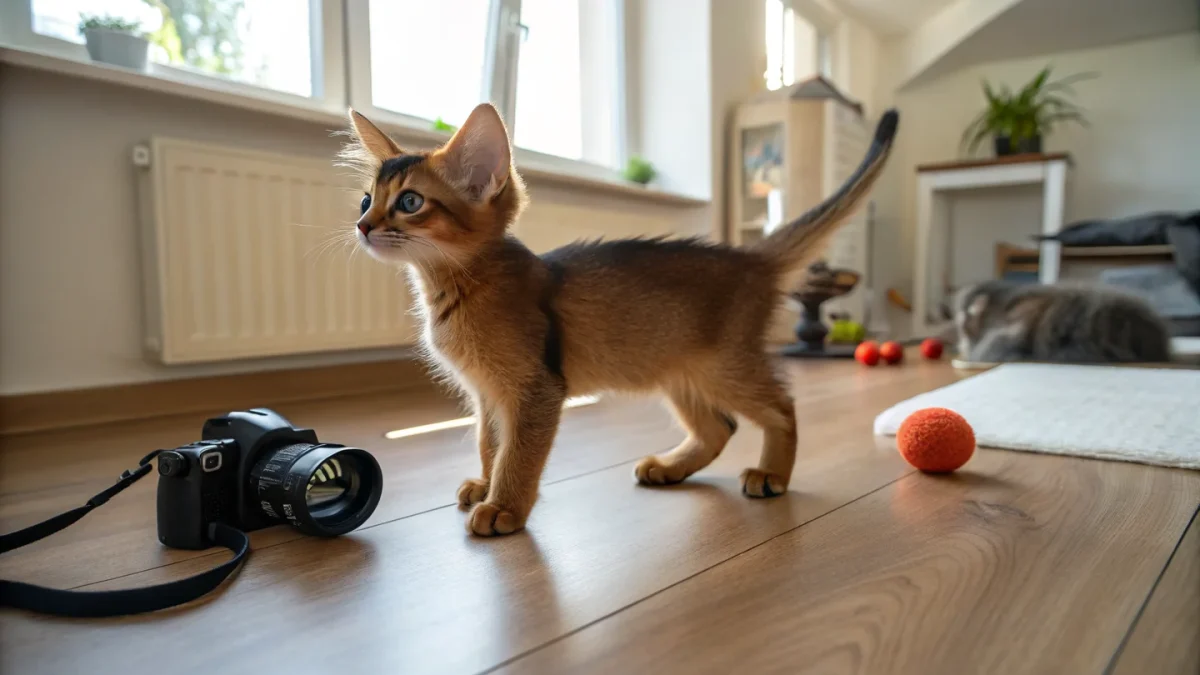
There's a running joke among Somali and Abyssinian owners that bringing home a kitten of these breeds is best understood as bringing home a small, fast, opinionated disruption that will reorganize your concept of what a cat can accomplish in three minutes unsupervised.
It's an exaggeration. A mild one.
The Somali cat breed guide sets expectations for the adult cat. The kitten phase is the same personality in a more concentrated form, without the developed social calibration that age brings. Here's how to prepare.
Before the Kitten Arrives
Kitten-proof the environment. This means more than removing breakables from low shelves. Somali kittens are curious about heights immediately. Anything at mid-height — bookshelves, counters, the upper reaches of cat trees — will be reached sooner than you expect. Check that tall furniture is stable and that items knocked from heights won't cause injury.
Secure small openings. Kittens explore gaps. Gaps behind appliances, spaces under low furniture, and cabinet interiors are investigated with determination. Check for anything that might trap or injure a small cat.
Prepare vertical space. Cat trees, wall-mounted shelves, or a dedicated climbing structure should be in place before the kitten arrives. A Somali kitten without vertical options will create its own.
Have the grooming tools ready. A medium-tooth steel comb and a soft brush. Start using them immediately to establish grooming as routine before the coat grows out — the kitten's coat is short and the sessions accomplish little, but the habit-formation is the point.
Health Documentation
Before bringing any Somali kitten home, confirm that both parents have been tested for pyruvate kinase deficiency (PKD2) and progressive retinal atrophy (PRA). These are DNA tests — results should be available as certificates from an accredited testing laboratory.
A kitten from two tested-clear parents cannot be affected by these conditions (though it may carry one copy of the recessive gene). A kitten from untested parents has unknown risk status. This is non-negotiable due diligence with this breed.
Establish a relationship with a veterinarian early — ideally before collecting the kitten — so the first health check can happen within the first few days at home.
The First Days
Somali kittens are typically bold rather than timid, but even confident kittens benefit from a contained introduction period. Start with one room rather than the whole house. This prevents the kitten from getting lost or overwhelmed while allowing it to establish a secure base.
Once the kitten is eating, drinking, using the litter box reliably, and exploring its initial room with confidence, expand access gradually. Most Somali kittens are ready for the full house within a few days — they push toward exploration rather than away from it.
Socialization
The Somali's social confidence with people is shaped by early exposure. Kittens handled regularly by multiple people during the first 2–7 weeks of life (by the breeder, ideally) arrive home with a social confidence that good subsequent handling reinforces.
Continue the socialization work: invite calm visitors, let the kitten interact with gentle children, introduce it to the sounds of household activity. A Somali kitten exposed to variety during this formative period becomes the adaptable, visitor-welcoming cat the breed is known for.
If other pets are present, manage introductions carefully. A Somali kitten meeting a resident adult cat should have a gradual, supervised process — initial separation with scent swapping (bedding exchanged between spaces), then visual introductions through a barrier, then supervised physical contact. The kitten's natural boldness means it will push the process faster than the resident cat may appreciate.
Introducing Grooming
See the adult Somali coat care article for the full grooming protocol. For kittens, the priorities are:
- Begin light grooming sessions immediately, keeping them short and positive
- Use food rewards consistently to create positive associations with handling
- Practice handling the ears, mouth, and paws regularly — not for grooming purposes yet, but for habituation to handling that will matter at vet visits throughout the cat's life
- Introduce the comb gently; the kitten coat is thin and the grooming accomplishes little, but the cat learns to tolerate and accept it
A Somali that has been groomed since kittenhood is cooperative throughout its life. The investment in early sessions pays forward for fifteen or more years.
Play and Enrichment
Somali kittens are persistently active. Schedule multiple short play sessions daily rather than one long one — this better matches the kitten's attention span and prevents the "rampage until complete exhaustion" pattern that happens when kittens have been understimulated.
Wand toys, small balls, crinkle toys, and puzzle feeders that dispense kibble are all appropriate. Rotate toys to maintain novelty — a Somali kitten's interest in a toy that has become predictable is limited.
The energy is part of the breed. Managing it through enrichment rather than restriction is the approach that produces a well-adjusted adult.