

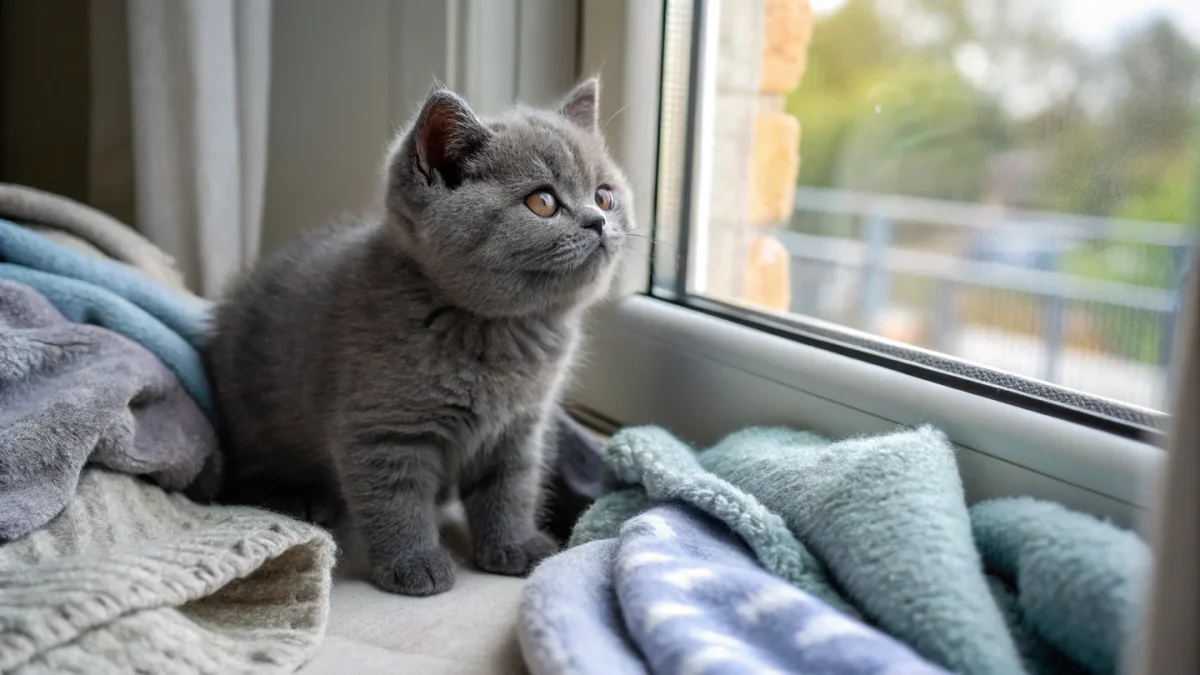
British Shorthair kittens are round, dense little cats that look like they were designed by someone who wanted a cat but wasn't sure cats could be sufficiently satisfying and added extra material just to be safe. They are genuinely delightful. They are also somewhat different in character than the sedate adult British Shorthair their future selves will become.
The breed matures slowly in both physical size and temperamental calm. Planning for that arc — rather than assuming the round kitten in your arms will immediately become the dignified adult in the photographs — sets realistic expectations and better preparation.
For the full breed profile, see the complete British Shorthair breed guide. For grooming guidance, see British Shorthair grooming.
Before They Come Home
A confined initial space. New kittens benefit from a smaller safe zone at first — a bedroom or living room, not the entire house. British Shorthairs are confident kittens but still benefit from establishing a base before exploring everywhere.
Kitten-appropriate equipment. Low-sided litter box (accessible for small legs), food and water dishes at kitten height. British Shorthairs aren't dramatic about access challenges, but appropriate equipment makes the transition smoother.
No small swallowable items. British Shorthair kittens are less frantically destructive than some high-energy breeds, but they do investigate with their mouths. Remove small objects from floor level.
Multiple resting spots. British Shorthairs will find and claim their preferred spots within days. Providing options — a cozy bed, a window seat, a cat tree at a moderate height — lets them self-select rather than claiming your furniture exclusively.
The Kitten Energy Surprise
Adult British Shorthairs are calm. Kittens are not. They run, they climb, they chase things, they wake you up at 5 AM. This is universal kitten behavior and it applies to British Shorthairs like any other breed.
The calm starts appearing gradually — more evident at 1 year than at 3 months, more pronounced at 3 years than at 1 year. Full adult temperament in a British Shorthair arrives around 3-5 years, the same window in which the breed reaches physical maturity, when the self-possessed, measured character the breed is known for is fully settled.
Managing kitten energy appropriately — play sessions, appropriate toys, enough exercise — prevents the behavior problems that under-stimulated young cats develop. The calm comes with time and appropriate development, not with ignoring kitten needs.
Socialization in the First 12 Weeks
British Shorthairs are not shy cats, but they can become somewhat one-person in their orientation if they're not socialized broadly during the primary socialization window (up to about 12-14 weeks). A kitten that meets many people, is handled gently by multiple individuals, and is exposed to normal household sounds during this period becomes an adult cat that's comfortable with a range of people.
A kitten that spends its entire kitten phase with one person in a quiet household will bond deeply with that person and be noticeably more reserved with everyone else. This isn't pathological — it's normal bonding behavior — but it's worth knowing if you want a cat that's socially comfortable in a multi-person household or with guests.
Even if your household is small: invite people to interact gently with the kitten during the first few months. The investment in that socialization is lasting.
Color and Eye Development
British Shorthair kittens can look substantially different from their adult appearance. Blue kittens are born with dark gray-blue eyes that shift to the characteristic deep copper or orange by 1-2 years. Golden kittens' green eyes develop gradually. White kittens' final eye color may not be clear for several months.
Coat color similarly shifts: the adult "blue" coat (gray) of a blue British Shorthair doesn't fully stabilize until 12-18 months. Golden shaded kittens may look pale and indistinct before the adult coat's warm tones and tipping develop properly.
Ask the breeder to show you parents and adult examples if you want to accurately predict the adult appearance of a specific kitten.
Growth Timeline
British Shorthairs are slow growers. Full size arrives at 3-5 years. At 12 months a British Shorthair has most of its height but is still filling out in chest, body, and coat density. The cat you'll be living with in five years looks notably different from the 6-month-old kitten — broader, denser, more substantial.
Practical implications: buy equipment for the adult cat. The litter box and carrier that's right for a 10-pound adult cat is more investment upfront than one sized for a 3-pound kitten, but it's the one you'll keep.
Finding a Responsible Breeder
British Shorthairs have documented predispositions to hypertrophic cardiomyopathy (HCM) and polycystic kidney disease (PKD). PKD in British Shorthairs is caused by the same autosomal dominant PKD1 gene mutation found in Persians — the breed's post-war reconstruction used Persian crosses, introducing the mutation into the gene pool. A validated genetic test identifies PKD carriers from a simple DNA sample and can be done in very young kittens. HCM in British Shorthairs is thought to be inherited (with some evidence for autosomal dominant pattern), but no validated genetic test exists for the breed-specific mutation, so cardiac screening via echocardiogram remains the standard. Ask for PKD genetic test results and cardiac ultrasound documentation on both parents.
Ask any breeder for testing documentation before committing.
Kittens should not go to new homes before 12 weeks; many British Shorthair breeders prefer 16 weeks given the breed's value in extended sibling socialization during the kitten period.