

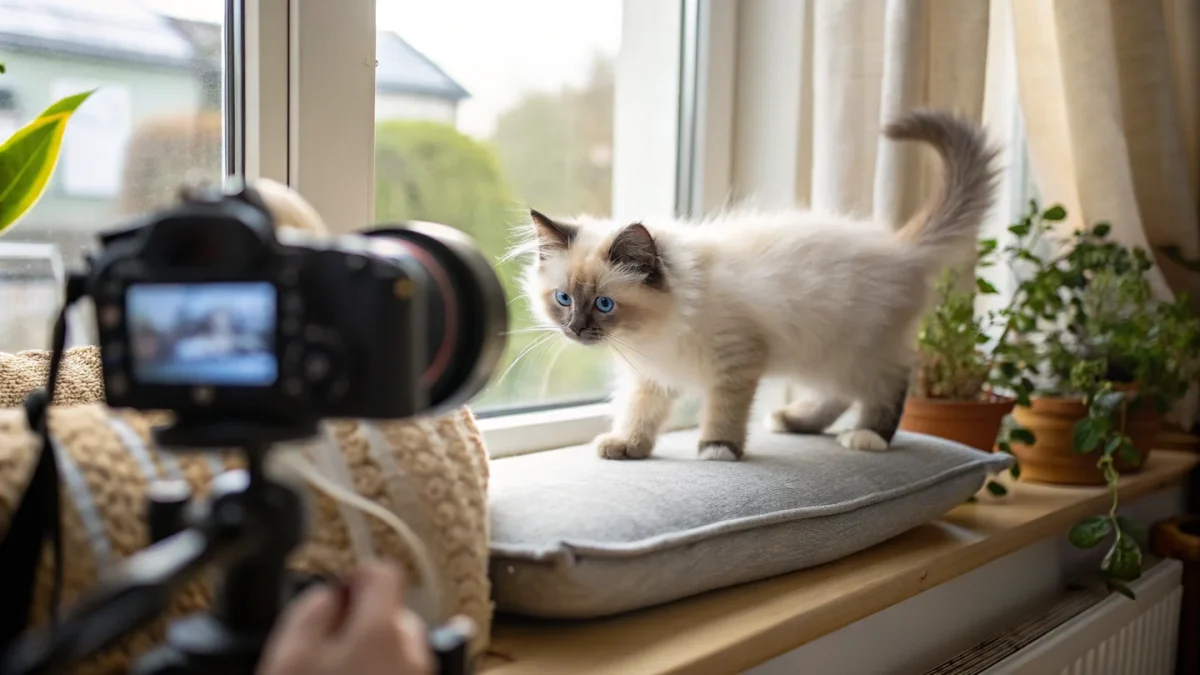
Ragdoll kittens are born white — completely white, regardless of the colorpoint pattern they'll eventually develop. Watch a newborn Ragdoll next to one that's 6 weeks old, and the color is already beginning to appear on the points. By 12 weeks, the pattern is clearly visible. Full color development takes 2-3 years, and the adult color is consistently darker and richer than the kitten's early point color.
This developmental arc is one of the distinctive features of the breed in its first year — but not the only one. For the full breed profile, see the complete Ragdoll breed guide.
The White Kitten Stage
Ragdolls carry the colorpoint gene (the cs allele of the TYR gene), which produces a temperature-sensitive form of tyrosinase — the enzyme required for melanin production. This mutated enzyme becomes active in the cooler extremities of the skin (mask, ears, legs, tail) but is suppressed at normal body temperature, so only the points develop color. According to the UC Davis Veterinary Genetics Laboratory, colorpoint kittens are born solid white because the warmth of the uterus suppresses the enzyme uniformly; as the kitten develops, the temperature differential between body and extremities establishes itself and color appears at the points.
As the kitten develops thermoregulation and the temperature differential between body and points establishes itself, color appears at the extremities and darkens progressively. The point color at 8 weeks — the typical adoption age — gives you an indication of the adult color but is noticeably lighter than the final result.
Energy Levels: Not What You Might Expect
People who know Ragdolls primarily as calm adult cats sometimes expect a Ragdoll kitten to be a sedate, gentle creature. Ragdoll kittens are regular kittens. They play hard. They run at speed. They climb things. They find imaginative applications for every surface in the house.
The characteristic calm of the adult Ragdoll develops progressively — more noticeable at 1 year than at 3 months, more pronounced still at 2 and 3 years. The kitten phase is genuinely active, and expecting a 10-week-old Ragdoll to be the floppy, peaceful cat of the adult photographs will leave you bewildered.
This is worth mentioning because it affects expectations around play and enrichment. A Ragdoll kitten needs play sessions, toys, and opportunities to be a kitten. The breed's eventual adult calm doesn't change what kitten behavior looks like.
Establishing Grooming Habits
The first year is the most important window for grooming socialization. A Ragdoll that grows up with regular, gentle grooming becomes an adult that accepts grooming without drama. A Ragdoll kitten that was rarely groomed will become an adult that finds grooming stressful — which makes what should be a neutral maintenance task into an ordeal for both cat and owner.
Start within the first week of bringing the kitten home. Short sessions (2-5 minutes) while the kitten is calm. Run the comb gently through the coat. Handle the paws, pressing each toe to extend the nail. Touch the face and ears.
Pair with calm verbal reassurance and follow with something pleasant (play, treats, affection — whatever the individual kitten values). The goal is to build an association that grooming is a normal, non-threatening part of life. See Ragdoll grooming for the adult approach in full.
Growth Timeline
Weeks 0-12: Kitten is small, active, learning the household. Color developing on the points. Eat kitten food, multiple small meals daily.
3-6 months: Rapid growth phase. The kitten is putting on size quickly. Paws may look disproportionately large relative to the body.
6-12 months: Growth continues but less dramatically visible on a week-to-week basis. The cat begins to look like a recognizable Ragdoll — colorpoint pattern clear, body structure present, though still lean compared to the adult.
1-4 years: Continued growth — body fills out, chest broadens, muscle mass increases. A Ragdoll at 12 months is not a fully adult Ragdoll. Full size and coat development arrives closer to 4 years.
Don't buy kitten-sized equipment expecting it to last. Buy litter boxes, carriers, and climbing structures that will accommodate the adult cat.
Blue Eyes: Will They Change?
All Ragdolls have blue eyes — this is a breed constant directly tied to the colorpoint gene. Because the same TYR gene mutation that restricts pigment to the extremities also suppresses melanin production in the iris, colorpoint cats' eyes are always shades of blue: without pigment layered on top, only the blue structural color of the eye's stroma is visible. The depth and intensity of the blue typically increases as the kitten matures.
A Ragdoll kitten whose eyes are beginning to change to any other color is either not a purebred Ragdoll or has an unusual genetic variant worth discussing with the breeder.
Finding a Good Breeder
Ragdoll kittens should not be adopted before 12 weeks; 16 weeks allows better socialization with siblings and the mother. Responsible Ragdoll breeders will have current HCM cardiac testing on both parents available — ask specifically. The HCM mutation in Ragdolls (the R820W variant of the MYBPC3 gene) is well characterized; the UC Davis Veterinary Genetics Laboratory and NC State's College of Veterinary Medicine both offer testing for it, and reputable breeders test their breeding stock as standard practice.
Early-taken kittens (before 8 weeks) have higher rates of behavioral issues, including inappropriate elimination and social difficulties. Research on feline early separation — including a study published in Applied Animal Behaviour Science (2023) — links premature maternal separation to elevated stress responses, increased aggression, and separation-related elimination behaviors. This applies across breeds and is particularly relevant in social breeds like the Ragdoll, where sibling and maternal socialization shapes the adult temperament.