

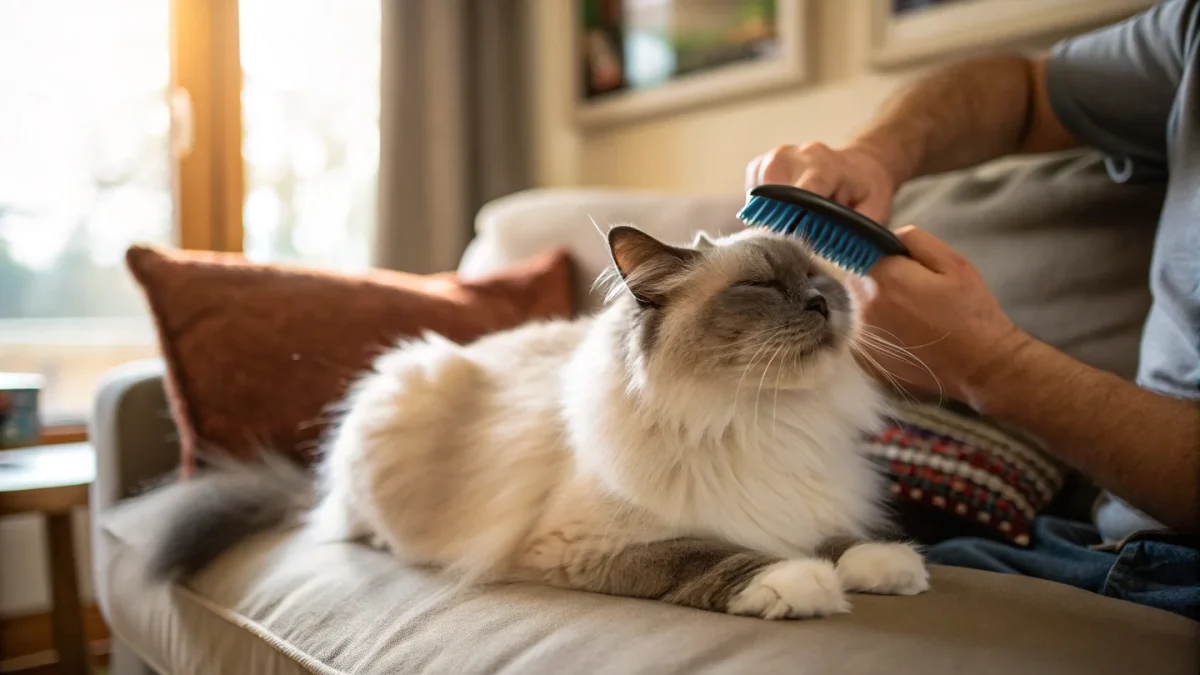
One of the pleasant surprises of Ragdoll ownership is discovering that the coat — which looks like it should require daily maintenance from its volume alone — is actually considerably more manageable than it appears. The silky texture and low undercoat density are genuinely forgiving characteristics, and most Ragdolls can go through their entire lives without a single mat if their owners keep up with a twice-weekly routine.
This isn't permission to ignore the coat. It's calibration. For the full breed profile, see the complete Ragdoll breed guide and whether a Ragdoll cat is right for you.
The Ragdoll Coat Explained
Ragdoll fur is semi-long: longer at the neck ruff, tail, and hindquarters; shorter on the shoulders and face. The texture is silky — fine individual hairs with minimal undercoat density. This last point is the key difference from high-maintenance long coats like the Persian's: the undercoat is thin enough that it doesn't readily felt into tight mats.
The coat also has a natural tendency to lie smooth rather than sticking out in all directions. Combined with the silky texture, this means Ragdolls typically look presentable between grooming sessions in a way that dense-coated breeds don't.
Seasonal shedding does happen. Spring is the main event, when the winter coat sheds out. During this period the daily brush is recommended; the quantity of loose fur produced can be surprising given how tidy the coat usually looks.
Grooming Frequency
Non-shedding seasons: Twice to three times per week with a wide-toothed metal comb. This baseline prevents tangles from developing and removes loose fur before it can felt.
Spring shedding (peak): Daily brushing for the 4-6 weeks when the winter coat is actively shedding. The loose undercoat, if not removed regularly, can mat against the growing coat beneath it.
Fall shedding: Moderate. Two to three times weekly is usually sufficient but worth increasing to daily if you notice more fur than usual on furniture.
Areas Requiring Special Attention
Even with the Ragdoll's forgiving coat, a few areas mat more readily than others:
Neck ruff: The ring of longer fur around the neck is the densest section and the most prone to tangling, particularly where the ruff meets the chest. Comb this area in sections, from the base of the fur outward.
Hindquarters and "pantaloons": The longer feathering on the hind legs and around the hindquarters can develop tangles in the fur-on-fur friction of sitting and grooming. These areas are easily neglected during a quick comb-through.
Behind the ears: Less common in Ragdolls than in Persians but worth checking during each grooming session.
Belly: Some Ragdolls develop light tangles in the belly fur if they spend time on rough outdoor surfaces.
The Grooming Session
A wide-toothed metal comb (Greyhound comb) is the main tool. A slicker brush (rubber or wire pin type) is useful for finishing and removing loose surface fur.
Work through the coat section by section. The ruff first, then the back and sides, then the hindquarters and belly. Short, controlled strokes that reach through the full coat depth are more effective than long sweeping passes.
Most well-socialized Ragdolls accept grooming readily — their characteristic relaxed temperament that makes them go limp when held extends to accepting handling during grooming sessions. A Ragdoll that was introduced to grooming as a kitten should make grooming one of the more low-drama parts of cat ownership.
Bathing
Ragdolls accept bathing more readily than most cat breeds, particularly when introduced to it young. An occasional bath — every few months or as needed — keeps the coat clean, reduces allergen load, and helps manage seasonal shedding.
The silky texture means water penetrates more easily than through a Persian's woolly coat. A cat-appropriate shampoo, thorough rinse, and towel-drying followed by low-heat blow-drying produces a clean, fluffy coat. Some Ragdolls are so compliant with bathing that owners describe it as a routine without drama.
If bathing wasn't introduced in kittenhood, starting as an adult is possible but requires more patience. Short introductory sessions — paws in shallow water, positive reinforcement — before progressing to a full bath.
Mat Removal
If a mat does develop, don't pull the comb straight through it. Hold the mat at its base between two fingers to prevent pulling on the skin, and work from the outer edge inward, breaking the mat into smaller sections before combing through.
For tight, felted mats: a mat splitter or dematting comb works through the felted fiber. Work slowly and patiently. If the mat is against the skin and firmly attached, the safest removal is with scissors — cut parallel to the skin, never toward it, and cut through the mat rather than trying to free it in one piece.
Severe matting is best handled by a professional groomer. A groomer with longhaired cat experience can shave out mats humanely and reset the coat in better condition.
Tools Worth Having
A wide-toothed metal Greyhound comb for full-coat grooming.
A fine-toothed comb or flea comb for the face and around the ears.
A rubber grooming glove or slicker brush for the finishing pass and loose fur removal.
Stainless steel nail clippers — nail trimming every 2-3 weeks prevents snags in the coat.
None of these need to be expensive. The quality that matters is metal teeth for combs (plastic creates static and doesn't reach the coat properly) and firm enough bristles on a brush to actually contact the coat rather than skimming the surface.