

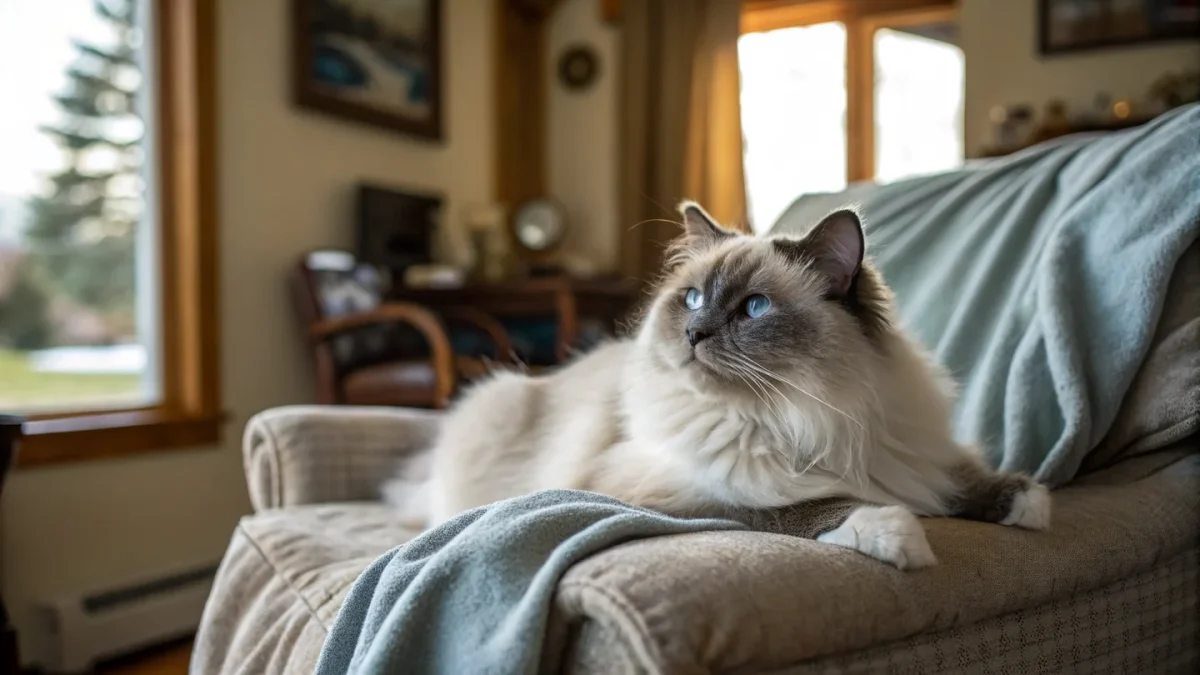
Ragdolls are one of those breeds that creates instant appeal in photographs — big, beautiful, soft-looking, with those blue eyes and the relaxed expression. That appeal is genuine; Ragdolls are genuinely wonderful cats. But "wonderful" is always context-dependent, and there are specific household profiles where Ragdolls thrive and ones where the match doesn't work as well as either party would hope.
For the complete breed profile, see the complete Ragdoll breed guide and a deeper exploration of Ragdoll temperament.
What Ragdolls Need
Consistent presence. Ragdolls are social, people-oriented cats that do best with regular human contact. They're not prone to severe separation anxiety the way some highly social breeds are, but they notice prolonged absence and respond with increased lethargy and reduced engagement. If your household is consistently empty for 10+ hours daily, either a companion animal or careful consideration of whether the breed is appropriate.
Indoor-only environment. Ragdolls are indoor cats. Their trusting temperament and low flight-instinct make them poorly adapted to outdoor life. Breed experts and veterinarians consistently note that Ragdolls are more vulnerable outdoors than most breeds: they approach strangers rather than fleeing, don't react quickly to threats such as traffic or aggressive animals, and their distinctive appearance makes them targets for theft. The docility that makes them wonderful indoors is exactly what makes outdoor life a poor fit.
Regular grooming. Twice to three times weekly with a wide-toothed comb is the baseline. This is less intensive than Persian ownership but more intensive than a shorthaired breed. The neck ruff and hindquarters are the areas that need most attention. Neglected Ragdoll coats can develop mats.
Scale-appropriate equipment. Adult Ragdolls weigh 10-20 pounds and take 4 years to reach full size. The litter box, cat carrier, and furniture that fits a 5-pound kitten won't fit the adult cat. Plan ahead.
Who Does Well With a Ragdoll
Families with children are among the best matches. The Ragdoll's gentleness, size, and tolerance for handling make them one of the genuinely better choices for households with kids old enough to interact respectfully. The characteristic limpness when held delights children, and the breed's low reactive aggression means the risk of a child-related scratch incident is lower than with most cats.
Multi-pet households often work well. Ragdolls are non-aggressive with other cats and typically adjust to calm dogs without significant conflict. Their low-key temperament doesn't escalate situations.
People who work from home or are home frequently. Ragdolls benefit from the consistent presence, and having a large, calm, beautiful cat as ambient company during a workday is one of the genuinely pleasant aspects of Ragdoll ownership that owners talk about.
First-time cat owners. Ragdolls are forgiving of owner inexperience. The docile temperament, manageable grooming (relative to other longhaired breeds), and gentle response to mistakes make them more suitable for people who haven't owned cats before than a more reactive or demanding breed would be.
Who Should Think Carefully
People who travel frequently without reliable, skilled pet care. Ragdolls can be cared for by cat-sitters, but the cat-sitter needs to maintain the grooming routine and provide the social engagement the breed needs. A Ragdoll left with food and water for a week and no additional contact is not thriving.
People who want a highly active, engaging, stimulating cat. Ragdolls are calm, gentle, and relatively low-activity. They'll play, but they won't launch themselves at toys with frantic energy. If you want a cat that behaves like a miniature predator on crack, a Ragdoll is not your breed — consider an Abyssinian or Bengal instead.
People with severe allergies. No cat is hypoallergenic. Ragdolls shed and produce Fel d 1 protein like all cats. While Ragdolls lack the dense undercoat of Persians — which may mean somewhat less allergen distributed through the home via shedding — they are not considered a low-allergen breed, and people with serious sensitivities should spend time with Ragdolls before committing.
Breed-Specific Health Awareness
Ragdolls have a documented predisposition to hypertrophic cardiomyopathy (HCM). Unlike the Maine Coon mutation (A31P), the Ragdoll-specific HCM mutation is the R820W variant in the MYBPC3 gene — a distinct autosomal dominant mutation studied by researchers at NC State's College of Veterinary Medicine. Homozygous cats face elevated risk of early cardiac death; heterozygous carriers may live normal lifespans. Responsible breeders test their breeding stock via both genetic testing and cardiac ultrasound. Ask any breeder for their HCM testing protocol — a reputable one will have that information immediately.
Ragdolls are among the cat breeds with an increased incidence of calcium oxalate bladder stones and feline lower urinary tract disease (FLUTD), with males at higher risk of urinary blockages. Adequate hydration — wet food, water fountains — and regular veterinary monitoring are the practical responses.
These are known risks, not certainties. A Ragdoll from health-tested parents, fed well and given appropriate veterinary care, typically lives 12-17 years without encountering these issues.
The Honest Assessment
Ragdolls are among the best-matched breeds for the broad category of "person who wants a lovely, large, gentle indoor cat that will be a good family member." They're not the right breed for every household, but the household that matches what they need will find them enormously rewarding.
The main honest caution: plan for the indoor-only requirement from the start. The same gentleness that makes Ragdolls wonderful with families makes them poorly equipped for outdoor risks. An indoor-only Ragdoll with adequate enrichment is a healthy, thriving cat. An outdoors-accessing Ragdoll is one that's playing odds its temperament isn't built for. If you're still comparing breeds, how to choose a cat breed offers a broader framework for mapping lifestyle to breed characteristics.