

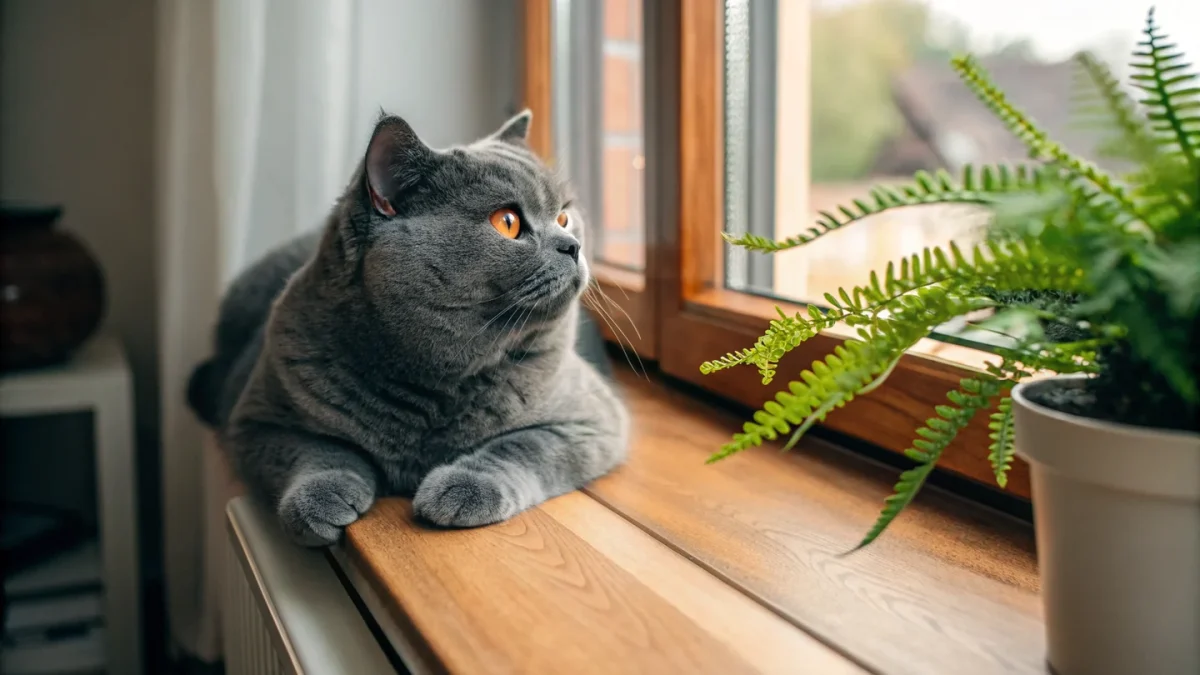
The British Shorthair's most famous color — the solid blue-gray with deep copper eyes — is so associated with the breed that "British Blue" was used as an alternate name for decades. But the breed actually carries a remarkably broad color range, from golden shaded individuals with green eyes to colorpoint cats with blue eyes to a full range of tabbies, bicolors, and particolors.
For the full breed overview, see the complete British Shorthair breed guide.
The Iconic Blue
Solid blue (a genetic dilute of black, producing the cool gray-blue color) remains the most commonly associated color with the breed. Blue British Shorthairs have the dense plush coat in an even, cool gray that ranges from a pale silvery blue-gray to a medium-depth slate. The eyes are deep copper or orange, a contrast that's visually striking and immediately recognizable.
The color doesn't fade or change dramatically with age once the adult coat is established, though kittens' eyes take 1-2 years to develop the full copper depth. Sunlight can affect coat color over time — blue fur can bleach slightly with extensive sun exposure, which is why indoor-kept cats maintain richer color.
Solid Colors
Beyond blue, British Shorthairs come in a full range of solid colors:
Black: Dense, warm black coat with no brown tinge in good specimens. Black British Shorthairs have deep copper or orange eyes. The coat can "rust" with sun exposure.
White: Pure white with no tinge of yellow. White British Shorthairs may have blue eyes, copper eyes, or odd eyes (one each). Blue-eyed whites have a well-documented association with congenital sensorineural deafness, mediated by the dominant KIT gene allele (W) that produces the white coat and can suppress both pigmentation and inner-ear development. According to the ASPCA's figures, approximately 65–85% of white cats with two blue eyes are deaf; the rate drops to around 40% in odd-eyed whites. Any white kitten, particularly a blue-eyed one, should be BAER (brainstem auditory evoked response) tested.
Cream: Dilute of red, producing a pale warm cream. Cream British Shorthairs have copper eyes.
Red: Warm orange-red. Red cats always show some degree of tabby patterning — this is a genuine genetic rule rather than a breeder preference. The orange gene (located on the X chromosome) is epistatic to the agouti gene, meaning it overrides the non-agouti suppressor that would normally hide tabby markings. All red cats, regardless of their agouti genotype, express tabby patterning at least faintly. In cream cats (the dilute of red), this patterning is softer and may be less obvious, but it's always genetically present.
Chocolate: Warm brown. Chocolate British Shorthairs were developed through careful breeding and are less common than blue or black individuals. Copper eyes.
Lilac: The dilute of chocolate. Cool pinkish-gray. Among the most delicate-appearing of the British Shorthair colors.
Cinnamon and Fawn: Less commonly seen colors. Cinnamon is a warm medium brown; fawn is its dilute. Both appear in the breed and are recognized by some registries.
Tabby Varieties
British Shorthairs carry three tabby patterns: classic (blotched), mackerel (striped), and spotted. The breed's dense, plush coat changes how tabby patterns read — the classic blotched tabby in a British Shorthair has a slightly softened, rounded appearance compared to the same pattern in a shorthaired breed with a flatter coat.
Silver tabby — silver-white background with dark (black or blue) tabby markings and green or hazel eyes — is one of the most visually dramatic British Shorthair varieties. Brown tabby, blue tabby, cream tabby, and red tabby round out the most common tabby color options.
Silver and Golden Shaded
These varieties involve the inhibitor gene (I), which restricts pigment to the tips of the hair shafts, leaving the base of each hair white or silver.
Tipped/Chinchilla: The lightest degree of tipping. The coat appears silver-white with just a hint of color at the hair tips.
Shaded: More pronounced tipping. The coat shows clear color on the back and sides, with the tipping creating a shimmering gradient effect.
Smoke: The heaviest degree of tipping. The cat appears solid-colored at rest but reveals the white/silver underbase when the fur moves.
Golden varieties: When the base color is a warm cream-gold instead of white, the result is the golden British Shorthair. Golden shaded individuals — warm gold with darker tipping — have green eyes rather than the copper typical of most British Shorthairs. They're among the most sought-after variants. The golden gene combination produces a cat that looks quite different from the blue or silver types.
Colorpoint
Colorpoint British Shorthairs carry the Siamese-type pattern: dark points (face, ears, legs, tail) with a lighter body, and blue eyes. The colorpoint gene entered the British Shorthair gene pool through the post-World War II Persian crosses that were used to rebuild the breed — Persians themselves carrying the colorpoint allele from their own Himalayan crossings. The result is a cat that is structurally a true British Shorthair — cobby body, dense coat, round face — but with the color-restricted pattern and blue eyes of a pointed cat.
Colorpoint British Shorthairs are recognized by some registries and shown in some countries. The coat and body type are identical to other British Shorthairs; only the pattern and eye color differ.
Eye Color by Coat
The relationship between coat color and eye color in British Shorthairs follows predictable genetics:
- Most solid colors (blue, black, cream, chocolate, lilac, cinnamon): copper or orange eyes
- White: blue, copper, or odd-eyed (one of each)
- Silver and golden shaded/tipped: green eyes
- Colorpoint: blue eyes
- Some bicolors: can inherit eye colors from either contributing parent type
Green-eyed British Shorthairs are typically from silver or golden backgrounds. The specific intensity and tone of green varies between individuals but is distinctly different from the amber-green sometimes seen in non-silver cats.