

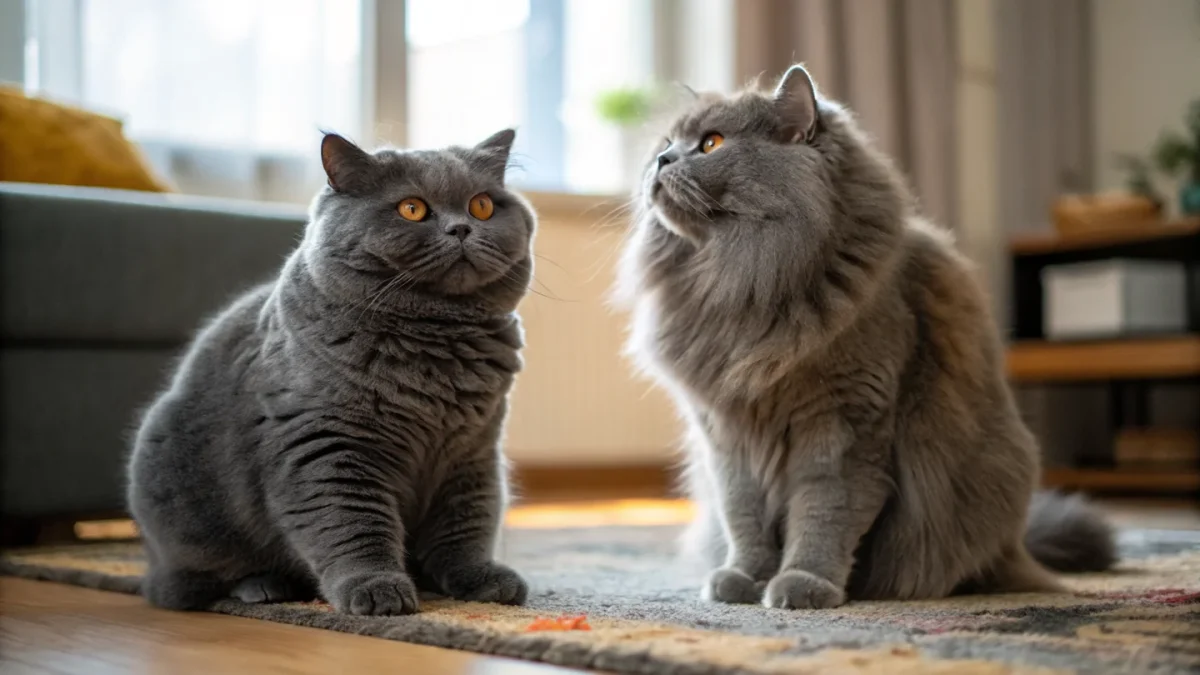
The British Longhair is not a separate breed so much as a longhaired version of the British Shorthair — and the history of how that separate name came about tells you something about how cat fancy categorization works.
For the complete British Shorthair profile, see the complete British Shorthair breed guide. For the full color range overview, see British Shorthair colors.
The History of the British Longhair
British Shorthairs were crossed with Persians (as well as Russian Blues and French Chartreux) during the breed rebuilding period after World War II. These crosses were necessary — the breed's numbers had been severely depleted by wartime conditions — and the Persian crosses in particular contributed the denser, fuller coat and more rounded face structure seen in modern show specimens. The GCCF ultimately accepted only third-generation Persian × British Shorthair crosses to maintain breed standard integrity.
Those Persian crosses also introduced the longhair gene. Longhaired kittens appeared in British Shorthair litters — the genetic inheritance of the Persian ancestry surfacing when two carriers were bred together. For decades, these longhaired kittens were registered as British Shorthairs or simply not registered formally; the longhair gene was present in the gene pool without formal acknowledgment.
As breeders began specifically selecting for longhaired offspring and working to establish consistent type, the British Longhair emerged as a recognized breed. Its recognition varies by organization and country — some registries treat it as a separate breed, others as a coat variant within British Shorthair.
Physical Comparison
| Feature | British Shorthair | British Longhair |
|---|---|---|
| Coat length | Short, dense, plush | Semi-long, flowing |
| Coat texture | Hard plush, stands away from body | Softer, lies somewhat closer to body |
| Face structure | Round, broad | Round, broad (identical) |
| Body type | Cobby, substantial | Cobby, substantial (identical) |
| Size | 7-17 lbs | 7-17 lbs |
| Eye color | Coat-dependent | Coat-dependent (same rules) |
| Ruff/tail feathering | None to minimal | Present; collar ruff, full tail |
The body structure is so similar that the two cats at rest, facing away from you, are distinguishable primarily by the coat. The British Longhair's longer coat produces a different silhouette — a fuller tail, a visible neck ruff, and a softer overall edge to the silhouette compared to the Shorthair's dense, structured profile.
Temperament
Identical. Both breeds have the same self-contained, calm, dignified temperament. Both are quiet, tolerant of routine alone time, affectionate on their own terms, and good with children and other animals. The coat difference does not affect personality.
Grooming Comparison
This is the significant practical difference between the two:
British Shorthair: Weekly brushing sufficient under normal conditions. Increases to 2-3 times weekly during shedding seasons. No matting.
British Longhair: 2-3 times weekly brushing needed as a baseline. During shedding seasons, daily brushing prevents tangles. The longer coat can mat in the armpits and hindquarters if neglected. The ruff and tail need their own attention.
The British Longhair's grooming commitment is noticeably higher than the Shorthair's — not as intensive as a Persian, but approaching Ragdoll-level commitment. For people who love the British Shorthair temperament but are drawn to the longer coat's visual appeal, this is the key tradeoff to evaluate honestly.
Health
Both breeds share the same health predispositions: hypertrophic cardiomyopathy (HCM) and polycystic kidney disease (PKD). PKD in British Shorthairs results from a single autosomal dominant gene mutation introduced through Persian ancestry, and a validated genetic test exists for it. HCM in British Shorthairs has no validated genetic test as of writing — the mutation differs from the one identified in Maine Coons and Ragdolls — so cardiac screening via echocardiogram (ultrasound) remains the recommended approach for breeding stock. Responsible breeders screen for both regardless of coat type.
The coat difference doesn't introduce new health factors. The longhair gene is a simple recessive and doesn't carry independent health implications.
Which to Choose?
Choose the British Shorthair if:
- Minimal grooming commitment is important
- You love the dense, plush, toy-like coat texture
- You want the most widely available British Shorthair type
Choose the British Longhair if:
- You prefer a longer, flowing coat and find it more visually appealing
- You're prepared for the additional grooming commitment
- You want the British Shorthair temperament in a slightly softer-looking package
The underlying cat — temperament, health predispositions, size, living requirements — is the same. The decision is genuinely about which coat appeals to you and how much grooming time you're willing to commit.