

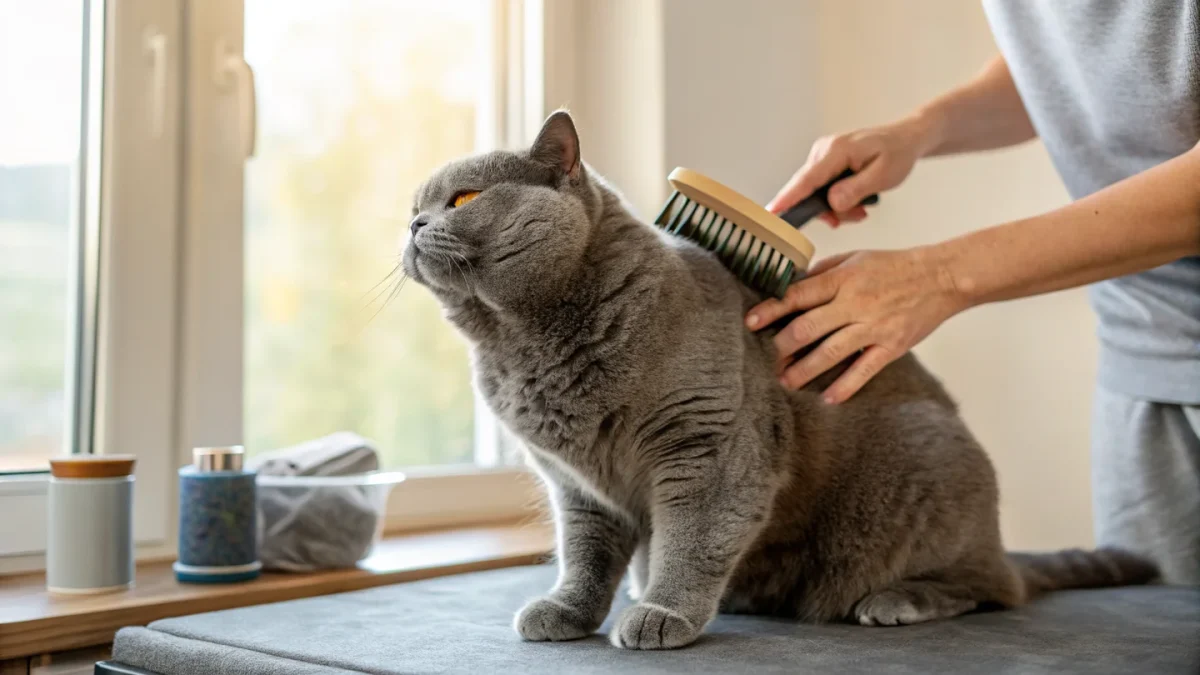
If you've ever compared the grooming notes on a Persian and a British Shorthair — "daily combing essential" versus "weekly brushing adequate" — the practical difference is significant. The British Shorthair's short, dense coat is one of its genuine practical advantages over longhaired breeds, and it's a meaningful consideration for households that want a beautiful cat without major grooming commitment.
For the complete breed profile, see the complete British Shorthair breed guide and whether a British Shorthair is right for you.
Understanding the British Shorthair Coat
The British Shorthair coat is short — shorter than a Ragdoll, considerably shorter than a Persian — but it's notably dense. Each hair is fine, and the hairs are packed together in a high-density arrangement that gives the coat its characteristic plush, teddy-bear quality. The coat stands away from the body rather than lying flat, which is what produces the rounded, toylike appearance in person.
This structure has practical implications:
No matting. Short hairs with the fiber distribution the British Shorthair has simply don't tangle. You will not encounter a mat in a British Shorthair coat under normal circumstances.
Substantial shedding. The dense coat means a lot of individual hairs. British Shorthairs shed more than their short coat might suggest — particularly during seasonal transitions. The volume can surprise owners who expected a short-coated breed to shed minimally.
Easy brushing. When you do brush, the process is quick and simple. The coat doesn't require working through multiple layers or careful attention to specific problem areas. A thorough brush with a firm-bristle brush or rubber grooming tool covers the whole cat in a few minutes.
Grooming Routine
Off-season (winter/summer): Once per week. Use a firm-bristle brush or rubber curry comb. Work from head to tail in sections. The coat is short enough that a few minutes per session covers the whole cat.
Shedding seasons (spring especially, fall moderately): 2-3 times per week. During the spring coat shed, daily brushing significantly reduces the quantity of fur that ends up on furniture, clothing, and floating through the air. A single week of daily brushing during peak shed removes a surprising amount of loose coat.
The practical reason to increase frequency during shedding is not mat prevention — it's cleanliness management. The loose fur from a British Shorthair is short and light and will settle on every horizontal and vertical surface in the home. Regular removal during peak shed is significantly easier than cleaning up after it has distributed.
Tools
A rubber curry comb or grooming glove is often the most effective tool for the British Shorthair coat. The rubber nubs grip the short individual hairs and pull them out effectively. Many British Shorthairs find this more comfortable than bristle brushes because the rubber is gentler on the skin.
A firm-bristle brush works well for finish brushing after the rubber glove pass — it smooths the coat and removes the last of the loose surface fur.
A fine-tooth comb is useful for the face and around the ears on cats where the face fur is long enough to warrant it (not always the case in British Shorthairs, whose face fur is typically quite short).
Steel nail clippers: British Shorthairs have dense, round paws. Trim nails every 2-3 weeks.
Bathing
British Shorthairs don't need regular bathing. Occasional baths — perhaps 1-3 times per year — are well-tolerated and useful for managing allergen load and improving coat condition. The short, dense coat means bathing is faster than with longhaired breeds.
The breed is typically cooperative with bathing when introduced to it young. Adult cats that have never been bathed may require a more gradual introduction: getting the paws wet first, then progressing to full immersion over several sessions.
The coat dries relatively quickly given its short length, though towel blotting removes the initial water volume efficiently.
Ear and Dental Care
British Shorthairs have medium-sized ears with reasonable ear canal access. Check and clean ears monthly — remove visible wax buildup with a soft cloth dampened with an appropriate ear cleaner. Don't insert anything into the ear canal.
Dental care is worth establishing as a routine regardless of what that looks like in your household — whether brushing (most effective), dental treats, or water additives. British Shorthairs don't have the dental crowding issues that flat-faced breeds have, but dental hygiene benefits any cat.
The Low-Maintenance Reality
The British Shorthair's grooming requirements are genuinely among the lowest for a purebred indoor cat. Weekly brushing, seasonal increases, occasional baths, and standard nail/ear maintenance is the whole picture. There's no mat removal, no daily eye cleaning, no specialized coat products.
For people who want a beautiful, substantial cat without significant grooming commitment, the British Shorthair delivers. The fur on the furniture is real and worth managing, but the management required is substantially less than most longhaired alternatives.