

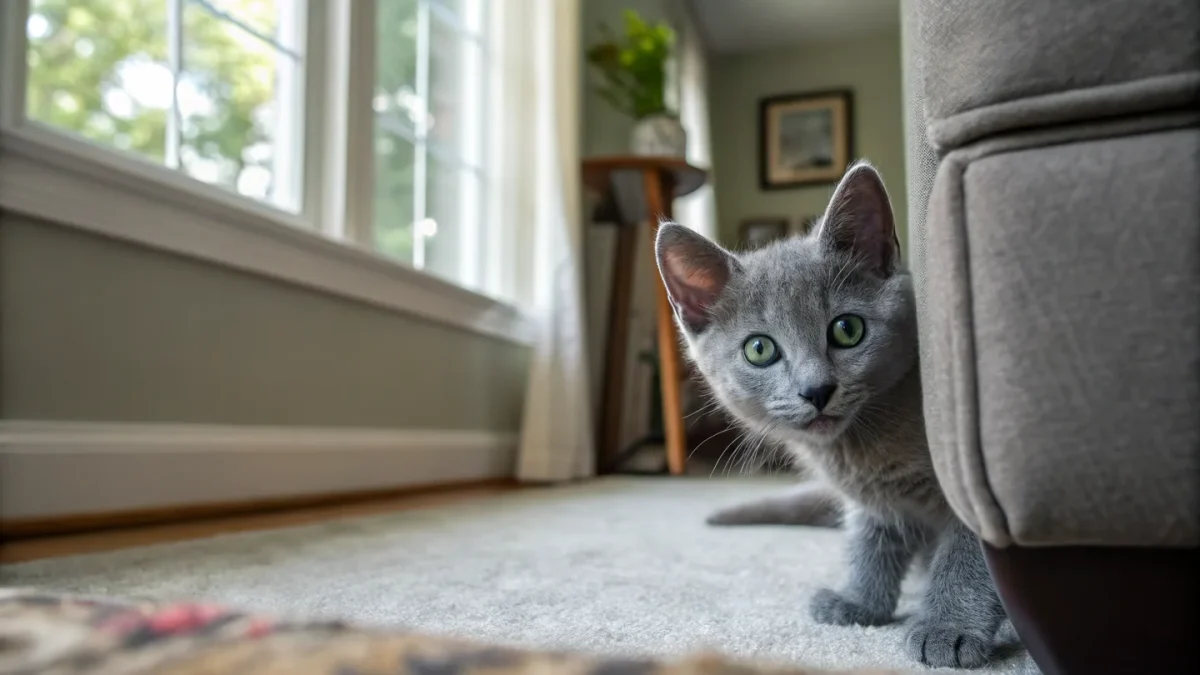
The Russian Blue kitten will not necessarily throw itself at you when it comes home. This surprises some new owners who expect kitten enthusiasm to override the breed's characteristic reserve. But the reserve is present from kittenhood — it's not something that develops with age. Understanding this from the start shapes the entire settling-in experience in a productive direction.
The good news: the same reserve that makes the initial period feel slow means the trust, when it develops, is real. You are not waiting for nothing.
The First Days: Giving Control to the Kitten
The most common mistake with a new Russian Blue kitten is trying to accelerate the introduction. The kitten needs to explore on its own terms, encounter you on its own terms, and decide when contact is welcome on its own terms.
Set up a small, comfortable initial space — a room where the kitten can settle in, find the litter box, water, and food, and explore without being overwhelmed by the full house. Sit in this space quietly and let the kitten come to you. Do not reach for the kitten. Do not follow the kitten. Be present, be calm, and be available.
Most Russian Blue kittens will approach within a day or two. The approach will be tentative at first — a sniff from a distance, withdrawal, another approach. This is the trust-building process in real time. Each approach that is met with calm, non-grabbing presence advances the relationship. Each reach for the kitten that wasn't invited sets it back.
Consistent Routine as Foundation
The Russian Blue is a routine-dependent breed from kittenhood onward. Meals at the same time, handling at times the kitten has shown receptivity, play sessions as part of a daily pattern — these establish the predictability the Russian Blue needs to feel safe.
Unpredictable environments — loud unexpected noises, erratic schedules, frequent visitors in the first weeks — slow the settling-in process considerably. If possible, keep the kitten's environment relatively stable for the first two to three weeks while the basic trust foundation is established.
Socialization: The Critical Window
Like all kittens, the Russian Blue has a sensitive period for socialization — roughly the first two to four months of life when exposure to different people, sounds, and experiences has the greatest positive effect on adult temperament. Responsible breeders will have begun this process before you receive the kitten.
Your job in the first weeks is to continue it without overwhelming the kitten. Gentle, calm exposure to different visitors — people who will sit quietly and allow the kitten to approach, not people who will immediately try to pick it up — extends the socialization without creating the fearful association that pushy handling produces.
Handling the kitten's paws, ears, and mouth gently and regularly during this period is worth the investment of time. A Russian Blue adult that accepts nail trimming, ear cleaning, and brief veterinary examinations calmly is a direct result of gentle, consistent handling during kittenhood.
What Normal Looks Like
A Russian Blue kitten that seems reserved or watchful in its first days at home is not necessarily anxious or unhealthy — it may simply be doing exactly what the breed does: assessing the situation before committing. Signs that the transition is going well include:
- Eating and drinking normally
- Using the litter box
- Playing spontaneously (even in your absence — you may catch it mid-game if you enter quietly)
- Gradually increasing the distance it's willing to be from you during exploration
Signs that warrant more attention: refusing food for more than 24-48 hours, hiding continuously without emerging for basic needs, or visible signs of illness. The complete Russian Blue breed guide covers health considerations; the coat care routine can begin gently during the kitten period to establish it as normal handling.
The Long Game
The Russian Blue kitten that seems slow to warm up in the first weeks will not stay that way. The same careful temperament that makes the initial period feel cautious produces an adult cat that knows exactly who its person is and maintains that knowledge with extraordinary consistency.
The investment in patience during the kitten stage pays compound interest in the adult relationship. Build the routine, let the kitten lead the pace, and resist the urge to speed things up. The Russian Blue will come to you when it's ready — and when it does, it tends to stay.