

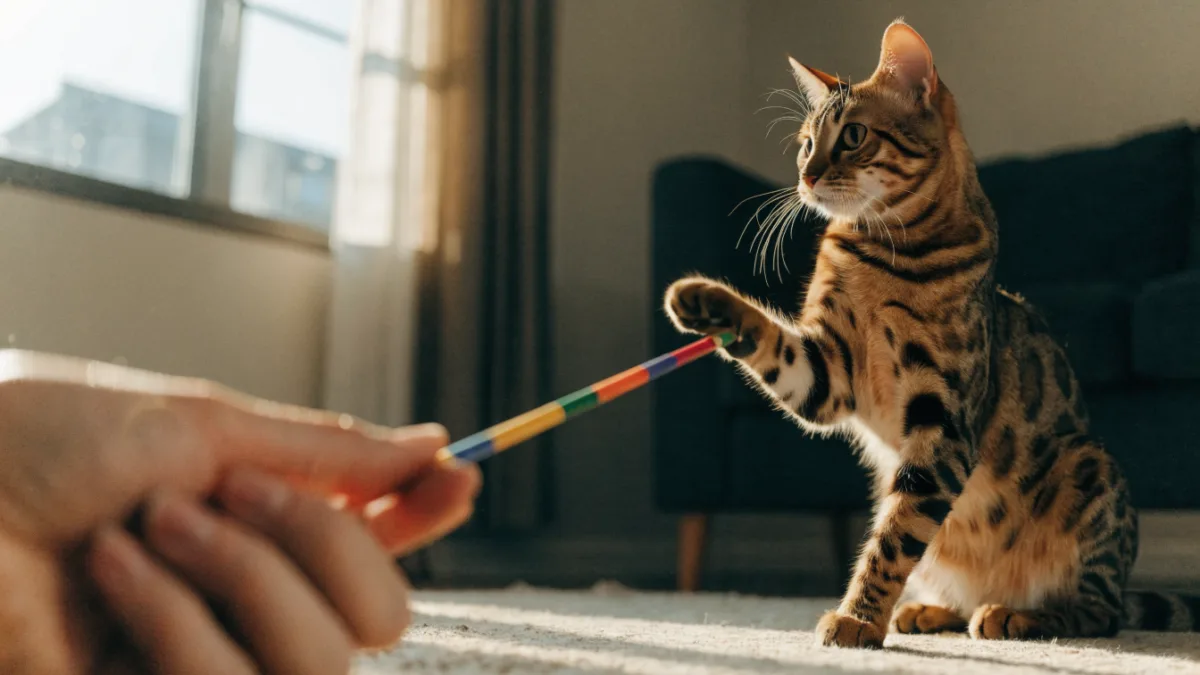
I’ll be honest with you. For the first decade of my career, I bought into the stereotype. Cats? Trainable? Sure, maybe in the same way that a toaster is trainable — you push a button and hope for the best. Then a client named Maria brought her cat Bones to a group session I was running. Not because she wanted Bones to sit on command, but because the cat was spraying on every vertical surface in her apartment and she was at her wit’s end. I almost turned her away. Glad I didn’t. Watching Bones learn to target a stick with his nose in under ten minutes — and watching Maria’s face when it happened — rewired something in my brain about what “trainable” actually means.
The Wrong Yardstick
Here’s the core problem: we measure cat intelligence and cooperation against a standard invented entirely for dogs. It’s like grading a fish on its tree-climbing ability and then writing a think piece about how stupid fish are.
Dogs were built to work with us. Thousands of years of selective breeding went into creating animals that read human body language, respond to pointing cues, and genuinely seem to enjoy following instructions. Your average Golden Retriever lives for the moment you ask him to do something. He wants the job. He wants the partnership.
Cats took a completely different evolutionary off-ramp. Biologist John Bradshaw’s work makes this clear: cats didn’t evolve alongside humans in a cooperative working relationship. They domesticated themselves — or more accurately, they figured out that human grain stores attracted tasty rodents, and they decided to stick around. The deal was always transactional. We provided the buffet. They showed up to eat.
That single difference shapes everything about how cats learn, why they respond the way they do, and why calling them “untrainable” says more about our expectations than their abilities.
Self-Domestication Changes Everything
When humans domesticated dogs, we chose specific traits and bred for them over generations. We wanted herding instinct, guarding behavior, retrieving drive, biddability — the willingness to take direction from a handler. We literally engineered dogs to care about what we think.
Cats? Nobody was breeding ancient Egyptians’ barn cats for obedience. Nobody was selecting the most compliant tomcat and pairing him with the most biddable queen. The cats that succeeded were the ones that hunted well, stayed alert, and didn’t get themselves killed. Independence wasn’t a bug. It was the whole point.
The cats that succeeded were the ones that hunted well, stayed alert, and didn’t get themselves killed. Independence wasn’t a bug. It was the whole point.
This means that when you ask a cat to do something, you’re working against thousands of years of evolution that rewarded independent decision-making. A dog’s default is “what do you want me to do?” A cat’s default is “what’s in it for me?” Neither is wrong. They’re just different operating systems.
The Dominance Myth Needs to Die
If I had a dollar for every time someone told me their cat was “trying to be dominant,” I could retire. This one makes me grind my teeth because it’s not just wrong — it’s actively harmful to the relationship between cats and their humans.
Here’s the thing: dominance theory — the idea that animals constantly jockey for position in a hierarchy and that misbehavior is really an attempted power grab — has been largely debunked even for dogs. Applied behaviorists and veterinary behaviorists have moved away from this framework for years. But when people apply it to cats, it becomes genuinely absurd. As feline behavior experts point out, the concept of a cat attempting to dominate a human is.[1] as it gets.
Cats are not pack animals. They don’t form the kind of hierarchical social structures that wolves do. A cat who scratches your couch isn’t staging a coup. A cat who bites when you pet her isn’t asserting rank. These are communication breakdowns, not power struggles. When you frame every behavior problem through the lens of dominance, you miss what the cat is actually telling you — and you’re more likely to respond with punishment, which destroys trust and makes everything worse.
We’re Bad at Reading Cat Emotions
A 2023 study by Candace Croney and colleagues revealed something uncomfortable about how humans perceive pet emotions. Pet owners were significantly less likely to believe cats experience complex emotions like sadness, friendship, sympathy, compassion, or pity compared to dogs. Same species asking the questions — Homo sapiens — just different assumptions depending on the animal in front of them.
This isn’t just an academic quibble. It has real consequences.
If you believe your dog is capable of missing you while you’re at work, you adjust your routine. You might get a pet sitter for midday visits, or you might invest more time in enrichment activities. But if you think your cat is basically a furry robot that feels nothing beyond “hungry” and “not hungry,” you’re less likely to invest in training, socialization, or environmental enrichment. You write the cat off as aloof and move on.
The problem is that cats do show complex emotions. They just show them differently. A slow blink is affection. A tail held high with a curved tip is a greeting. Ears rotated sideways are anxiety. The signals are there — most humans just never learned the vocabulary. And when we can’t read what an animal is feeling, we assume they’re not feeling much of anything.
What Actually Works with Cats
Mutual Benefit Over Blind Compliance
You can train a cat. I’ve watched it happen. I’ve helped make it happen. But you have to abandon the idea that the cat owes you compliance. Cats respond to positive reinforcement — specifically, they respond when the reinforcement is something they genuinely want and when the timing is precise.
Clicker training works beautifully with cats. The click marks the exact behavior you want, and the treat that follows makes it worth repeating. I had a client whose cat, a tortoiseshell named Pepper, would charge the front door every time someone knocked. Classic problem. Classic stress for the owner. We trained Pepper to run to a specific mat on cue instead. It took two weeks of short sessions — five minutes at a time, a handful of times per day. The cat figured it out because the reward was valuable to her, not because she wanted to please anyone.
Find the Right Currency
Dogs will often work for praise alone. Some cats will too, but most won’t. You need to find what motivates the individual cat. For Bones, it was squeeze treats. For Pepper, it was freeze-dried chicken. For another client’s cat, a Siamese named Kiko, the only thing that worked was a specific brand of lickable treats — I won’t name it, but look for high-value, strong-smelling options that you can deliver in small amounts.
Key things to look for in training treats for cats: strong aroma (cats are driven by scent), soft texture (hard treats take too long to chew and slow down the session), and small size so you can do rapid repetitions without filling the cat up in three rounds.
Keep Sessions Ridiculously Short
Most dogs will work for fifteen or twenty minutes. Cats will give you five, maybe. Push past that and you’ll see what people misread as stubbornness — the cat walking away, grooming, or simply losing interest. That’s not defiance. That’s a cat being a cat. Multiple short sessions throughout the day will always beat one long session.
The Stakes Are Real
This isn’t just about whether your cat can learn to high-five. The myth of the untrainable feline has serious welfare consequences. Behavioral issues — inappropriate elimination, aggression, destructive scratching — are among the [2] When people believe cats can’t be trained or that behavior problems are just “cats being cats,” they don’t seek help. The cat gets the raw end of that deal every single time.
There’s also a growing movement of cat agility training, leash walking, and trick training that’s chipping away at the old stereotypes. These aren’t party tricks. They’re enrichment. A cat who learns new skills in structured training sessions is a cat with more mental stimulation, more confidence, and a stronger relationship with their human. The research is catching up too — recent work in veterinary and behavioral science is finally [2] rather than constantly measuring it against canine benchmarks.
So here’s the takeaway, and it applies whether you’re living with a cat, a dog, or both: stop asking animals to be something they’re not. Cats aren’t broken dogs. They’re not stubborn dogs. They’re not disobedient dogs. They’re highly capable learners who operate on a different value system — one built on mutual benefit rather than hierarchy. Meet them where they are, figure out what they care about, and you might be surprised what they’re willing to do. The myth of the untrainable feline says nothing about cats and everything about how long we’ve been asking the wrong questions.
Sources
- "as silly and illogical" — facebook.com
- leading reasons cats are surrendered to shelters — pmc.ncbi.nlm.nih.gov