

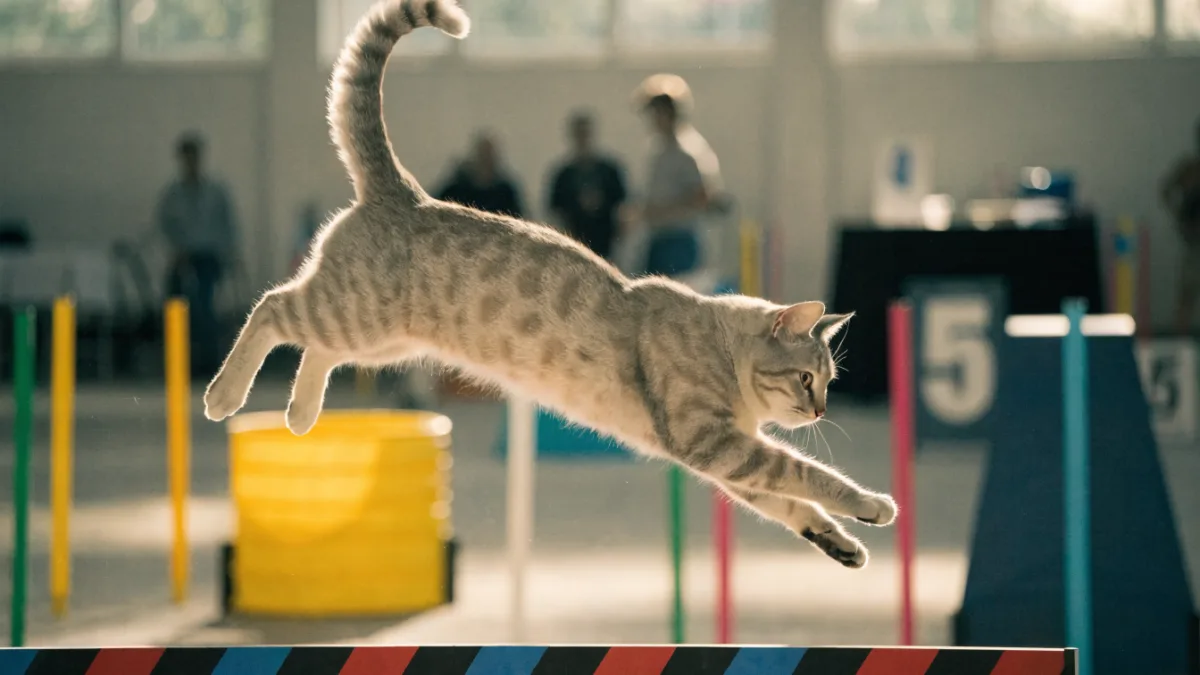
If you’d told me ten years ago that cats would be giving dogs a run for their money in agility, I’d have laughed you out of the room. I’ve spent enough time around both species to know the stereotype: dogs are eager athletes, cats are couch-dwelling royalty who couldn’t care less what you want them to do. But the times? They are shifting. Fast.
Feline agility is having a genuine moment, and it’s not a novelty act anymore. The Cat Fanciers’ Association and International Cat Agility Tournaments are hosting real competitions at major cat shows. Owners are building DIY obstacle courses in their living rooms and posting the results online. And some of these cats are genuinely impressive — weaving through poles, clearing jumps, and navigating tunnels with a fluidity that makes plenty of dogs look clumsy by comparison.
So let’s talk about what’s happening here, why it works, and what dog people like me can actually learn from it.
Wait — Cats Run Agility Courses?
Yeah, they do. And the structure will look familiar to anyone who’s spent time around dog sports. Cats are timed as they navigate a course of obstacles — jumps, weave poles, tunnels, ramps, the works. Fastest completion wins. The CFA has been promoting this for years, and:[1] dogs don’t just compete for best of breed at these events — cats are training and running agility too.
But here’s where it gets interesting. The mechanics of how a cat moves through a course are fundamentally different from how a dog does it, and it comes down to physics as much as personality.
Built Different
Cats have a lower center of gravity, exceptional balance, and a skeletal structure that basically turns them into liquid when they want it to. I watched a,[2] and the contrast was striking. The dog — bigger, heavier, with wider paws — had to really commit to each obstacle. There was effort there. The cat? It flowed through the same course like it was a Sunday stroll.
Open grates and unstable surfaces that make dogs pause and reconsider their life choices? Cats walk right over them. Their balance is that good. It’s not training — it’s just how they’re built. Those same instincts that let a cat land on its feet from a kitchen counter make them natural athletes on an obstacle course.
The Motivation Question: Prey Drive vs. Pack Mentality
This is where I think the conversation gets genuinely fascinating, and it’s something every animal person should understand.
Dogs run agility courses for a mix of reasons, but a big one is social motivation. They want to work with their handler. They want approval. They’ve been bred for thousands of years to cooperate with humans, and that pack mentality shows up on the course. You give a cue, your dog responds, and there’s a feedback loop of communication happening the whole time.
Cats? Not so much.
Cats run courses because something is worth chasing. Handlers use teaser wands, feather toys, and sometimes laser pointers to trigger the cat’s prey drive. The cat isn’t thinking, “I want to make my human proud.” The cat is thinking, “I am going to catch that thing if it’s the last thing I do.”
This changes the entire handler-animal dynamic. With a dog, you’re a team. With a cat, you’re the one controlling the prey. Different relationship, different skill set, same sport.
I used to think this made cats harder to train. I’m not sure that’s right anymore. It makes them different to train. You’re not working with cooperation — you’re working with instinct. And when you tap into that instinct correctly, cats are shockingly fast and focused.
Course Modifications: Not Just Shrunk-Down Dog Equipment
You can’t just take a standard dog agility course, shrink it by 40%, and call it a cat course. Well, you can, but it won’t work as well.
Feline-specific courses are scaled down to match a cat’s body mass and stride length, sure. But the design philosophy is different too. Cats don’t have the raw power of a medium-to-large dog, so jumps are lower. Weave poles are closer together because a cat’s stride is shorter. Tunnels are narrower — a cat shouldn’t have to crouch through something it could comfortably walk through.
Ramps and elevated elements actually play to a cat’s strengths more than a dog’s. Cats are natural climbers. They’re comfortable at height. So you’ll often see more vertical challenges in a feline course, where a dog course emphasizes horizontal speed and jumping.
The Unpredictability Factor
Here’s where I have to be honest: cat agility is not as predictable as dog agility, and that’s both its greatest challenge and its best entertainment value.
A well-trained dog on an agility course is going to run the course. Maybe not perfectly, but the path is generally predictable. The handler knows where the dog is going next because they’ve rehearsed it hundreds of times.
A cat? A cat might run three obstacles beautifully, then stop dead in the middle of the tunnel to investigate a smell. Or sit down on the ramp and start grooming. Or decide the course is boring and walk off to explore the judging area. I’ve seen videos where a cat cleared every jump flawlessly, then spent thirty seconds staring at a pole before deciding it wasn’t worth the effort.
That’s not a training failure. That’s a cat being a cat. And honestly? Audiences love it.,[3] feline agility is drawing younger, bigger crowds at traditional cat shows because people want to see cats do unexpected things. The unpredictability is the appeal.
The Real Conversation: Laser Pointers and Stress
Now let’s get into the stuff people actually argue about, because there are two debates happening in the feline agility world that matter.
The Laser Pointer Problem
Some handlers swear by laser pointers to keep cats moving at top speed through a course. And it works — there’s nothing quite like a red dot to make a cat sprint. But there’s a real concern here: cats are predators. When they chase something, they expect to catch it. A laser pointer is literally uncatchable. Some behaviorists argue this creates frustration and stress, because the cat’s hunting sequence never reaches its natural conclusion.
Others in the community say that if you pair the laser with a physical reward at the end — a toy the cat can actually grab and “kill” — it resolves the issue. The debate isn’t settled, and honestly, it probably varies from cat to cat. Some cats seem to find the chase itself satisfying. Others get visibly agitated when they can’t catch the dot.
If you’re trying this at home, my suggestion is simple: if your cat seems frustrated after a laser session, don’t use one. If they’re having a blast and don’t seem bothered, you’re probably fine. Read your animal.
Show Stress vs. Home Enrichment
The bigger conversation is about whether cats should be at loud, crowded show environments at all. Dogs are generally social animals. Many of them genuinely enjoy the chaos of a competition — new smells, new people, other dogs around. It’s stimulating in a good way.
Cats are territorial. A cat’s comfort zone is its home. Taking a cat to a strange environment full of noise, unfamiliar animals, and hundreds of humans can be genuinely stressful, even if the cat performs well on the course.
This is why the rise of home-based “Cat Olympics” matters so much. Social media has popularized DIY agility setups that owners build in their living rooms or backyards. The cat gets the physical exercise and mental stimulation of navigating obstacles, but in an environment where it feels safe. For most cats, that’s going to be the better option.
You don’t need fancy equipment either. Cardboard boxes become tunnels. Couch cushions become jumps. A broom handle balanced on two books is a perfectly serviceable obstacle. What matters is that the cat is moving, problem-solving, and engaging its body and brain.
What Dog People Can Learn From This
I’ll be straight with you: I used to think cats were untrainable. I was wrong. Cats aren’t untrainable — they’re trainable differently. The mistake is assuming that because a cat doesn’t respond to the same methods as a dog, the cat can’t be trained at all.
The rise of feline agility is proving that every single day. Cats are running courses, clearing obstacles, and yes, sometimes stopping to groom themselves mid-run. They’re doing it on their terms, driven by instinct rather than obligation. And there’s something genuinely cool about watching an animal choose to participate because it wants to, not because it’s been conditioned to please you.
The bigger picture here matters too. Indoor cats face a real health crisis in the form of obesity and behavioral issues linked to understimulation. They’re evolved to hunt, climb, sprint, and problem-solve. A cat sleeping twenty hours a day on your couch isn’t “lazy” — it’s bored. Feline agility, whether at a competition or in your living room, gives cats an outlet for the behaviors they were literally built to perform.
Dogs might have invented the agility course, but cats are showing up and reminding us that athleticism comes in different packages. Some athletes run because you ask them to. Others run because there’s something worth chasing. Both are worth watching.
Sources
- they've been pretty vocal about it — facebook.com
- video recently of a cat and dog racing the same course — facebook.com
- As VetStreet noted in their coverage of the sport — vetstreet.com