

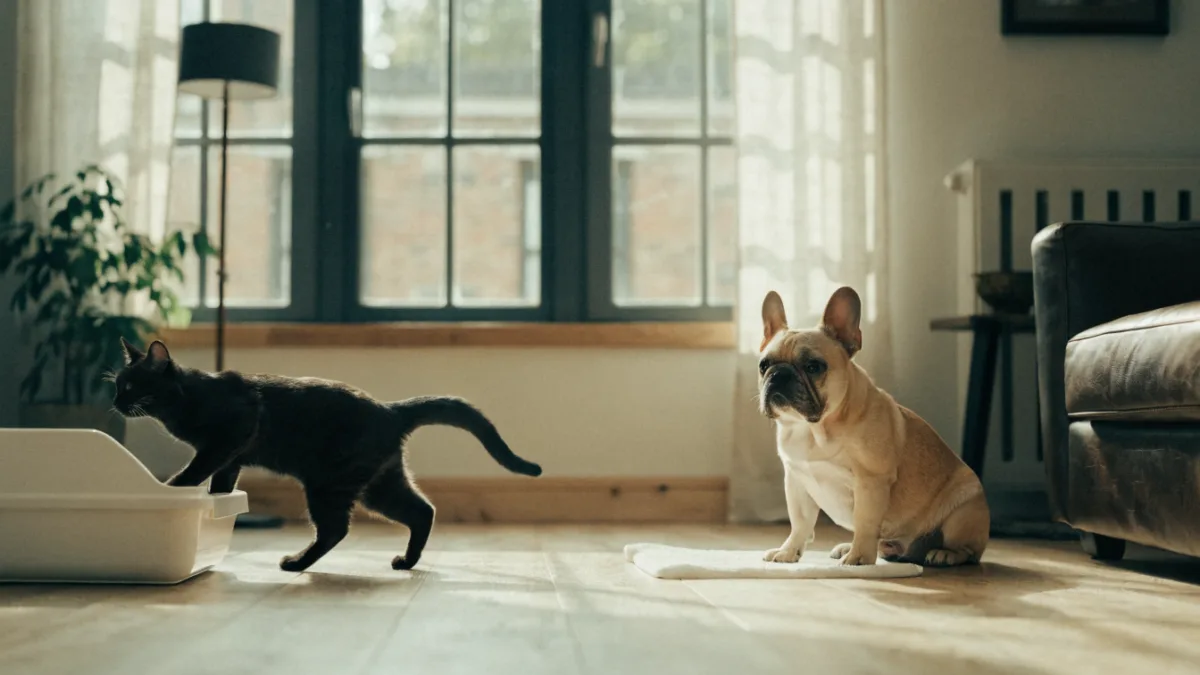
Your new kitten finds the litter box on day one and just uses it. No fanfare. No weeks of accidents behind the couch. Meanwhile, you’re standing outside at 6 AM in the freezing slush with a nine-week-old Labradoodle who’s sniffing every blade of grass like it owes her money — and doing absolutely nothing productive.
If you’ve ever lived with both species, you’ve probably wondered why cats seem to arrive pre-programmed and dogs arrive as blank slates. The answer isn’t about intelligence. It’s about where each animal came from, what they evolved to survive, and how they view something most humans would rather not think too hard about: their own waste.
Two Species, Two Evolutionary Playbooks
Let’s rewind about 10,000 years.
Domestic cats descend from the African wildcat (Felis lybica) — a small, solitary predator that thrived in arid, desert-like environments. These cats hunted alone, slept alone, and survived alone. Staying invisible was their entire strategy. Every scrap of food, every hiding spot, every decision came down to one question: how do I avoid being noticed by something bigger than me?
Dogs, on the other hand, evolved from wolves. Highly social, pack-hunting animals that communicated constantly through scent, body language, and vocalization. For a wolf ancestor, being part of the group wasn’t just a nice bonus — it was survival. And the group communicated through everything. Including where they went to the bathroom.
That fundamental difference — hide versus broadcast — is the entire foundation of what we might call the Great Potty Divide. And once you understand it, a lot of seemingly baffling pet behavior suddenly makes perfect sense.
Why Cats Just Know
Here’s something that still catches me off guard even after years of working with animals: a kitten’s drive to dig, eliminate, and bury waste is hardwired. It’s innate. It’s not taught through repetition. It’s baked into the DNA.
Kittens usually pick up the final “etiquette” — the covering ritual, the careful digging — from their mothers by about four weeks old. But the core instinct is already there before any learning takes place. A kitten separated from its mother early will still seek out something loose and diggable. It doesn’t need to be shown. The software came pre-installed.
The reason comes straight back to that solitary survival strategy. In the wild, an uncovered pile of waste is basically a neon sign reading “small cat is here.” It attracts predators. It alerts prey animals to clear out of the area. For a lone hunter relying on stealth to catch dinner and avoid becoming dinner, burying waste isn’t about tidiness — it’s about not dying.
The commercial litter box works because it perfectly mimics what the African wildcat evolved to prefer: loose, sandy, dry substrate that’s easy to dig in and effective at covering scent. We basically built a consumer product around an ancient instinct and called it training. Your cat isn’t trained. Your cat is being a cat.
Why Dogs Leave Everything Out in the Open
Dogs have a completely different relationship with waste. For them, it’s a communication tool — a biological bulletin board.
Dogs possess active anal glands and dedicated scent glands in their paws. When your dog stops to thoroughly sniff a spot where another dog eliminated, they’re reading detailed information: sex, health, diet, stress levels, reproductive status, how recently that dog passed through. It’s a chemical social media feed. When your dog defecates and then kicks up grass or dirt afterward, they’re not trying to bury anything. They’re intentionally depositing additional pheromones from their paw pads — like signing their name at the bottom of a message.
I worked with a guy who had a male German Shepherd named Bruno. He was convinced Bruno was “broken” because Bruno would kick dirt for a solid thirty seconds after every bowel movement. He thought it was compulsive anxiety behavior. I had to break it to him that Bruno was doing exactly what canine evolution designed him to do: writing a very enthusiastic status update for the neighborhood. There was nothing to fix.
For dogs, hiding waste would completely defeat the purpose. The whole system relies on it being findable.
The Stare-Down: Why Your Dog Watches You While Pooping
If you’ve ever wondered why your dog makes deep, somewhat unsettling eye contact with you while doing their business, it’s not weird. It’s actually deeply functional.
Elimination is a vulnerable moment for any animal. Cats handle that vulnerability by hiding — finding a quiet, secure, low-traffic spot where they won’t be disturbed. This is also why shoving a litter box in a noisy laundry room or next to a scary appliance can trigger litter box avoidance. Cats need to feel safe when they’re at their most exposed.
Dogs handle vulnerability differently. As social animals descended from pack-hunting wolves, they instinctively look to their group for protection during vulnerable moments. When your dog locks eyes with you while squatting on the sidewalk, they’re essentially asking you to watch their back. You’re their safe presence. They trust you to alert them if something approaches. It’s actually a significant compliment, even if the eye contact makes you uncomfortable.
Can Dogs Use Litter Boxes?
Short answer: yes, but you’re working against biology.
Dogs can be trained to use indoor potty solutions — litter boxes designed for dogs, pee pads, artificial grass patches with drainage systems. I’ve helped clients make it work. But here’s what I always tell them upfront: you’re not tapping into a natural instinct the way a litter box does for a cat. You’re overriding one. And that takes significantly more repetition, consistency, and patience.
Small breeds are the most common candidates. I worked with a woman in a fourth-floor walk-up apartment who had a Chihuahua mix named Pepper. Getting Pepper downstairs and outside fast enough in the morning was becoming a daily crisis, especially during an icy winter. We spent about eight weeks building a rock-solid routine with an indoor grass patch — rewarded every single successful use, no exceptions, no skipped reinforcement sessions. It worked. But it worked because the owner was absolutely relentless about consistency.
There’s genuine debate among trainers about whether indoor potty options confuse dogs and undermine outdoor housetraining. Some argue it muddies the waters — the dog can’t distinguish between “this absorbent surface inside is fine” and “that similar-feeling rug is definitely not fine.” Others point out that for apartment dwellers, people with mobility limitations, or owners dealing with extreme weather, indoor options aren’t just convenient — they’re necessary.
In my experience, it comes down to the individual dog and the handler’s consistency. Some dogs generalize the distinction without issue. Others genuinely struggle. Know your dog before you commit to a hybrid approach.
When the Instinct Breaks Down in Cats
Even in cats, that famous litter box instinct isn’t unbreakable. I’ve talked with cat owners who were baffled when their previously reliable cat suddenly started avoiding the box. The causes range from urinary tract infections to box placement to substrate changes — and one of the most well-documented triggers is pain.
Declawed cats, for instance, frequently develop litter box aversion. The procedure can cause lasting nerve pain in the paws, and digging in standard clay litter becomes genuinely uncomfortable. When the act of burying gets associated with pain, the instinct gets overridden, and the cat starts seeking softer, less painful surfaces — your bed, the bathmat, a pile of laundry. It’s not spite. It’s self-preservation.
This is part of why the recent surge in alternative litter materials matters so much. The pet industry has driven significant innovation away from traditional strip-mined bentonite clay toward gentler, more sustainable options: recycled paper, walnut shells, cassava, even tofu-based litters. These materials work with feline instincts rather than against them, and they give owners options if a cat finds traditional litter uncomfortable. Smart litter boxes that track a cat’s weight and bathroom frequency are also turning the litter box into a early-warning medical diagnostic tool — catching urinary issues before they become emergencies.
What This All Means for You
The potty divide isn’t an intelligence gap. It’s not about cats being “smarter” or dogs being “stubborn.” It’s about two radically different evolutionary histories producing two completely different sets of instincts around the same basic biological function.
Cats came to domestication with a built-in drive to bury waste in loose, sandy substrate. We gave them a box of granules and said “good kitty.” Dogs came with a built-in drive to broadcast scent information and seek their group’s presence during vulnerable moments. We had to teach them where and when that behavior fits into a human household — and rewiring instincts takes months of consistent repetition, not minutes.
Here’s something worth sitting with: keeping cats indoors with litter boxes isn’t just convenient — it’s one of the most impactful choices you can make for local wildlife. Free-roaming and feral cats are responsible for enormous pressure on native bird and small mammal populations worldwide. When outdoor cats eliminate in the environment, they can also spread parasites like Toxoplasma gondii to wild animals and even into waterways. The very instinct that makes cats such tidy indoor companions — that drive to bury, to stay hidden, to leave no trace — is the same instinct that makes an indoor litter box the better ecological choice.
So next time you’re freezing on the sidewalk at dawn waiting for a puppy to figure it out, or scooping a litter box for the thousandth time, remember you’re participating in a relationship that’s thousands of years deep. Your cat is following an ancient survival script written in the desert. Your dog is learning a new one, one repetition at a time. Understanding where those scripts come from doesn’t just make you a better pet owner — it makes the whole messy business of living with animals make a lot more sense.