
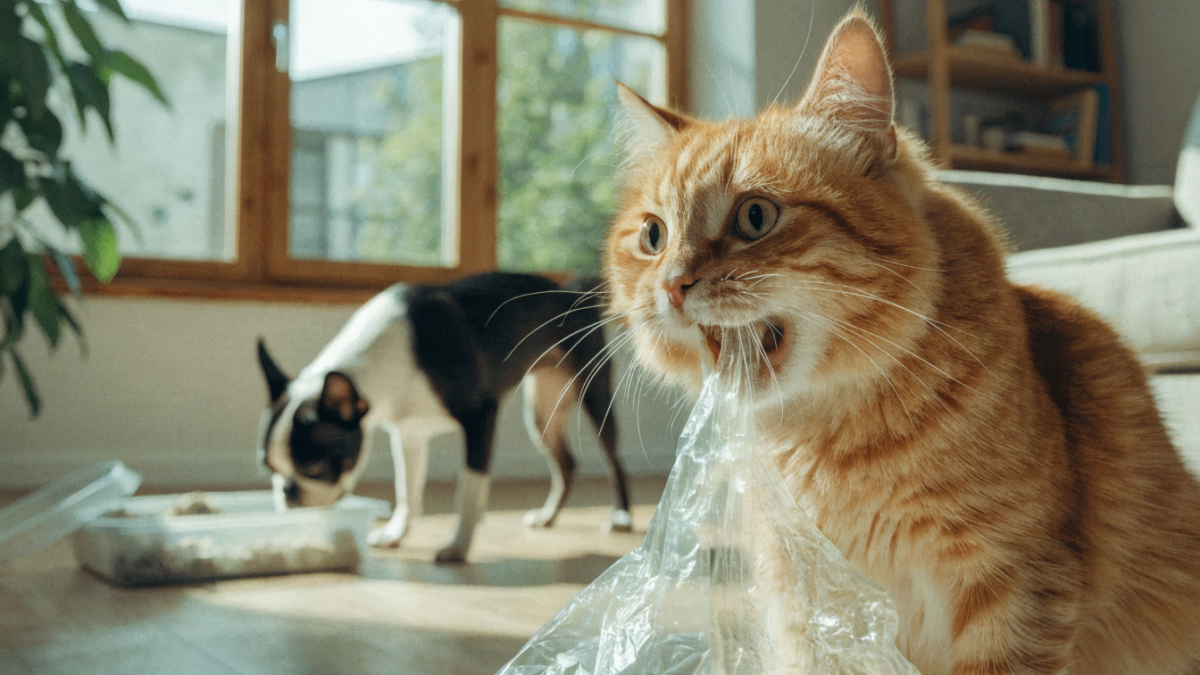
There’s a moment every dog owner dreads. You’re walking through the house, minding your own business, and you catch your beloved companion nose-deep in the cat’s litter box like they’ve discovered a five-star buffet. Or maybe you walk into the living room and find your cat happily gnawing on a plastic grocery bag like it’s the greatest toy ever invented. Your first reaction is probably disgust. Your second is confusion. Your third — if you’re like most of the people I talk to — is quiet panic that something is fundamentally broken.
Nothing is broken. These behaviors are gross, no question. But to your pets, they make perfect sense. Let’s talk about why.
The Poop Problem: Why Your Dog Can’t Resist
Coprophagia — the clinical term for stool eating — is one of the most common behaviors I get asked about. And despite what you might think, it’s not a sign that your dog is broken, sick, or badly raised. It’s so common that veterinarians consider it a normal — if deeply unpleasant — canine behavior.
I used to tell owners that poop eating was almost always a behavioral issue. Boredom, habit, curiosity. I was wrong about that, or at least I was only telling half the story.
The reality is that coprophagia splits into two main categories: medical and behavioral. On the medical side, poor nutrition or nutritional deficiencies are the usual suspects. If your dog isn’t absorbing enough iron, minerals, or vitamins from their food, their body drives them to find those nutrients elsewhere — and unfortunately, feces still contains residual nutrients. On the behavioral side, you’ve got boredom, stress, habit formation, and plain old canine curiosity.
There’s an ongoing debate among veterinarians and behaviorists about which category matters more. Some argue coprophagia is primarily an evolutionary quirk — a leftover instinct from wild ancestors who kept their sleeping areas clean by removing waste. Others insist it’s almost always rooted in a nutritional gap. In my experience, it’s usually a mix of both, and you need to look at the whole picture before deciding how to address it.
The Cat Poop Obsession
If your dog is specifically targeting the litter box, there’s a reason, and it comes down to what cats eat. Cat food is significantly higher in protein and fat than dog food. That means cat waste retains a strong scent and nutritional residue that dogs find absolutely irresistible. To your dog, that litter box doesn’t smell like waste. It smells like a high-value snack.
I once worked with a Labradoodle named Benny whose owners were at their wit’s end because he’d broken into their cat’s litter box three times in one week. They’d tried scolding him, moving the box, even installing a baby gate. What finally worked was understanding that Benny wasn’t being defiant — he was responding to a biological drive that was, to him, completely logical. The litter box was a treasure chest.
Here’s the good news: eating cat poop typically won’t kill your dog, even though the thought of it might kill your appetite. It can cause gastrointestinal upset — vomiting, diarrhea, some unpleasant-smelling breath — but serious illness is rare. That said, if your dog is eating waste from unknown animals or wildlife, the risk goes up considerably because of parasites and disease.
Plastic Obsession: When Cats Go After Your Grocery Bags
Now let’s talk about the other gross habit that drives pet owners crazy. Your cat sits on the counter, delicately chewing the handle of a plastic bag like it’s a piece of jerky. You pull it away, they find another one. You hide the bags, they discover the cellophane wrapper from your takeout container.
This behavior has a name: pica. It’s a psychological and behavioral condition where animals eat non-food items, and it’s surprisingly common in cats.
So why plastic specifically? It turns out plastic bags hit several feline buttons at once. Many modern bags — especially the biodegradable kind — are made with plant-based materials like cornstarch or gelatin. To your cat, that bag smells faintly like food. Add in the residual scent of whatever the bag previously held, and you’ve created an object that smells interesting, tastes interesting, and makes a satisfying crinkly noise that mimics the rustling of prey rustling through leaves.
The underlying causes of plastic chewing usually fall into a few categories. Dental issues are a big one — cats who are teething or experiencing gum pain may chew for relief. Anxiety and stress are common triggers. Boredom plays a role, especially for indoor cats who don’t have enough enrichment. And just like with dogs and poop, nutritional deficiencies can drive cats to seek out unusual things to consume.
Unlike the poop situation with dogs, eating plastic is genuinely dangerous for cats. It can cause intestinal blockages, choking, and internal injuries. This isn’t a behavior you can manage with patience alone. If your cat eats plastic, it’s a veterinary concern, not just an annoying habit.
Breaking the Cycle: What Actually Works
Here’s where I need to be straight with you. Punishment doesn’t work for either of these behaviors. I know that sounds counterintuitive — when you catch your dog with a mouth full of something disgusting, your instinct is to correct them immediately. But punishment increases stress, and stress makes both coprophagia and pica worse, not better.
The modern consensus among behaviorists leans heavily toward management. That means changing the environment rather than trying to change the animal.
For Dogs Eating Poop
- If your dog is eating their own waste, talk to your vet about dietary additives. These go into your dog’s food and make the resulting stool taste terrible — even to a dog who already thinks poop is a snack.
- Clean up immediately. Don’t give the behavior an opportunity to happen. The longer waste sits in the yard, the more likely your dog is to sample it.
- For litter box access, physical barriers are your best friend. A covered litter box in a room the dog can’t reach solves the problem completely.
- Recent developments in probiotic and digestive enzyme supplements look promising. The idea is that if your dog absorbs more nutrients from their food in the first place, they won’t feel driven to find those nutrients elsewhere. It’s not a magic cure, but it’s worth discussing with your vet.
For Cats Eating Plastic
- Keep bags out of reach. This sounds obvious, but you’d be amazed how many people leave bags lying around and expect their cat to ignore them. Cats don’t ignore crinkly, food-scented objects. That’s not how cats work.
- Provide alternative chew and play opportunities. Puzzle feeders, interactive toys, and regular play sessions can address the boredom factor that often drives pica.
- Have your vet check your cat’s teeth and gums, especially if the plastic chewing is a new behavior.
- Watch out for eco-friendly plastics. This is a concerning trend — compostable bags made from corn or soy are more attractive to pets, not less. If you’ve switched to biodegradable products and noticed an increase in chewing behavior, that could be the connection.
When to Call the Vet
If either behavior appears suddenly in an adult animal, schedule a vet visit. A dog who never showed interest in poop suddenly eating it at age six might have developed a nutritional absorption issue. A cat who starts chewing plastic out of nowhere could be dealing with dental pain or a medical condition that needs attention. New behaviors in adult animals are always worth investigating, because they often signal that something has changed internally.
Puppies eat poop. Kittens chew things. That’s normal development, and most of them grow out of it with consistent management. But when these behaviors show up later in life or escalate quickly, you’re looking at a symptom, not a quirk.
The bottom line is this: your pets aren’t gross because they’re bad. They’re gross because they’re animals, and their bodies and brains are wired differently than ours. The more we understand the actual reasons behind these behaviors — nutritional, psychological, evolutionary — the better equipped we are to help our pets live healthier, happier lives without the stuff that makes us cringe. Meet the behavior with curiosity instead of frustration, and you’ll usually find your way to a solution.