

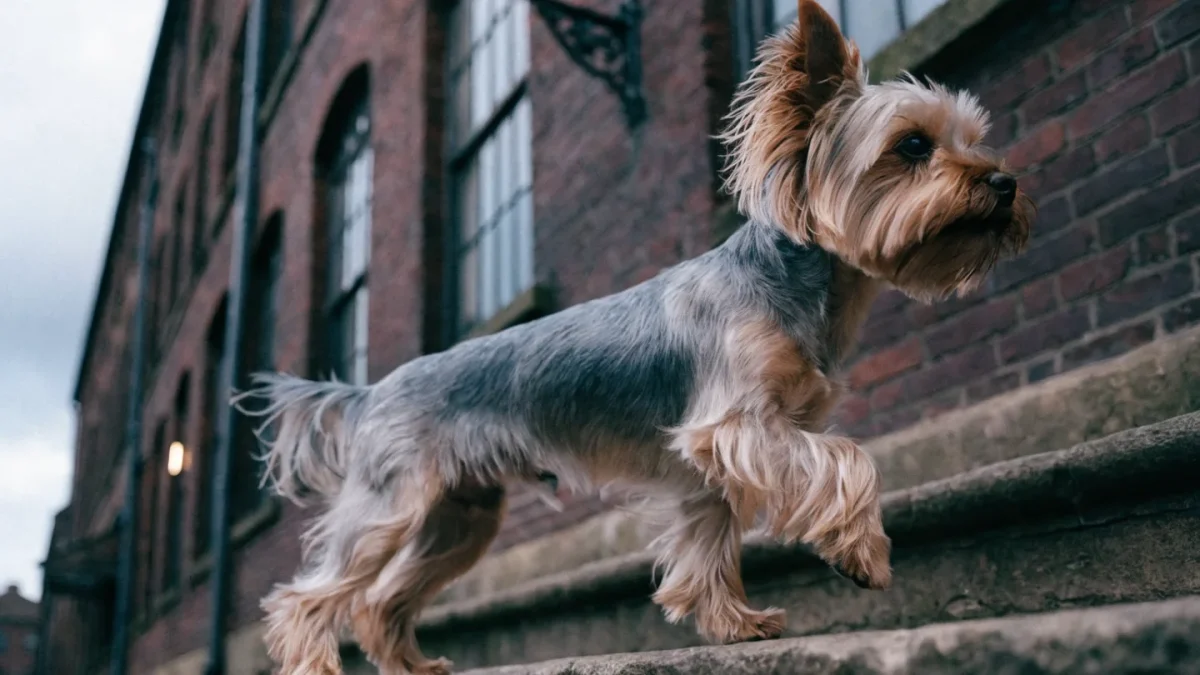
On a Saturday afternoon in August 1871, a six-year-old dog named Huddersfield Ben was struck and killed by a carriage on the streets of Accrington, Lancashire. His owner, Mary Ann Foster of Bradford, lost a pet. The dog fancy lost the most important Yorkshire terrier that ever lived — an animal whose genetic influence was so outsized that virtually every pedigreed Yorkie alive today descends from him. Ben had won over 70 prizes in both ratting competitions and conformation shows, a dual career that captures the breed's identity crisis in a single biography: working ratter and show dog, mill floor and exhibition ring, separated by nothing but which day of the week it was.
The yorkshire terrier history origins story is messier, more working-class, and more interesting than the polished breed narratives suggest. This isn't a dog engineered in country estates by aristocrats with studbooks. It's a dog assembled in industrial towns by factory workers who needed something small enough to follow rats into tight spaces and tough enough to kill them when they got there.
The Scottish Migration
The story begins not in Yorkshire but in Scotland. During the 1850s and 1860s, economic shifts pulled thousands of Scottish textile workers south to the mills of Yorkshire and Lancashire. They brought their skills, their families, and their dogs.
These were small rough-coated terriers — collectively referred to by various local names, none of them standardized. Paisley Terriers, Clydesdale Terriers, Skye Terrier variants — breeds that in many cases no longer exist as distinct populations. The dogs served a practical purpose: controlling rats and mice in the cramped, grain-rich environments where weavers worked and lived.
Nobody kept breeding records. Working-class dog ownership in mid-Victorian England wasn't an activity that generated paperwork. What we reconstruct about the Yorkie's foundation stock comes from show catalogs, newspaper accounts, and the claims of early breeders — sources that are helpful but not always reliable, since breeders had economic incentives to exaggerate or obscure their dogs' lineage.
What the evidence supports is that the founding stock included at least Paisley Terriers (small, silky-coated dogs with blue-and-tan coloring), Clydesdale Terriers (similar in type, now extinct as a separate breed), some form of Skye Terrier, and very likely Maltese — the last contributing the silk coat texture that would become the breed's hallmark. English Black and Tan Terriers and Waterside Terriers may have been in the mix as well. The point is that the Yorkshire terrier didn't descend from a planned breeding program. It condensed out of a regional population of small working terriers through informal selection by men who needed a rat dog that could do its job.
The Mill Floor Years
The ratting function was real and economically meaningful. Textile mills stored raw materials — cotton, wool, flax — that attracted rodents. A serious rat infestation could damage inventory and spread disease through a tightly packed workforce. Small terriers that could navigate the narrow spaces between looms, follow rats into wall cavities, and dispatch them quickly had genuine value.
Mine shafts posed similar problems. Rats colonized the dark, enclosed spaces where miners worked, and a small terrier could be sent ahead to clear vermin from tunnels. The dogs needed to be small — ideally under five kilograms — but structurally sound enough to work hard in cramped, physically demanding conditions.
This working context shaped the yorkshire terrier temperament that persists today: the alertness, the tenacity, the prey drive, and the vocal tendency to alert handlers when quarry was cornered. Modern Yorkies that bark at every noise in the apartment are running software written for a factory floor.
Huddersfield Ben and the Birth of a Breed
By the mid-1860s, the dogs that would become Yorkshire terriers were appearing in competitive ratting matches and early conformation shows across northern England. They were still called by various names — Scotch Terriers, Broken-Haired Terriers, Toy Terriers — and varied considerably in size, coat, and color.
Huddersfield Ben changed that. Born in 1865, owned by Mary Ann Foster, Ben established what the Yorkshire terrier was supposed to look like. At roughly 5 kg — larger than today's standard — he combined the working ability to win ratting contests with a coat quality that caught judges' eyes in the show ring. His influence on the breed was enormous precisely because early breeders concentrated heavily on his line, and a significant portion of the resulting gene pool passed through him.
The name "Yorkshire terrier" was proposed in 1870 by Angus Sutherland, a journalist reporting on a dog show. Sutherland argued that the breed had been so improved in Yorkshire that continuing to call it a Scottish terrier was inaccurate. The name stuck, and within a decade, it was the established designation.
The Class Transition
What happened next was one of the fastest social transformations in canine history. Between roughly 1870 and 1890, the Yorkshire terrier went from factory ratter to fashionable accessory — a shift driven almost entirely by the coat.
The breed's long, silky, steel-blue-and-tan coat was unlike anything else in the terrier world. At exhibitions, Yorkies displayed on velvet cushions with their coats brushed to the floor drew crowds and, crucially, drew the attention of upper-class women looking for an elegant small companion. The dogs went from the laps of weavers to the laps of ladies in barely two decades.
This class migration changed the breed physically. New owners wanted smaller dogs — prettier dogs, dogs that fit in a lap and looked ornamental. Working ratting ability became irrelevant. Selective pressure shifted from function to appearance: smaller bodies, longer coats, more refined features. By the 1890s, the average Yorkie was noticeably smaller than Huddersfield Ben had been.
The Kennel Club in England recognized the breed in 1886. The American Kennel Club followed the same year. Classification in the Toy Group — rather than the Terrier Group — cemented the breed's new identity as a companion animal. The working past receded into footnote status, where it has remained ever since in public perception.
The Twentieth Century and Smoky
The Yorkshire terrier's popularity grew steadily through the early 1900s but exploded after the Second World War, thanks in part to a single famous dog.
Smoky was a 1.8 kg Yorkie found in a foxhole in New Guinea in 1944 by an American soldier named William Wynne. Over the next two years, Smoky served in twelve combat missions, survived 150 air raids on New Guinea, and — in what may be the breed's most impressive working moment — pulled a communications wire through a 21-meter-long drainage pipe only 20 centimeters in diameter under an active airstrip in Luzon, Philippines. The alternative was digging up the runway under enemy fire.
After the war, Wynne and Smoky toured hospitals performing tricks for wounded veterans — work that some historians credit as early animal-assisted therapy. Smoky's story put the breed on magazine covers and in newspapers across the United States, introducing it to a mass audience as a charming, resilient small dog.
The breed entered the top-ten most popular breeds in the U.S. during the 1990s and has remained there or near it since. Globally, it ranks consistently among the most popular toy breeds.
What the History Tells Us Today
The complete breed guide covers the modern implications in detail, but the history yields a few conclusions worth stating directly.
First, the breed's behavioral wiring is terrier wiring installed during the working years and never revised. The alertness, the barking, the prey drive, the stubbornness — these aren't quirks. They're features built for a specific job that the breed no longer does but still carries the toolkit for.
Second, the transition from working dog to show dog to companion compressed into a remarkably short period — roughly thirty years — and the health consequences of that compression are still unfolding. Shrinking the frame to satisfy fashion demand introduced structural vulnerabilities that the original mill dogs didn't face: liver shunts, tracheal collapse, dental crowding, fragile bone structure.
Third, the "purse dog" image is a twentieth-century invention layered on top of a nineteenth-century working dog. Understanding that history doesn't change the breed's current reality, but it does explain why Yorkies behave the way they do — and why treating them as decorative objects rather than dogs with terrier brains produces anxious, reactive animals.
The Yorkshire terrier's journey from mill floor to velvet cushion is one of the most dramatic reinventions in the dog world. The irony is that the terrier personality that made the breed functional in its original role is the same personality that makes it difficult when owners expect a passive lapdog. The mill ratter is still in there. It just has a better haircut.