

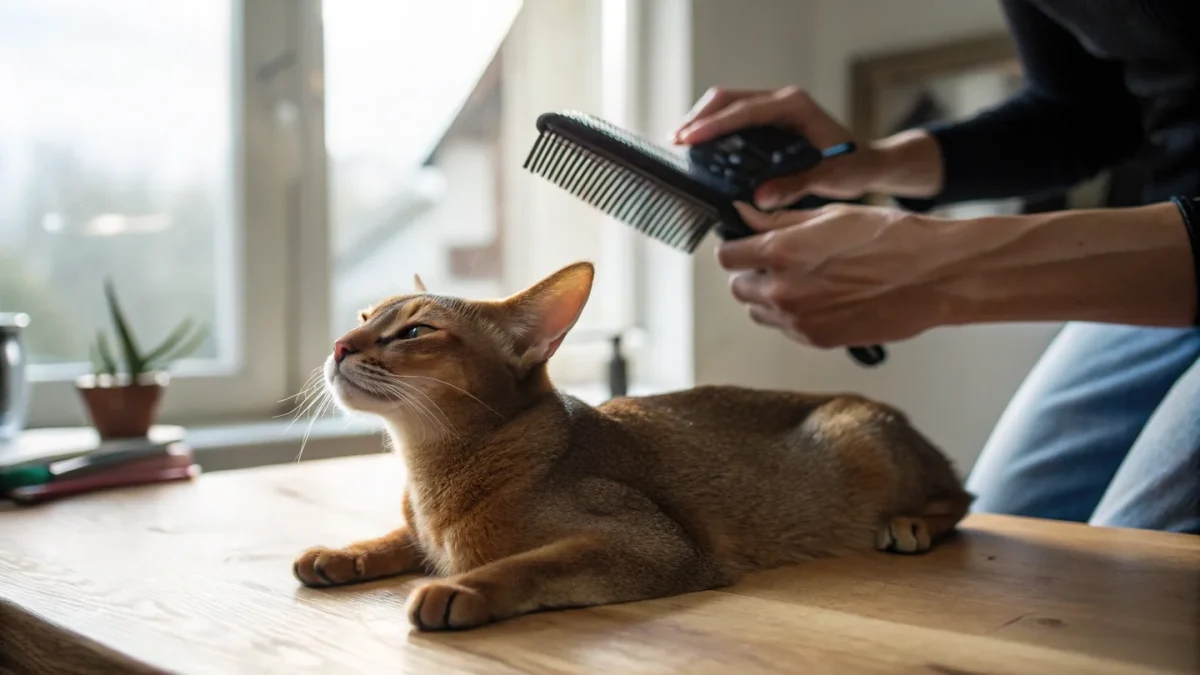
The Abyssinian's ticked coat looks almost impossibly fine — each hair banded in multiple colors, no visible striping or pattern on the body, just that shimmering, depth-producing texture that photographs can't quite capture. The upkeep doesn't match the appearance. This is a coat that largely takes care of itself.
Where Abyssinian maintenance actually requires attention is less glamorous: dental health, given the Abyssinian's health profile and its lean jaw structure; nail trimming, for a cat that climbs enthusiastically; and regular ear and eye checks as part of the general physical familiarity that helps catch health issues early in a breed with specific hereditary conditions.
Coat Brushing
Once a week with a fine-toothed metal comb or soft rubber brush is adequate for most Abyssinians. This removes loose hair, distributes skin oils across the coat, and helps maintain the sheen that makes the ticked pattern so striking.
The coat is so short and close-lying that matting essentially never occurs. Shedding exists — all cats shed — but the tight structure of the coat means it doesn't broadcast loose hair around the house the way some double-coated breeds do.
Some Abyssinians actively enjoy brushing; others tolerate it. Either way, keeping sessions brief and ending while the cat is still neutral (rather than pushing to a point of resistance) maintains the routine without creating negative association.
A damp chamois or microfiber cloth buffed gently over the coat after brushing enhances the color depth and sheen. This step is purely aesthetic and entirely optional.
Dental Care
The Abyssinian's lean, relatively narrow jaw means teeth may be somewhat more crowded than in broader-faced breeds. Crowded teeth accumulate tartar faster.
Tooth brushing with cat-appropriate paste, built up gradually from initial lip-touching through outer tooth contact to a fuller routine, provides the most effective ongoing maintenance. Many cats accept this if introduced in kittenhood; cats introduced to tooth brushing as adults need patient gradual acclimatization.
Dental treats and water additives provide supplementary benefit but do not replace brushing in effectiveness.
Professional veterinary dental checks annually allow early intervention if tartar is building beyond what home care manages. Abyssinian ownership commitment includes this ongoing dental maintenance — catching periodontal disease early has significant health implications given the breed's predisposition to renal issues.
Nail Trimming
Abyssinians are climbers and athletic cats that use their claws actively. Trim nails every 2–3 weeks, cutting just the clear tip before the pink quick.
For a cat that climbs as much as an Abyssinian does, providing adequate scratching surfaces is also important — both for the cat's comfort and for your furniture. Vertical scratching posts and horizontal boards give the cat appropriate nail-maintenance surfaces between trims.
Ear Care
Check ears weekly. Abyssinians are not particularly prone to ear problems, but routine checking is a basic part of the physical familiarity that helps owners know their cat's baseline and notice early changes.
Healthy ears are pale pink, clean, and odor-free. Light wax is normal. Dark debris, unusual discharge, or any persistent odor warrants a vet visit. Clean the visible outer portion only with a soft cloth or cotton pad if needed — never probe the ear canal.
Eye Care
Abyssinians have large, expressive eyes — almond-shaped and prominent. Some accumulate a small amount of discharge at the inner corner, particularly as they age. Gently wipe away with a damp cloth. Persistent discharge, redness, cloudiness, or tearing warrants veterinary evaluation, particularly given the breed's known predisposition to progressive retinal atrophy.
The Physical Familiarity Principle
The Abyssinian's specific hereditary health risks — progressive retinal atrophy, pyruvate kinase deficiency — are best managed through regular veterinary testing and monitoring rather than through grooming directly. But the grooming routine serves a second function: it builds physical familiarity that makes you better at noticing when something changes.
A cat you handle regularly, whose baseline body condition you know, whose eyes and ears you check weekly — that cat's health changes are more likely to be caught early than a cat handled rarely. This matters especially for a breed where some conditions progress gradually.
Keep grooming sessions consistent, brief, and associated with calm attention. The Abyssinian's intelligence means it adapts quickly to routines established early and accepts them as normal for life.