

The first Abyssinian to appear in Western records arrived in England in 1868, brought by Captain William Barrett-Lennard following the British military expedition to Abyssinia — modern-day Ethiopia. The cat was named Zula, after the port of disembarkation. An illustration of Zula appeared in a popular natural history magazine in 1876, showing a cat with the distinctive ticked coat that still defines the breed today.
The naming logic seemed clear: the cat came from Abyssinia, so it was an Abyssinian. For over a century, the breed's Ethiopian origin was accepted as historical fact, and a secondary romantic theory flourished alongside it: that Abyssinians were the living descendants of the sacred cats of ancient Egypt, based on their visual resemblance to the slender, large-eared cats depicted in Egyptian art.
Both theories have since been complicated by evidence that neither fully anticipated.
The Egyptian Theory
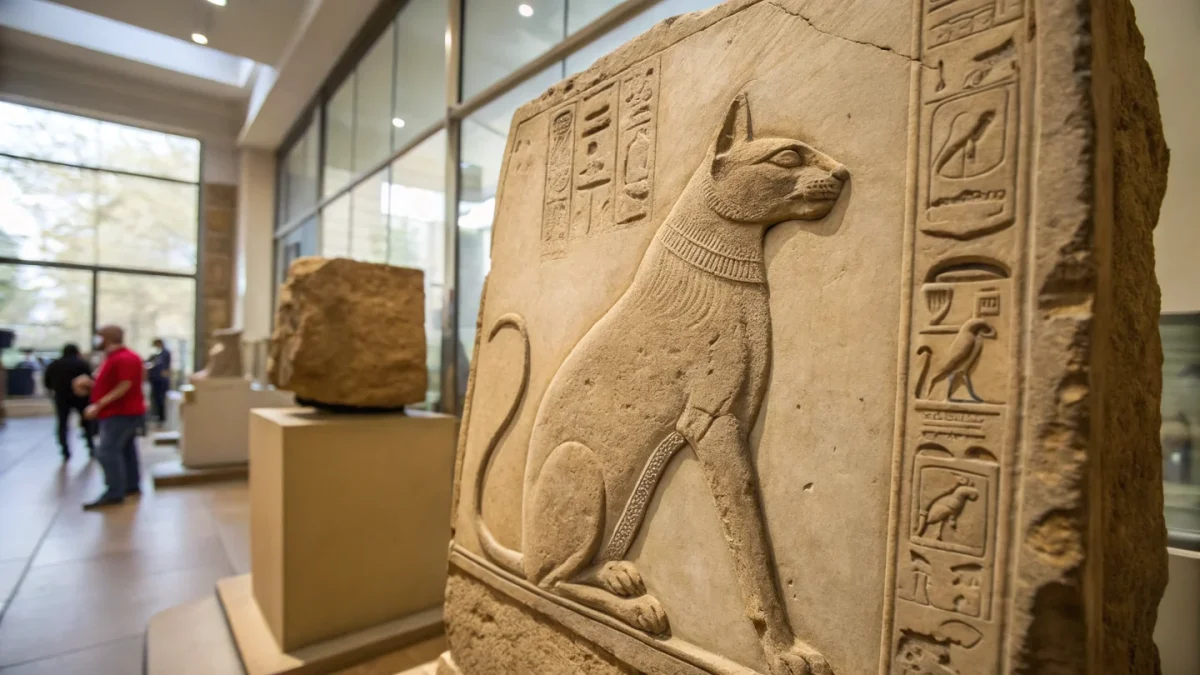
The Egyptian cat connection is the more dramatic claim, and it captures the imagination. Egyptian temple art and grave goods do depict cats with lean, angular builds and large ears that resemble the modern Abyssinian. The resemblance is real. The interpretive leap — that this visual similarity indicates direct genetic descent — is where the claim runs into trouble.
Ancient Egyptian cats were almost certainly a domestic cat population descended from the African wildcat (Felis lybica lybica), the ancestor of all domestic cats. Those populations dispersed from Egypt into Europe, Africa, and through trade routes to Asia. The physical type depicted in Egyptian art — slender, long-eared, elegant — may reflect either genuine genetic relationship to the Abyssinian, or simply the fact that domestic cats in hot climates tend toward leaner builds naturally.
The genetic evidence for a direct Egyptian origin of the modern Abyssinian breed, as opposed to a more general shared ancestry with all domestic cats via African wildcat populations, is not established. The resemblance is evocative, but evocative is not the same as proven — the population genetics work that's actually been done on Abyssinian ancestry points toward the Indian Ocean coast and Southeast Asia, not Egypt or the Horn of Africa. More on that below.
What the Victorian Records Actually Show
The more documented history begins in England in the 1870s and 1880s. Zula was exhibited — and a small breeding population was established among cat fanciers who found the ticked coat pattern unusual and appealing. The breed was shown in early cat shows in Britain, where the unusual coat attracted attention.
What is less clear from Victorian records is whether Zula herself was a founder of the modern breed, or whether breeders working to establish the "Abyssinian" type incorporated other cats — particularly British tabbies with ticking — to build a viable breeding population. Some historians of the breed believe early Abyssinian breeders may have been more eclectic in their founding stock than the Ethiopian origin story suggests — and the Cat Fanciers' Association's own breed history backs that up. Its records note that early pedigrees dating to 1904 show entries with unknown sires and dams alongside outcrosses to cats that clearly weren't Abyssinians by type.
The breed received formal recognition and a breed standard in the early 20th century, which helped stabilize the type. By the 1930s, the Abyssinian had been introduced to the United States, where it gained significant popularity in the post-World War II period.
What the Genetics Say
The molecular evidence, which emerged from population genetics work done in the 2000s — most notably a 2008 study in Genomics that genetically evaluated cat breeds and random-bred populations across five continents — shifted the understanding of Abyssinian origins significantly.
Genetic cluster analysis of domestic cat populations globally places the Abyssinian not with African or Ethiopian cat populations but with cats from the Indian Ocean coastal region — likely the area around the Bay of Bengal, coastal India, or Southeast Asia. This suggests that the Abyssinian breed's actual genetic origin may trace to cats brought to Britain via trade routes from Asia, rather than to the single cat from the Abyssinian Campaign.
The ticked tabby pattern itself is found in cat populations across coastal Asia and is not specifically associated with Ethiopian cat populations. The agouti gene variant that produces ticking could have reached England from multiple directions, and the Zula founding narrative may have shaped the breed name more than the breed genetics.
This doesn't make the history less interesting — if anything, it adds a layer of complexity. The breed may have been named for one founding cat's documented origin while its actual genetic background was drawn from a broader, cosmopolitan population of the kind that always gathered around ports and trade routes.
The Breed After Recognition
Once established in Britain and then in the United States, the Abyssinian developed into one of the more popular shorthaired breeds. Breeding programs in the early and mid-20th century refined the type — the lean, elegant build, the large ears, the expressive almond eyes, and above all the distinctive ticked coat — into the recognized standard.
The Second World War nearly eliminated the British Abyssinian population. The breed's numbers in England dropped to critically low levels, and post-war rebuilding required importing cats from elsewhere in Europe and from American lines. The recovery took years and involved careful management of a very small gene pool.
The breed that emerged is what makes Abyssinians distinctive today: consistent in type, recognizable internationally, and carrying a history that's more complicated than "captain brings cat home from Africa" — but also more interesting for being so.
The Origin Story That Remains
What the modern genetic evidence doesn't resolve is exactly which cats contributed to the early British breeding program. Zula remains the documented founding story, and the name "Abyssinian" stuck. The ticked cat that arrived at that particular port in 1868 sparked something, regardless of where its ultimate ancestry trailed back to.
The romance of the Egyptian connection and the colonial-era origin story have shaped how the breed is perceived for over 150 years. The genetic reality — cosmopolitan, trade-route-spread, probably Indian Ocean coastal — is less dramatic but arguably more interesting for telling us something about how domestic cats followed human commerce across the ancient world.