

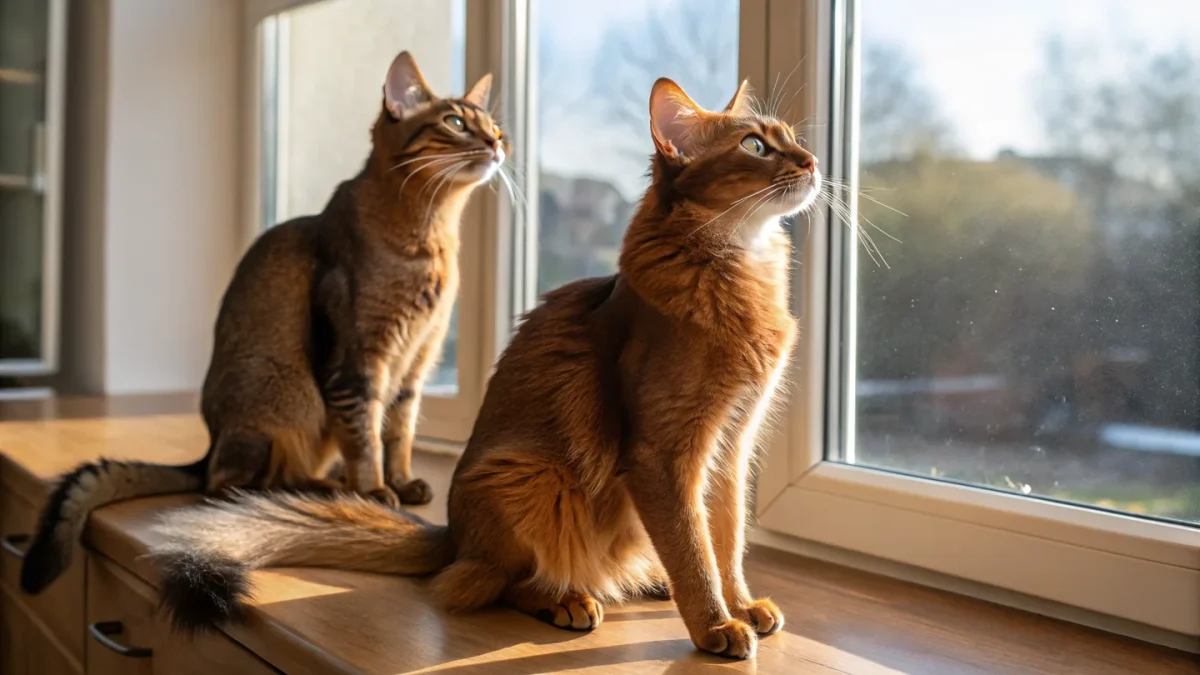
The Somali cat's origin story involves a surprise. Abyssinian breeding programs in the mid-20th century began occasionally producing kittens with longer, fuller coats — not the breed standard, and not intentional, but the product of a recessive longhair gene that had entered the Abyssinian gene pool at some point during the breed's development. For years, these long-coated kittens were quietly removed from breeding programs and placed as pets without ceremony.
Then, in the 1960s and 1970s, some breeders looked at those "misfit" kittens and saw something worth preserving. The Somali was developed from longhaired Abyssinians, with the ticked coat pattern extended by the semi-long coat into what many people consider an even more spectacular visual effect. The Somali was named after Somalia — the country neighboring Ethiopia (Abyssinia) — in a naming choice that mirrored the Abyssinian convention.
The Shared Foundation
Understanding the comparison begins with accepting that the Abyssinian breed and the Somali are, genetically, the same cat with one key difference: the Somali carries two copies of the recessive longhair allele, the Abyssinian carries zero or one. Everything else — the temperament, the activity level, the ticking pattern, the health profile — is identical or very nearly so.
The ticked tabby pattern is what defines both breeds visually. Each hair has multiple bands of color, producing the shimmering, depth-heavy coat surface that distinguishes both from any solid or striped breed. In the Somali, the semi-long coat means each banded hair is longer, creating an even more dramatic visual texture — particularly on the tail, which becomes a dramatic plume, and the ruff around the neck.
Physical Differences
Coat: The most obvious difference. The Abyssinian coat is short, tight, and flat. The Somali coat is semi-long — not as long as a Persian or Maine Coon, but distinctly longer and fuller than the Abyssinian. The Somali has a ruff, longer britches on the hindquarters, a full tail plume, and ear furnishings. The body coat lies closer than in longhaired breeds.
Tail: The Somali tail is often described as the breed's most striking feature — a full, fox-like plume that moves expressively. The Abyssinian tail is fine and tapered, elegant but not plumlike.
Overall silhouette: Both breeds have a similar lean, elegant build, but the Somali reads as larger and more substantial because of the coat volume. The underlying bone structure and muscle mass are comparable.
Shedding: The Somali sheds more than the Abyssinian. The longer hair distributes more visibly around the house, though the coat doesn't mat as dramatically as some long-coated breeds because of its fine texture.
Temperament: The Same Cat
This is where the comparison becomes simple: the temperament is essentially identical. Somalis are curious, active, engaged cats with the same need for environmental enrichment, social company, and structured play that Abyssinians require. The activity level, the intelligence, the relatively quiet voice (compared to Siamese, both breeds have a pleasant but not insistent trill), and the directed curiosity — all of these carry across both breeds.
If you find an Abyssinian temperament appealing, a Somali will be the same experience in a different coat. If an Abyssinian's needs don't suit your lifestyle, a Somali doesn't solve that mismatch.
Health: Also the Same
The Somali shares the Abyssinian's hereditary health conditions:
- Progressive retinal atrophy (rdAc-PRA) — the CEP290 mutation
- Pyruvate kinase deficiency (PK-Def)
- Renal amyloidosis tendency
Responsible breeding programs for both Abyssinians and Somalis include DNA testing for PRA and PK-Def. Ask any breeder for documentation of parental health testing, regardless of which breed you're considering.
Grooming: The Meaningful Difference
For practical ownership, grooming is the primary point of divergence.
Abyssinian grooming: Once a week, briefly, with minimal effort. The short flat coat manages itself.
Somali grooming: Requires 2–3 brushing sessions per week, more during shedding seasons. The semi-long coat can develop minor tangles particularly around the hindquarters and behind the ears, though this is much less severe than in fully longhaired breeds. Nail trimming, dental care, and ear checks apply equally to both.
The time commitment for Somali grooming is real but not excessive — perhaps 15–20 minutes per week across multiple sessions, rather than the Abyssinian's 5–10 minutes weekly. Whether this matters depends on the owner.
Which to Choose?
This choice genuinely comes down to coat preference and grooming inclination. There is no meaningful temperament or health advantage to one over the other.
If you find the Abyssinian's short ticked coat and the way light plays across it at close range appealing — and you prefer minimal grooming — the Abyssinian suits you.
If you are drawn to the dramatic Somali tail plume, the longer coat, and the fox-like silhouette — and you're comfortable with slightly more maintenance — the Somali gives you the same personality in a more visually elaborate package.
Both breeds are genuinely underappreciated relative to more common shorthairs and longhairs. Either way, you're getting one of the most visually distinctive and behaviorally interesting cat breeds available. For a complete profile of the longhaired side of this comparison, see the Somali cat.
| Feature | Abyssinian | Somali |
|---|---|---|
| Coat length | Short, tight | Semi-long |
| Brushing frequency | Weekly | 2–3 times per week |
| Shedding | Low-moderate | Moderate |
| Temperament | Curious, active, social | Same |
| Health profile | Same | Same |
| Tail | Fine, tapered | Full plume |