

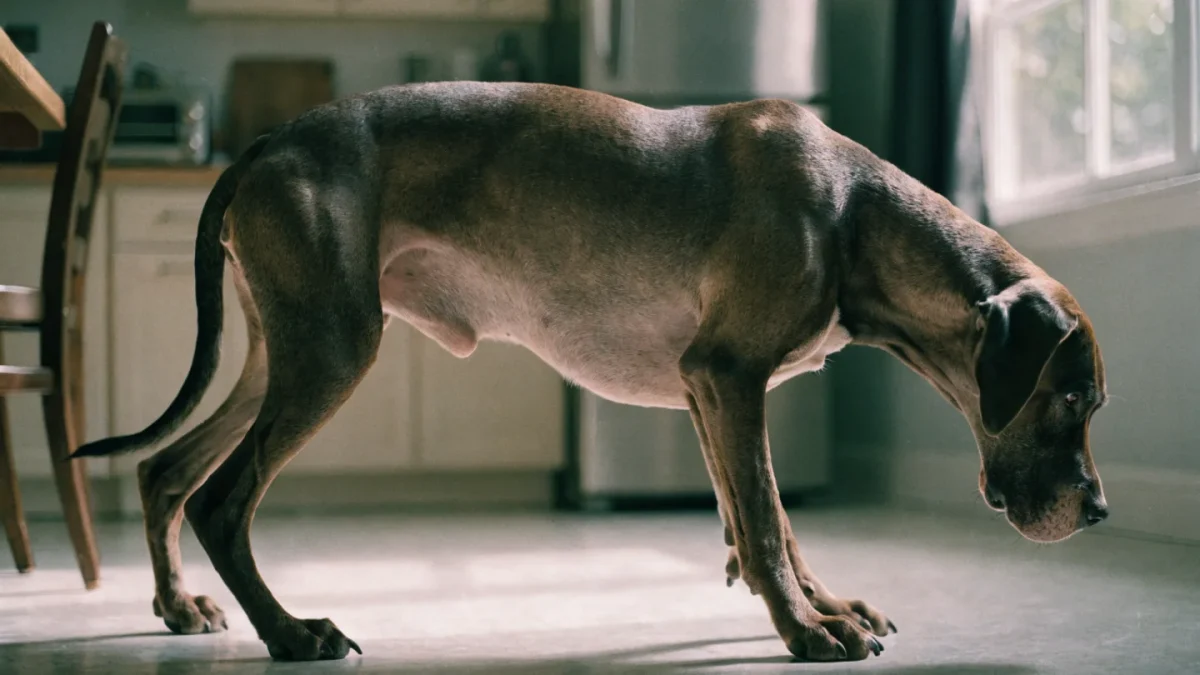
Rex was a four-year-old Weimaraner whose owners noticed he seemed "a little off" after dinner — restless, not quite settling. They watched him for two hours before calling. By the time they arrived, his abdomen was visibly distended and he'd retched unproductively four or five times. X-rays confirmed GDV. We went to surgery within twenty minutes of his arrival. Rex made it. Two hours more and he probably wouldn't have.
The most critical acute emergencies in dogs include bloat (gastric dilatation-volvulus), severe pancreatitis, and urinary tract blockages. Bloat is the most immediately life-threatening — a dog with a distended belly and unproductive retching needs emergency care within the hour. Pancreatitis and urinary blockages also require same-day veterinary attention.
This guide explains each condition clearly: what's happening inside the body, what it looks like from the outside, and exactly what warrants a call to an emergency clinic rather than waiting for a regular appointment.
For broader context on dog health conditions, the overview of common dog health problems is the right starting point.
Bloat (Gastric Dilatation-Volvulus)
The Anatomy of a Life-Threatening Emergency
Bloat — properly called gastric dilatation-volvulus (GDV) — is the condition I want every dog owner to know about cold. It kills quickly. A dog can go from appearing uncomfortable to dying within hours without surgical intervention.
Here's what happens: the stomach fills with gas and liquid, distending dramatically. In simple gastric dilatation, this might resolve on its own or with veterinary decompression. But in GDV, the distended stomach rotates on its axis — the twisting cuts off blood supply to the stomach and spleen, prevents gas from escaping, and causes the tissue to die. The cardiovascular system goes into shock. The dog deteriorates rapidly.
Who's at Risk
Deep-chested, large breeds carry the highest risk. Research published in the Journal of the American Veterinary Medical Association identifies Great Danes (lifetime risk up to 39%), Standard Poodles, German Shepherds, Weimaraners, Irish Setters, and Doberman Pinschers among the highest-risk breeds. However, any dog can develop bloat — smaller dogs get it too, just less frequently. Older dogs are at higher risk than young dogs. A large-scale study found that dogs fed a larger volume of food once daily, those with a faster eating speed, and those with a first-degree relative with GDV history were at significantly higher risk — though evidence on whether post-meal exercise restriction helps remains inconsistent.
Warning Signs — Know These
- Unproductive retching — the dog is clearly trying to vomit but nothing (or barely anything) comes up. This is the cardinal sign.
- Visibly distended abdomen — the belly looks swollen, especially on the left side behind the rib cage. Tapping it may produce a hollow drum sound.
- Restlessness and inability to settle — pacing, lying down, getting up, inability to find a comfortable position
- Excessive salivation
- Rapid deterioration — increasing weakness, pale gums, collapse as shock progresses
What to Do
Do not wait. Do not try home remedies. Drive to the nearest emergency veterinary clinic immediately and call ahead while someone else drives if possible. GDV requires emergency surgery — the stomach must be derotated and the gas evacuated, and the stomach wall's viability assessed. Some dogs also require spleen removal if that tissue is non-viable.
Survival rates with prompt surgery are good. Survival rates without surgery are essentially zero once the stomach has twisted.
For a detailed breakdown of this condition, the article on bloat and gastric torsion in dogs goes deeper into risk factors, prevention strategies, and what to expect from surgery.
Preventive Options
For dogs at very high risk (large deep-chested breeds, dogs with a family history of GDV), a prophylactic gastropexy — surgical anchoring of the stomach to the abdominal wall to prevent rotation — is worth discussing with your vet. This is often done at the time of spay or neuter in high-risk breeds. The gastropexy doesn't prevent the stomach from dilating but does prevent the volvulus (twisting), which is what makes GDV fatal.
Pancreatitis
What's Happening
The pancreas serves two main functions: producing digestive enzymes and producing hormones (including insulin). In pancreatitis, those digestive enzymes become activated prematurely inside the pancreas itself, essentially causing the organ to begin digesting its own tissue. The resulting inflammation ranges from mild and self-limiting to severe and life-threatening.
Acute pancreatitis tends to hit suddenly. Chronic pancreatitis involves ongoing low-grade inflammation with periodic flare-ups.
What Triggers It
Diet is a major factor. High-fat meals — including table scraps, particularly fatty meats or oily foods — are a common trigger for acute pancreatitis, especially in dogs not accustomed to rich food. Holidays and celebrations are associated with pancreatitis spikes in practice for exactly this reason.
Other contributing factors include certain medications — potentiated sulfonamides, azathioprine, and some other drugs have been linked to pancreatitis in case reports; discuss any long-term medications with your vet — as well as hypothyroidism, diabetes, and Cushing's disease. Some dogs develop pancreatitis without an obvious trigger.
Certain breeds appear more susceptible: Miniature Schnauzers are the most consistently identified in research (partly due to breed-specific hypertriglyceridemia), along with Yorkshire Terriers and Cocker Spaniels.
Warning Signs
- Vomiting — often repeated, sometimes severe
- Abdominal pain — the dog may be reluctant to be touched on the belly, may adopt a "prayer position" (front end down, rear end up) that stretches and relieves abdominal tension
- Lethargy and depression
- Loss of appetite — often complete
- Diarrhea, sometimes bloody
- Fever in some cases
Severity Matters
Mild pancreatitis in an otherwise healthy adult dog may be treated as an outpatient: withhold food for 12-24 hours, then introduce a bland, low-fat diet gradually. More severe cases require hospitalization with IV fluids, pain management, and anti-nausea medication. The most severe cases can cause systemic organ failure and may be fatal.
The article on pancreatitis — causes, warning signs, and recovery covers the full spectrum from mild episodes to severe cases.
Recovery and Prevention
After a pancreatitis episode, most dogs need to remain on a lower-fat diet long-term. The pancreas can be sensitized by initial episodes, making recurrence more likely with dietary indiscretion. Strict dietary management is not optional for dogs with a history of pancreatitis.
Urinary Tract Infections and Obstruction
Uncomplicated UTIs
Bacterial urinary tract infections are common in dogs, particularly females (shorter urethra, closer proximity to the rectum). Signs include:
- Frequent urination with small volumes
- Straining or discomfort during urination
- Blood in urine (pink or red tinged)
- Unusual odor to urine
- Licking at the urinary opening
- Accidents in the house in a previously housetrained dog
Uncomplicated UTIs are typically treated with a course of antibiotics chosen based on urine culture results. They're unpleasant but not usually emergencies for otherwise healthy adult dogs.
However, UTIs can ascend to the kidneys (pyelonephritis), becoming significantly more serious — fever, back pain, and systemic illness indicate this has happened. Upper urinary tract infections always require aggressive treatment.
Urinary Obstruction — The Emergency
Complete urinary blockage is an emergency, particularly in male dogs. The male urethra is longer and narrower, making it much more vulnerable to obstruction by urinary stones (calculi) or urethral plugs.
A dog who is trying to urinate but producing nothing — or who cries when attempting to urinate — may have a complete obstruction. A distended, painful bladder, visible distress, and deteriorating condition confirm the urgency. Complete obstruction causes the bladder to overfill, urine toxins (particularly potassium) to reabsorb into the bloodstream, and the animal to go into life-threatening metabolic crisis within 24 to 48 hours.
Signs of urinary obstruction:
- Repeated straining with no urine produced
- Crying or visible pain when attempting to urinate
- Unusual lethargy in combination with straining
- Distended, tense lower abdomen
This is an emergency. Same-day veterinary or emergency clinic care is required.
Recognizing When to Act Immediately
Some situations clearly require emergency care. Others are urgent but can wait a few hours. Here's a practical guide:
Go immediately (within the hour):
- Suspected bloat — unproductive retching plus distended belly
- Complete urinary obstruction (straining with no urine produced)
- Collapse, unconsciousness, or profound weakness
- Suspected poisoning or foreign body obstruction
- Difficulty breathing or choking
Go today (within a few hours):
- Severe vomiting (more than twice in a few hours) with lethargy
- Suspected pancreatitis with significant abdominal pain
- Blood in urine with straining
- Any puppy or elderly dog with significant symptoms — they have less physiological reserve
Monitor and call your vet's office:
- Single vomiting episode in an otherwise alert, normal dog
- Loose stools without blood or lethargy
- Mild limping that isn't worsening
When in doubt: call. Your vet clinic (and any emergency clinic) can help you determine urgency over the phone. That call takes two minutes and can make the difference between a managed situation and a tragedy.
FAQ
How quickly do I need to get to a vet if I suspect bloat?
Within the hour if at all possible. GDV can be fatal within hours of onset. Don't stop to eat, make extensive phone calls, or wait to see if it improves. Get in the car and call the emergency clinic from the road.
Can pancreatitis happen more than once?
Yes. Dogs who've had one episode of pancreatitis have elevated risk of recurrence, particularly if the underlying dietary habits or medical conditions that contributed aren't addressed. Strict long-term dietary management — avoiding high-fat foods — significantly reduces recurrence risk.
Are some breeds more likely to have urinary blockages?
Male dogs of any breed are more anatomically prone to obstruction than females. Certain breeds are more prone to forming the types of stones that cause blockages — Dalmatians have a genetic inability to convert uric acid to allantoin, making them strongly predisposed to urate stones, while Miniature Schnauzers are prone to calcium oxalate stones due to breed-specific urinary calcium handling.
How can I tell if my dog is in enough pain to need emergency care?
Dogs hide pain well, which makes this difficult. Signs that suggest significant pain: inability to settle or find a comfortable position, panting that isn't heat-related, reluctance to be touched in a specific area, unusual vocalization (whimpering, crying), or a dramatic change in behavior or responsiveness. Combined with any of the physical signs in this article — distended belly, straining to urinate, repeated vomiting — these should prompt an immediate call to your vet or an emergency clinic.
When to see your vet: The three conditions in this article each have different urgency levels. Bloat is always an immediate emergency. Severe pancreatitis and urinary blockage require same-day care. Uncomplicated UTIs need a vet appointment within a day or two. If you're uncertain which applies to your dog, call and describe the symptoms — veterinary staff can help you triage.