

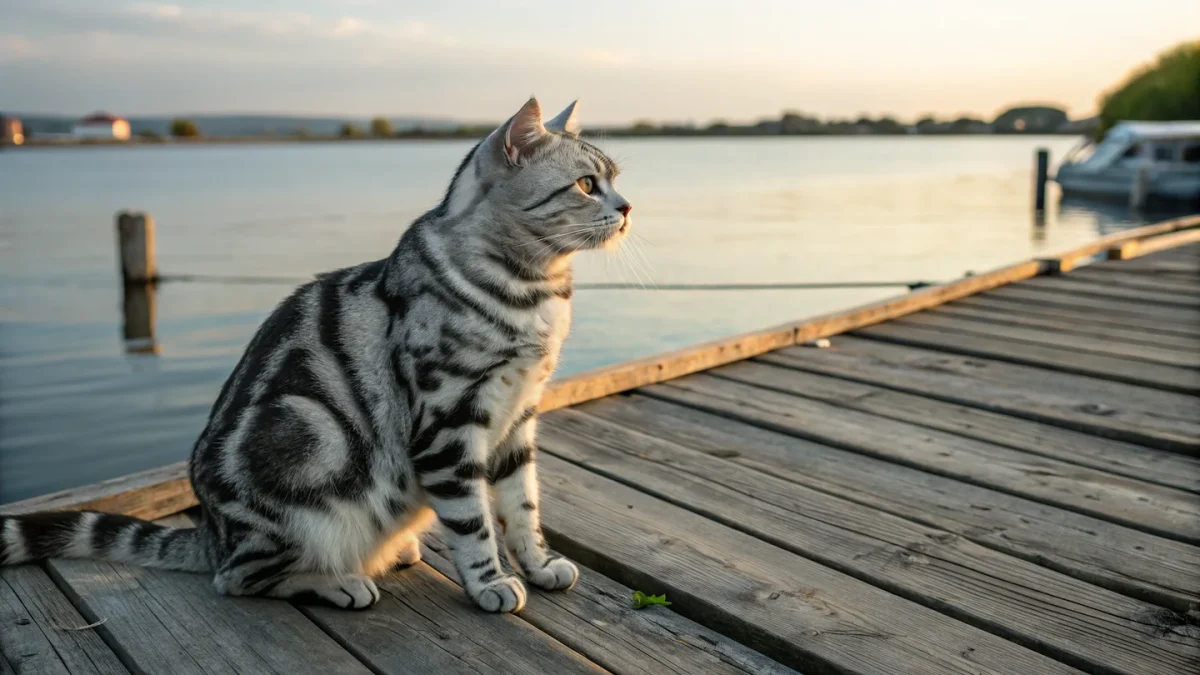
The Mayflower carried 102 passengers and enough provisions for a 66-day Atlantic crossing. The ship's records don't catalog every cat aboard, but ships of that era routinely carried working cats to protect grain stores from rats — the same rat populations that caused catastrophic losses on vessels without them. The cats that crossed with those early colonists were practical animals selected for competence. Three centuries later, their descendants became a recognized pedigreed breed.
The complete American Shorthair breed guide covers the full picture of what the breed is today. This article is specifically about the journey from colonial working cat to show hall.
Three Centuries of Selection
The cats that arrived with European settlers in the 17th century were generalist working animals — pest controllers, ship crew, farm residents. They interbred across the continent over the following centuries, producing the broad, genetically diverse population that would eventually be called the American Shorthair.
Selection pressure during this period wasn't aesthetic. It was functional: cats that caught rats survived and reproduced; cats that didn't were less valuable and less protected. Cold North American winters selected for the dense double coat. Life in working environments selected for physical sturdiness and adaptability. The result was an animal whose practical qualities were excellent long before anyone thought about breed standards.
By the 19th century, North America had a large, genetically diverse population of short-haired working cats with similar characteristics — the broad head, the dense coat, the sturdy build — produced by generations of natural selection rather than deliberate breeding.
The Cat Fancy Arrives
The American cat fancy organized in earnest in the late 19th century. The first major American cat show was held in Madison Square Garden in 1895, and the Cat Fanciers' Association was founded in 1906. British Shorthairs — an already-formalized breed from the English cat fancy — were being exhibited, and American fanciers recognized that the best native working cats had comparable or superior qualities.
The first cat registered as an American Shorthair (then called Domestic Shorthair) with the CFA was an imported British Shorthair male named Belle — an irony in the breed's history, since the foundational registered animal wasn't the native working cat the breed was supposed to represent. Early breed development in the United States used British Shorthair imports to refine the American working cat's type, introducing the rounder head and more consistent body type of the British breed.
This wasn't unusual in cat fancy history — early breed development frequently involved importing animals to set type, then selecting the best native animals against that standard.
The Silver Tabby and the Show Hall
The American Shorthair's most iconic look — the silver tabby with bold classic markings — became closely associated with the breed's show presence in the mid-20th century. Silver Tabby American Shorthairs regularly won Best in Show at major CFA events, and the image of the bold-marked silver tabby became the public face of the breed.
A CFA Best Cat win by a silver tabby American Shorthair — Shawnee Trademark, in 1965 — brought significant attention to the breed at a time when it needed it — the cat fancy was increasingly focused on exotic imported breeds, and the homegrown American Shorthair risked being overlooked as insufficiently glamorous.
The 1966 Rename
The most consequential administrative decision in American Shorthair history was the 1966 rename from Domestic Shorthair to American Shorthair. The original name was generic enough to describe any short-haired mixed-breed cat, which created persistent confusion: anyone with a tabby cat of unknown lineage could plausibly call it a Domestic Shorthair and claim the breed's characteristics for their pet.
The new name did what it needed to: it identified the breed's geographic origin, distinguished it from the British Shorthair, and made clear that a pedigreed American Shorthair was a specific, documented animal rather than a description of any mixed-breed domestic cat. The cultural lag from 60 years of the old name still produces occasional confusion, but the categorical distinction is now well-established in cat fancy usage.
The Breed Today
What what American Shorthairs are like to live with today describes is a temperament shaped by this history — the adaptability, the balanced sociability, the practical sturdiness — that reflects the centuries of functional selection before the breed entered the show hall.
The working cat didn't stop being a working cat when it got a breed standard. It became a breed standard that captured what working cats were like after centuries of doing their job well. The American Shorthair is the cat that competence produced, formalized.