

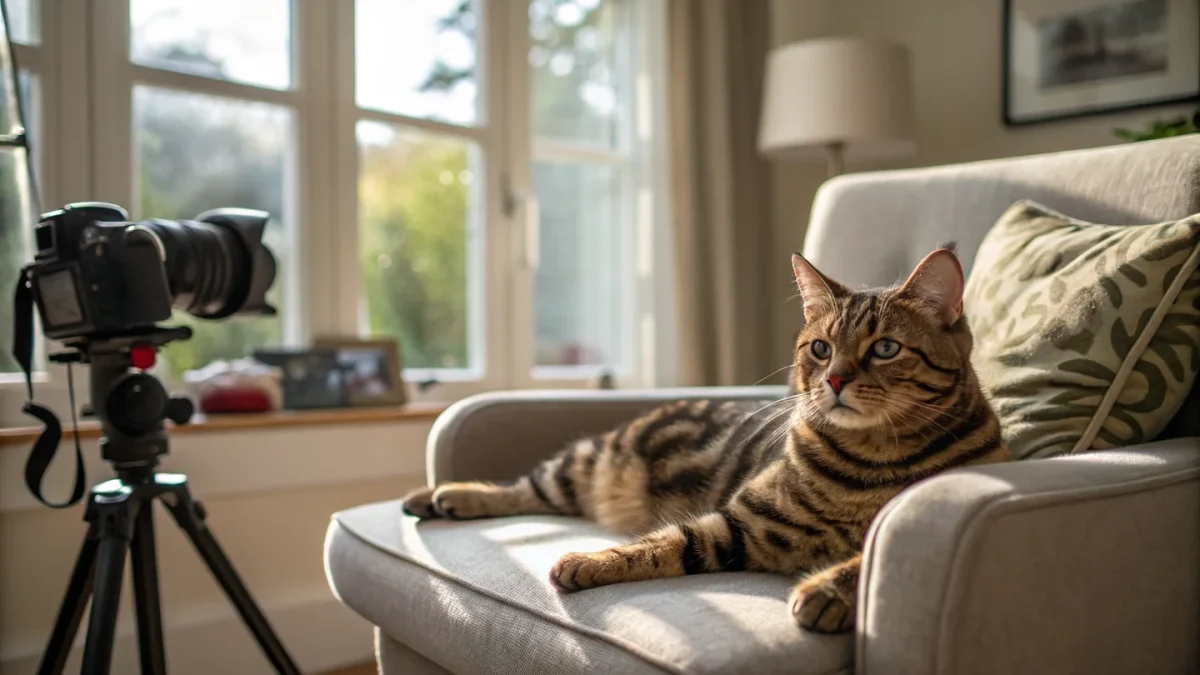
There's a cat breed that doesn't lead with drama or extremity — that doesn't announce itself with exotic looks, relentless demands, or the kind of personality that makes social media videos. It's been around longer than most American institutions, has sailed on more ships than most sailors, and has been quietly excellent company for a wider range of people than any other breed I can think of. For background on how this breed developed, the American Shorthair's breed history and origins tells the full story. What I want to address here is the temperament — specifically why "balanced" is both the most accurate and the most underselling word for what this breed actually delivers.
The Balance: What It Actually Means
The American Shorthair is often described as a balanced cat, and this is correct but easily misread as meaning "mediocre at everything." It means something more precise: the American Shorthair has traits that most people want from a cat companion — sociability, playfulness, affection, independence — without any single trait being pushed to an extreme that creates management challenges.
The Siamese family is extremely vocal. The Devon Rex is extremely social. The Persian is extremely sedentary. The Bengal is extremely active. The American Shorthair sits at the practical center of these spectrums, which sounds like compromise but is actually a distinct and valuable position.
You get a cat that is sociable enough to be genuinely companionable, but not so demanding that solitude is a crisis. Playful enough to be engaging, but not so frenetic that it wears you out. Affectionate enough that the relationship feels warm and reciprocal, but independent enough that it doesn't perform separation anxiety every time you leave the room.
This balance isn't accidental. It's the product of centuries of natural selection for functional temperament — working cats selected for competence and coexistence, not for extreme traits that suited a specific show standard.
Sociability: The Quiet Engagement
The American Shorthair is social in a way that many experienced cat owners describe as "just right." They want to be in the same space as their people. They'll follow from room to room with mild interest, choose to sleep within arm's reach, and greet arrivals with apparent pleasure. They're responsive to their names and learn household routines reliably.
What they don't do is demand. The American Shorthair doesn't sit on your keyboard until you pay attention, doesn't wake you at 4 AM for play, doesn't vocalize in extended complaint about routine inconveniences. The engagement is offered rather than insisted upon — a cat that makes itself available and is clearly pleased when contact happens, but doesn't perform distress when it doesn't.
For people who've had needy cats and found the relentlessness exhausting, this is a revelation. For people who've had very aloof cats and found the distance disappointing, the American Shorthair's warmth feels like exactly what was missing.
Adaptability: The Underrated Superpower
If I had to identify the single most practically valuable thing about American Shorthair temperament, it would be adaptability.
These cats recalibrate to their household. A quiet single-person apartment produces an American Shorthair that is calm, settled, and comfortable. A busy family home with children, dogs, and irregular schedules produces an American Shorthair that is more engaged, more actively playful, and socially fluent with the chaos. The same genetic temperament expresses differently based on environmental cues, and the cat adjusts rather than resisting.
Most breeds have an optimal household type. The Devon Rex needs social engagement and a companion animal. The Persian needs quiet and a predictable routine. The Oriental Shorthair needs near-constant interaction. The American Shorthair's optimal household type is "inhabited by humans who are reasonably present and reasonably engaged."
This adaptability extends to major household changes. New family members, new pets, changed schedules, relocations — American Shorthairs handle these disruptions with more equanimity than most breeds. They take longer to settle fully in a new environment than, say, a confident Bengal, but they get there without extended stress responses.
The Independence Quality
The American Shorthair's independence is one of its more misunderstood traits. Some prospective owners hear "independent" and interpret it as "standoffish" or "won't form a real attachment." Neither is accurate.
These cats do form real attachments — genuine, warm, specific bonds with the people they live with. The independence is about what they need from those bonds, not whether the bonds exist. An American Shorthair doesn't need to be touching its person to feel secure. It doesn't need vocal affirmation of the relationship. It can occupy a different room for several hours without distress and reunite with its person without drama on either side.
This independence is, for many people, a feature. The American Shorthair can be left alone for a working day without the behavioral fallout that more socially dependent breeds experience. They entertain themselves adequately with toys, window access, and whatever else the house provides. They don't require a companion animal the way Devon Rex or Oriental Shorthairs do, though they're generally fine with other cats and dogs.
Play and Activity: The Functional Drive
The American Shorthair's play drive is genuine and has a quality that reflects its working ancestry — when they hunt (or simulate hunting with a toy), they're purposeful about it. Wand toys with irregular, prey-like movement engage them well. A fishing rod toy dragged across the floor with unpredictable changes in direction gets serious, focused play.
The activity level is moderate across the lifespan but with clear variation by age. Kittens and young adults (under 3 years) are substantially more active than mature adults. The transition from energetic young cat to composed adult happens gradually and produces a cat that is still playful when play is offered, still capable of impressive athletic expression, but no longer feeling compelled to demonstrate it at every hour.
Many American Shorthairs show strong prey drive toward small, fast-moving things — insects, small toys, the occasional small mouse. The working cat heritage is intact. Owners who provide adequate play outlets see this drive expressed productively; owners who don't may see it redirected onto other household animals or objects.
With Children: The Gold Standard
If one thing stands out in accounts of the American Shorthair's social temperament, it's how consistently good they are with children.
The combination of patience, physical sturdiness, and low reactivity to rough handling makes them the closest thing to an all-ages cat. They tolerate the irregular, sometimes grabby interaction style of toddlers far better than most breeds. They're sturdy enough not to be injured by normal play. And critically, when a child crosses the line — too loud, too rough — the typical American Shorthair removes itself rather than escalating. This is the safety behavior that most matters with young children, and it's reliable in this breed.
With older children, the American Shorthair's moderate play drive is well-matched. They'll play catch-the-toy with a ten-year-old without the speed differential that makes playing with, say, an Abyssinian overwhelming for a child. They're present, engaged, and age-appropriate.
With Dogs: The Practical Compatibility
American Shorthairs are not dogs, but they've been living alongside dogs since before anyone was keeping records. The historical working context involved dogs and cats sharing space in barns and ships and farmhouses, and the American Shorthair's equanimity around dogs reflects that coexistence.
They're not easily spooked into flight, which is the behavior that most activates prey-chasing in dogs. A calm, confident American Shorthair walking past a dog that's giving it attention is communicating "I am not prey" effectively. This doesn't make them compatible with every dog — high-prey-drive breeds and specific training histories matter — but they start from a better behavioral position than most cats.
The Observation Quality
One thing that takes American Shorthair owners by surprise is how attentive these cats are. The composed exterior sometimes reads as passive or uninterested. Watch more closely, and you find a cat that is tracking everything: where people are in the house, what activities are happening, what patterns vary from normal. The round eyes miss very little.
This attentiveness means the American Shorthair adapts quickly to specific patterns of household life. They learn feeding time reliably, recognize specific sounds as precursors to events (the opening of a particular cabinet, the specific jingle of a key ring), and position themselves appropriately before things happen. It's the intelligence of a working cat — practical, pattern-oriented, constantly updated.
What the Temperament Adds Up To
The American Shorthair temperament, taken whole, produces something genuinely valuable: a cat that fits into your life rather than requiring your life to accommodate it. Not a passive or uninteresting cat — an attentive, warm, playful, genuinely present cat. But one whose needs and expressions fall within the range that most households can provide without restructuring.
That's a higher bar than it sounds. Many breeds with spectacular qualities come with requirements that restrict who can appropriately keep them. The American Shorthair's temperament is excellent enough to be a real first choice, and moderate enough to be a realistic one.