

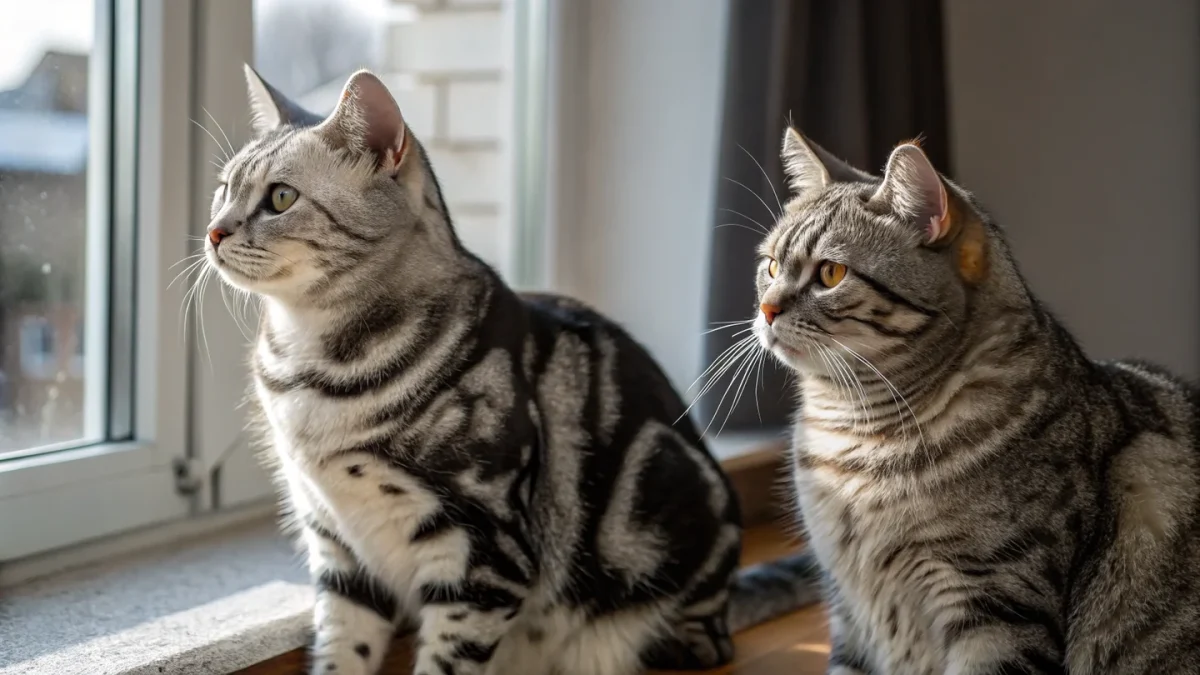
The question comes up constantly: someone has a cat that looks like what they've been told is an American Shorthair, and they want to know if it actually is one. The confusion is understandable and historically well-founded — until 1966, the pedigreed breed was called the Domestic Shorthair, creating decades of naming overlap that still produces confusion today.
For the full history of the American Shorthair as a breed, American Shorthair history and breed development covers it completely. This article focuses on the practical distinction between the pedigreed breed and the general mixed-breed population.
The Categorical Difference
American Shorthair: A pedigreed breed with a documented breed standard, a registry system, and traceable lineage. Breeders working with American Shorthairs maintain pedigree records that connect their cats to the founding stock of the breed. Cats sold as American Shorthairs are typically accompanied by registration papers. The breed standard specifies structural characteristics that distinguish it: the rounded head with full cheeks, the medium-to-large cobby build, the specific coat texture.
Domestic Shorthair: A catch-all term for any mixed-breed cat with a short coat. No standard, no lineage documentation, no predictable traits beyond "short coat." The domestic shorthair is not a breed — it's a description of coat length applied to the majority of cats in the world.
The distinction matters for consistency. A pedigreed American Shorthair has predictable size, temperament, coat type, and health predispositions. A domestic shorthair of similar appearance might be larger or smaller, more active or more reserved, with different health tendencies — all depending on the specific mix of breeds in its ancestry, which is typically unknown.
What an American Shorthair Actually Looks Like
The American Shorthair breed standard describes specific characteristics that separate the breed from a generic mixed-breed tabby:
Head: Large, round, and full-cheeked — not narrow or fine-featured. The head is slightly longer than wide, with a squared muzzle that's distinctly American Shorthair in profile. The cheeks are notably full compared to most domestic shorthairs.
Body: Medium to large, cobby and powerful. Males especially are substantially built — 11-15 pounds is typical, with a broad chest and strong musculature. This is a significantly bigger, more substantial cat than the average mixed-breed domestic shorthair.
Coat: Short to medium, dense, and with a hard texture — resilient rather than soft. The density is genuine and functional; running your hand against the coat's direction reveals substantial undercoat resistance. A domestic shorthair's coat is often softer and less dense.
Eye shape: Round and large, set wide apart. In silver tabbies specifically, vivid green is the standard.
Classic tabby pattern: The American Shorthair's most iconic coat pattern features bold, clearly defined blotches (classic tabby) rather than thin stripes. The markings are crisp and high-contrast.
The "Is My Cat an American Shorthair?" Reality
Many people with non-pedigreed cats that happen to have a strong American Shorthair phenotype wonder if their cat is "really" an American Shorthair. The genetic answer is probably "partly" — the domestic shorthair population contains a lot of American Shorthair genetics, given centuries of interbreeding. But without registry papers and documented lineage, the cat is a domestic shorthair regardless of how closely it resembles the breed standard.
This doesn't make the cat inferior. Domestic shorthairs can be wonderful companions, often live long healthy lives, and — because they typically represent a broader genetic mix — may have better genetic diversity than some pedigreed breeds. The question of whether a specific cat is "really" an American Shorthair is mostly relevant to people who care about pedigree documentation, show eligibility, or predictable breeding outcomes.
When the Distinction Matters
For buyers: If you want an American Shorthair specifically — for the breed's predictable temperament, health, and physical characteristics — buy from a documented pedigree source. A cat sold without papers as an "American Shorthair" is either a domestic shorthair or a misrepresentation.
For temperament prediction: The American Shorthair temperament characteristics describes traits that are reliable in pedigreed individuals. Mixed-breed domestic shorthairs can absolutely have similar temperaments, but there's no guarantee — their traits depend on the full breadth of their genetic background.
For health screening: The HCM predisposition documented in American Shorthairs is breed-specific. Domestic shorthairs have HCM risk too, but it's not the same elevated, documentable breed risk that American Shorthair breeding programs screen for.
For casual ownership: For someone who simply wants a short-haired, manageable, reasonably healthy companion cat and doesn't need documentation or predictability — a domestic shorthair is a perfectly excellent choice, often available from shelters with minimal cost and the additional benefit of providing a home to a cat that needs one.
The Name Change Residue
The 1966 rename from Domestic Shorthair to American Shorthair solved the industry problem (pedigreed breed vs mixed breed naming confusion) but created a cultural lag. Fifty years later, people still sometimes use "domestic shorthair" and "American Shorthair" interchangeably in casual speech, and the internet hasn't fully resolved the usage.
The technical distinction: "Domestic Shorthair" now means any short-coated mixed-breed. "American Shorthair" means the pedigreed breed with documented lineage. They're not the same thing, and the difference is worth maintaining.