

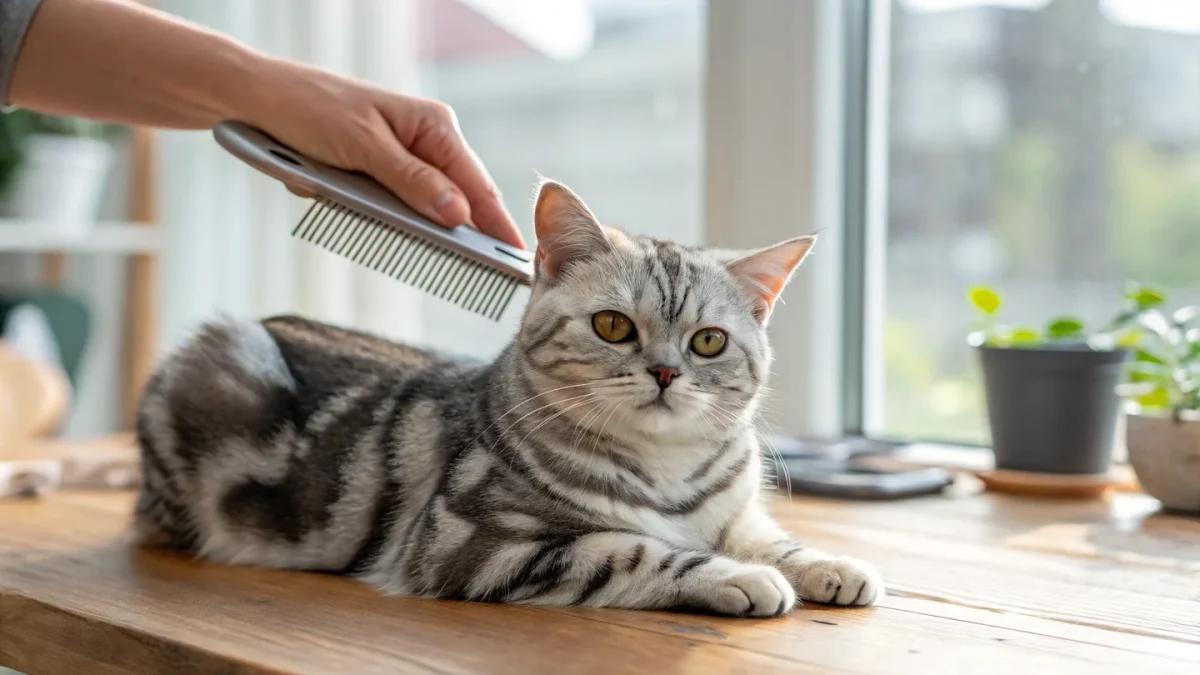
The American Shorthair's coat reflects its working-cat heritage: dense, hard-textured, and built to handle practical life. For the breed's full background, American Shorthair breed history and coat characteristics explains how centuries of natural selection produced a coat type optimized for function rather than aesthetics.
The practical result for groomers: this is one of the least demanding cat coats available. No exotic tools, no specialized techniques, no daily commitment. The main event is spring shedding, and even that is more manageable than it is with heavy-shedding double-coated breeds.
The Weekly Routine
During most of the year, one to two brushing sessions per week is entirely sufficient for the American Shorthair's double coat.
Tools that work well: A rubber grooming glove removes loose hair efficiently while giving the cat what amounts to a massage — most American Shorthairs respond positively to glove grooming. A medium-tooth metal comb or a slicker brush with flexible pins also works well. The goal is to reach through the outer coat into the undercoat and remove the dead hair before it ends up on your sofa.
Technique: Work from the neck backward, following the coat's natural direction. The American Shorthair's coat is dense enough that you need to make contact with the skin rather than skimming the surface — press slightly through the outer coat to reach the undercoat where most of the loose hair accumulates.
Pay particular attention to the sides and back — where the coat is thickest — and to the base of the tail, where many shorthaired cats accumulate a little more undercoat than elsewhere.
The American Shorthair coat is naturally resistant to matting, which means you don't need to work through tangles the way you would with a longer or silkier coat. Grooming sessions are brief and straightforward.
Spring Shedding: The Annual Event
The American Shorthair's dense winter coat releases in spring, and this is when the breed's shedding is most noticeable. The shed typically runs for four to six weeks, during which loose undercoat appears in quantity on furniture, clothing, and in the air.
Increase to daily brushing during this period. A deshedding comb designed for double-coated cats — with teeth that reach through the outer coat to remove undercoat specifically — is more efficient than a standard brush during heavy shedding.
A bath at the beginning of shedding season loosens the coat and accelerates the release, compressing the shedding window. Use a cat-appropriate shampoo, rinse very thoroughly, and dry the cat fully afterward — the dense coat takes time to dry completely, and a damp undercoat in cool conditions is uncomfortable for the cat.
Outside the spring window, year-round shedding is moderate and entirely manageable with weekly brushing. American Shorthairs don't shed the chronic background level that some breeds with continuous undercoat turnover produce.
Bathing
Unless the cat gets into something it shouldn't, the American Shorthair's coat is largely self-maintaining between annual or semi-annual baths. The dense, slightly hard-textured outer coat is reasonably water-resistant and doesn't accumulate dirt and oil the way fine coats or very long coats do.
When bathing is needed: use a cat-appropriate shampoo, work it through the coat to the skin (the density makes this take a few minutes), rinse very thoroughly, and dry with warm towels. The dense undercoat retains moisture longer than it appears to from the outside.
Ears, Nails, Teeth
Ears: Monthly inspection and cleaning as needed. The American Shorthair doesn't have the elevated ear wax accumulation risk of floppy-eared breeds or the architectural ear issues of some others. A gentle wipe with a cotton ball when you see accumulation is sufficient.
Nails: Every two to three weeks. The American Shorthair is not unusually destructive with nails, but routine trimming prevents overgrowth and reduces accidental scratching during play.
Dental hygiene: The American Shorthair has normal jaw structure with no crowding risk, but dental hygiene remains worthwhile. Tooth brushing introduced gradually as a kitten habit, or dental treats and water additives as supplementary support.
What Good Coat Condition Looks Like
A well-maintained American Shorthair coat lies close and slightly hard to the touch, with a density you can feel when running your hand from rump to neck against the coat's direction. In silver tabbies, the tabby markings are distinct and clear. In solid-colored individuals, the coat has a clean, dense appearance without dullness or patchiness.
Coat dullness, patchy appearance, or excessive shedding outside the spring window can indicate nutritional issues, stress, or underlying health concerns. The coat is a reliable general health indicator in this breed — attend to changes that aren't explained by season. For everything beyond grooming — temperament, compatibility, and what living with this breed actually requires — see the full American Shorthair ownership assessment.