

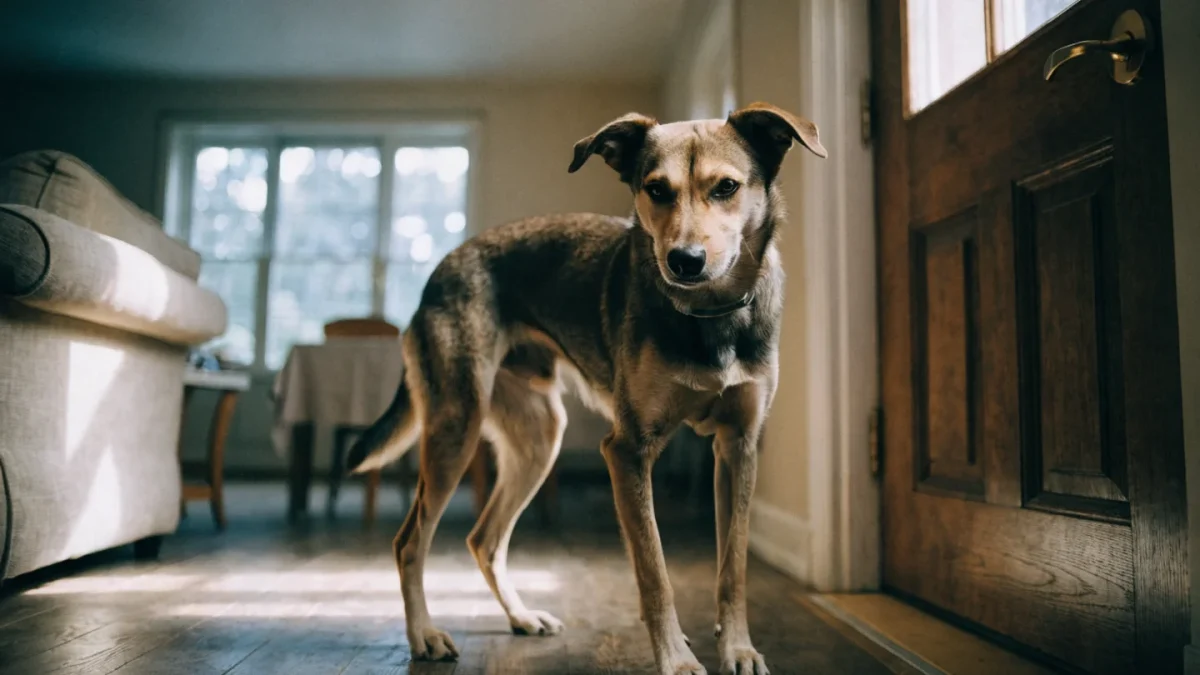
Roughly one in four dogs I see in my clinic shows signs of anxiety at some point in their life. Learn more about common dog health problems here. That's not a textbook number — it's what I've gathered from years of intake forms and conversations with owners who initially came in for something else entirely. A dog presented for chronic diarrhea turns out to be stress-related. A dog in for nail trims is trembling so badly the techs can barely hold the paw. Anxiety weaves itself into veterinary visits in ways that aren't always obvious.
Canine anxiety isn't one condition. It's a category, and the distinctions matter because treatment for separation anxiety looks quite different from treatment for thunderstorm phobia or generalized anxiousness.
Separation Anxiety
This is the one I diagnose most frequently. The dog is fine when the owner is home. The moment the owner leaves — or sometimes just starts the leaving routine (picking up keys, putting on shoes) — the dog panics. Destruction, house soiling, excessive vocalization, and attempts to escape are the hallmarks.
I treated a three-year-old Lab mix named Biscuit who'd destroyed two crate doors, bent the metal bars of a third, and cracked a tooth in the process. His owner thought he hated the crate. He didn't hate the crate. He was in full-blown panic about being alone, and the crate was just the thing between him and the door his person had walked through.
Separation anxiety exists on a spectrum. Some dogs whine a bit and settle after fifteen minutes. Others are in sustained distress for hours. Video evidence is invaluable here — I ask owners to set up a camera before they leave so we can see what's actually happening versus what the destruction suggests.
Noise Phobias
Fireworks and thunderstorms get the most attention, but dogs can develop phobias to any sudden or unpredictable sound. I've seen cases triggered by construction noise, gunshots in rural areas, and even the beeping of a delivery truck backing up.
What makes noise phobias tricky is that they tend to worsen with each exposure if left untreated. A dog who trembles during fireworks at age two might be crashing through windows at age five. The sensitization process works against you — every frightening experience deepens the association between that sound and panic.
There's also a seasonal component that catches owners off guard. Storm-phobic dogs often start showing anxiety before the owner even knows a storm is approaching. They're picking up on barometric pressure changes, static electricity buildup, or low-frequency thunder sounds that human ears miss.
Social Anxiety
Some dogs are anxious around unfamiliar people, other dogs, or both. This gets mislabeled as aggression all the time. A dog who lunges and barks at strangers on walks might not be aggressive — she might be terrified and using the only strategy that makes the scary thing go away.
I find social anxiety is underdiagnosed compared to separation anxiety because the symptom (reactivity) looks like a training problem rather than an emotional one. The treatment approaches overlap with pet mental health interventions for fear-based conditions — primarily desensitization at sub-threshold distances.
Poorly socialized puppies are at higher risk, but it's not a simple cause-and-effect. I've seen well-socialized dogs from excellent breeders develop social anxiety after a single traumatic event — a dog fight at a park, an aggressive encounter on a walk. One bad experience can undo months of positive socialization in a genetically predisposed dog.
Generalized Anxiety
This is the hardest to pin down. There's no single trigger — the dog just seems anxious about everything, all the time. Hypervigilant. Can't settle. Startles at minor environmental changes. Follows the owner from room to room. Sleeps lightly, wakes easily.
Generalized anxiety tends to have a stronger genetic component than other types. Certain breeds — herding dogs, working dogs bred for high alertness — show up in my anxiety cases disproportionately. That's not to say a Labrador can't have generalized anxiety, but I see a lot of border collies and German shepherds in this category.
Reading the Signals
The early signs of anxiety are easy to miss because they're so subtle. Before a dog escalates to destruction or vocalization, there's usually a period of:
Lip licking when there's no food around. Yawning when they're not tired. Whale eye — that crescent of white visible when the dog turns its head but keeps its eyes fixed on something. Tucked tail, lowered body posture, ears pinned back. Turning away from whatever's bothering them.
And then the things owners notice more easily: panting when it's not hot, pacing, drooling, trembling, refusing food (which is a significant red flag in a dog who normally inhales everything), and the inability to respond to known cues. If your dog knows "sit" perfectly but can't process the word during a thunderstorm, that's not disobedience. That's a brain flooded with stress hormones.
What Actually Works: Treatment by Type
For Separation Anxiety
Graduated departures are the backbone. You practice leaving for very short durations — thirty seconds, a minute, three minutes — and return before the dog hits panic threshold. Over weeks, you extend the duration. It's tedious. It works.
Medication accelerates this process significantly for moderate to severe cases. Fluoxetine (a daily SSRI) combined with trazodone for situational use during longer departures is my most common protocol. I used to be hesitant about medication. I've watched too many dogs suffer through pure behavioral approaches that weren't enough.
What doesn't work: flooding the dog by just leaving for eight hours and hoping they "get over it." Punishment for destruction that happened while you were gone. The dog connected your departure with panic — they won't connect your anger with the shredded couch.
For Noise Phobias
Noise desensitization recordings can help if you start at very low volumes and increase gradually over weeks. Pair the sounds with high-value treats or play.
During actual noise events, create a safe space — interior room, white noise, blackout curtains. Some dogs do well with pressure wraps. Medication for known events (fireworks holidays, storm season) is reasonable and not a failure.
For Social and Generalized Anxiety
These require the most patience. Structured exposure at sub-threshold levels, predictable daily routines, and often long-term medication. Environmental enrichment matters too — a dog with generalized anxiety who's also under-stimulated is in worse shape than one who has appropriate outlets.
I've had good results combining daily fluoxetine with targeted behavioral work for generalized anxiety. It's a slow process — we're talking months, not weeks — but the improvements tend to hold.
FAQ
Can puppies grow out of anxiety?
Some mild fearfulness during developmental periods does resolve with appropriate socialization and positive experiences. But established anxiety disorders rarely self-resolve — they're more likely to intensify. If your puppy shows persistent anxiety signs beyond the normal wariness of new things, address it early rather than waiting.
Is anxiety more common in rescue dogs?
Rescue dogs do show higher rates of separation anxiety and noise phobia in most studies, likely due to a combination of early life stress, rehoming disruption, and unknown genetic backgrounds. But I've treated plenty of anxious dogs from breeders too. Early life experience matters, genetics matter, and sometimes anxiety develops in dogs with perfectly fine histories.
Will getting a second dog help my anxious dog?
Sometimes, but I'd never recommend it as a treatment strategy. If the anxiety is specific to being alone, a companion might help — or it might give you two anxious dogs. If the anxiety is generalized or noise-based, a second dog won't address the underlying condition. Get the first dog's anxiety managed before adding complexity to the household.