

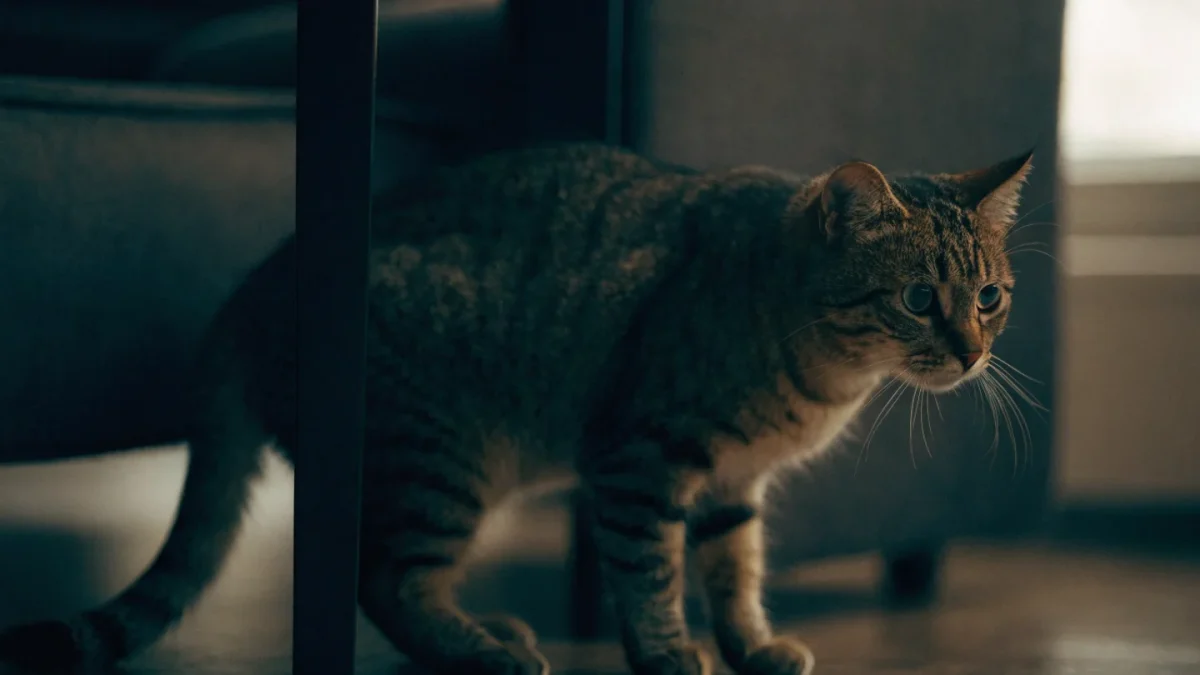
The most anxious cat I ever treated didn't look anxious at all. Oliver was a five-year-old domestic shorthair whose owner described him as "low maintenance — just sleeps a lot." She'd brought him in because he'd lost two pounds over three months. Blood work, urinalysis, thyroid panel — all normal. It wasn't until I asked about his daily routine that the picture formed: Oliver spent twenty-two hours a day under the bed. He ate at 3 a.m. when the household was asleep. He hadn't played with a toy in over a year.
Oliver wasn't low maintenance. He was chronically stressed, and he'd been that way so long his owner thought it was personality.
This is the fundamental challenge with feline anxiety. Dogs pace, whine, destroy furniture — they make their distress obvious. Cats just… vanish. Or they sit in a corner looking perfectly composed while their cortisol levels are through the roof.
Why Cats Hide Stress So Well
Evolution explains a lot here. Cats are mesopredators — they're predators of smaller animals and prey for larger ones. Showing weakness or vulnerability in the wild attracts the wrong kind of attention. A limping gazelle gets eaten. A cat who broadcasts distress might too.
So cats developed an extraordinary capacity to mask pain, fear, and stress. This served them well in the wild. In our living rooms, it means a cat can be deeply unwell — physically or emotionally — and we won't know until the coping mechanisms fail.
The signs that do emerge are easy to misinterpret. A cat who stops using the litter box gets labeled "spiteful." A cat who hisses at a new kitten gets labeled "mean." A cat who hides gets labeled "independent." I can't count how many times I've heard "she's always been like that" about a cat who's been stressed for years.
Common Triggers
Cats are territorial animals who value predictability, control, and personal space. Anything that disrupts those three things can trigger stress.
Environmental changes top the list. Moving to a new home is a big one — cats form attachments to territory more than many owners realize. But even smaller changes register: new furniture, renovations, a different brand of litter, a new air freshener. I had a client whose cat stopped eating for three days after they replaced the living room carpet. The scent landscape of her entire territory had changed overnight.
Other cats are the most common chronic stressor I see. Multi-cat households where cats don't have enough separate resources — food stations, water bowls, litter boxes, resting spots — create ongoing tension that humans often can't see. Two cats sharing a space without overt fighting doesn't mean they're getting along. One might be silently intimidating the other away from the litter box, the food bowl, or the sunny window spot.
Unpredictable schedules affect cats more than most people assume. An owner who works variable shifts, frequent visitors, a baby arriving, a family member moving out — these changes to the household rhythm register with cats who've built their daily patterns around predictable human activity.
Veterinary visits and travel are acute stressors for most cats. The carrier, the car, the clinic smells — it's a perfect storm of territorial displacement and unfamiliarity.
The Subtle Signs
I've started telling my clients to think of cat stress signals as a volume dial, not an on-off switch. The early signs are turned down low:
Increased hiding or time spent in unusual locations. A cat who used to sleep on the couch now sleeps in the closet. Subtle appetite changes — eating slower, eating less, or eating only when no one's watching. Decreased interaction with family members. Less play. More sleeping.
Then the volume increases. Over-grooming — especially the belly, inner thighs, and forelegs — to the point of creating bald patches. Or the opposite: a cat who stops grooming and looks unkempt. Inappropriate elimination. Spraying. Aggression toward other household pets or, less commonly, toward people.
At high volume, you get physical symptoms. Stress-related cystitis (bladder inflammation without infection), vomiting, diarrhea, weight loss. These send owners to the vet, which is good — but by this point the stress has been building for a while.
One thing I look for that owners rarely notice: pupil dilation. A stressed cat in a familiar, well-lit environment will often have dilated pupils. It's the sympathetic nervous system on alert, and it's one of the most reliable indicators I use during exam room assessments. For related context, see anxiety in dogs: types, triggers.
What Actually Helps
Resource Multiplication
In multi-cat homes, the formula is simple: one of everything per cat, plus one extra. Litter boxes, food stations, water sources, resting spots. And these need to be genuinely separate — two food bowls side by side doesn't count.
I find vertical space is underrated. Cats who have access to shelving, cat trees, or high perches have more options for avoiding conflict and feeling secure. A three-cat household with no vertical space is functionally smaller than a one-cat household with ceiling-height climbing options.
Environmental Enrichment
Bored cats and stressed cats overlap significantly. Puzzle feeders, rotating toy selection, window perches with bird feeder views, supervised outdoor access (catios), and dedicated daily play sessions — these aren't luxuries. For indoor cats, they're as important as mental health conditions in pets interventions.
Play sessions are particularly effective because they engage the predatory sequence: stalk, chase, pounce, "kill," eat. A wand toy session followed by a meal mimics the natural hunting cycle and provides a dopamine reward that directly counteracts stress.
Pheromone Products
Synthetic feline facial pheromone has the best evidence base of any over-the-counter calming strategies for anxious cats product for cats. It doesn't work miracles, but multiple studies show modest reductions in stress-related behaviors, particularly spraying and hiding. I use it as one component of a broader plan, not as a standalone fix.
Medication
For moderate to severe feline anxiety — especially when there's self-harm from over-grooming or recurrent stress-related cystitis — medication is appropriate. Fluoxetine is my most commonly prescribed option for cats. Gabapentin works well for situational anxiety (vet visits, travel). Both require veterinary oversight and monitoring.
I've had owners resist the idea of putting their cat on psychiatric medication, and I understand the hesitation. But I've also watched severely stressed cats transform on appropriate medication — start eating normally, emerge from hiding, begin playing again for the first time in months. The quality of life improvement can be dramatic.
FAQ
My cat hides when visitors come over — is that anxiety or normal introversion?
It depends on the baseline and the recovery time. A cat who retreats during a dinner party and reemerges an hour after guests leave is managing social stress normally. A cat who hides for 24 hours after a brief visitor, or who shows other stress signs (appetite changes, litter box issues) around visits, may have anxiety that warrants attention.
Can indoor-outdoor cats be stressed?
Absolutely. Outdoor access introduces its own stressors — territorial conflicts with neighborhood cats, encounters with predators, exposure to unpredictable stimuli. I've seen cats develop anxiety specifically related to outdoor encounters that then bleeds into their indoor behavior. Indoor-only cats face different stressors (boredom, lack of stimulation) but aren't exempt from anxiety either.
How quickly do calming interventions work for cats?
Environmental changes and pheromone products may show effects within a few days to two weeks. Behavioral medication like fluoxetine takes four to six weeks to reach full effect. The timeline also depends on how long the stress has been present — a cat who's been chronically stressed for two years won't recover as quickly as one dealing with a recent acute stressor.