
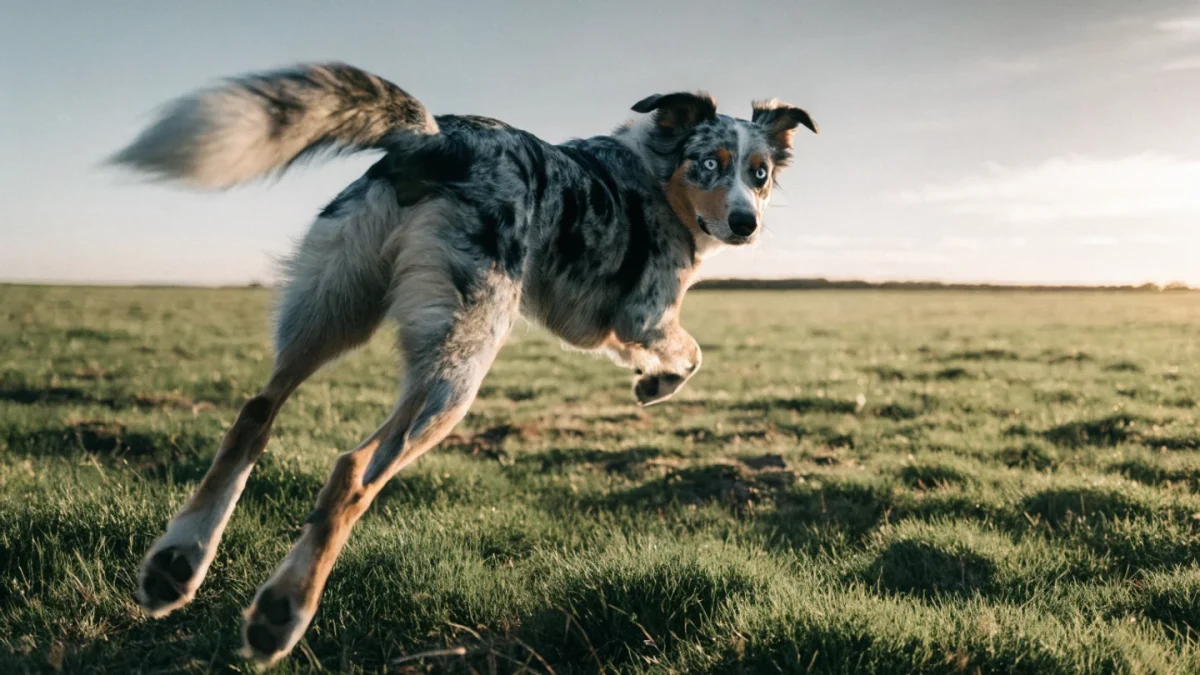
The Australian Shepherd was built to work an eight-hour day on rough terrain, making independent decisions about livestock management while covering ground that would exhaust most humans by noon. No pet owner needs to replicate that workload. But understanding the athletic and cognitive baseline this breed was designed for explains why a thirty-minute walk and a tennis ball don't come close to meeting australian shepherd exercise needs.
This is a breed where the gap between minimum and ideal is wide, and where the type of activity matters as much as the duration.
The Numbers
An adult Australian Shepherd in good health needs a minimum of 90 minutes of daily exercise. Some individuals — particularly dogs from working lines with strong herding drive — need closer to two hours. This isn't a phase they grow out of. Aussies maintain high energy levels from adolescence through middle age, and many are still demanding serious exercise at eight or nine years old.
Split activity across at least two daily sessions. A morning session of 40 to 60 minutes and an afternoon or evening session of similar length works for most households. A single long outing is less effective than two separated sessions because the mental reset of returning home and heading out again provides its own stimulation.
Puppies need less structured exercise but more frequent short activity periods. The standard guideline of five minutes per month of age, twice daily, provides a reasonable starting framework. A four-month-old puppy gets roughly 20 minutes per session. Over-exercising growing puppies — especially with repetitive impact activities on hard surfaces — risks damage to developing joints in a breed already predisposed to hip dysplasia.
Physical Exercise Alone Isn't Enough
Here's the mistake most first-time Aussie owners make: they think the problem is physical energy that needs burning off. They jog with the dog, throw the ball until their arm gives out, and then wonder why the dog is still pacing the house at 9 PM.
Physical exercise is necessary but insufficient. Australian Shepherds are herding dogs — bred to make decisions, solve problems, and manage complex situations in the field. Their brains need work as much as their bodies do. A physically exhausted Aussie with an idle brain is still going to find projects. Those projects will be your couch cushions, your garden beds, or your other pets.
The complete Australian Shepherd breed guide covers the temperament drivers behind this — the handler focus, the herding instinct, the need for structured engagement. From an exercise standpoint, the practical implication is that every activity should engage both body and mind.
What Works
Herding lessons and livestock work. Nothing matches the breed's design specification like actual herding. Even once-weekly sessions on sheep or ducks produce a noticeable calming effect for the rest of the week. Access to livestock isn't universal, but if it's available, this is the single most effective exercise for the breed.
Agility and obstacle courses. The combination of speed, handler communication, and route decision-making fits the Aussie brain perfectly. Competitive agility is one of the breed's strongest sports — the top performers are routinely Australian Shepherds — but backyard obstacle setups work, too. Change the course regularly to prevent memorization.
Hiking on varied terrain. Different from road walking because the changing surfaces, inclines, and novel scents provide continuous mental input. Aussies are excellent trail dogs with the endurance and foot-toughness for serious hikes. Varied terrain keeps the brain engaged where flat pavement doesn't.
Structured training sessions. Fifteen minutes of focused advanced obedience, trick training, or scent work can tire an Aussie's brain more thoroughly than thirty minutes of fetch. Training satisfies the breed's need to work with its handler and problem-solve simultaneously.
Treibball and herding-substitute sports. Treibball — pushing large exercise balls into a goal on cue — channels the herding drive without livestock. It requires the dog to read the handler, make positioning decisions, and control its own movement. It's one of the best urban substitutes for actual herding work.
Puzzle feeders and enrichment. Not exercise in the traditional sense, but feeding meals through puzzle toys, snuffle mats, or scatter-feeding in the yard adds mental work to the daily routine. An Aussie that works for every meal is slightly more satisfied than one that eats from a bowl.
What Doesn't Work
A fenced yard with no human involvement. Australian Shepherds don't self-exercise in a meaningful way. Left alone in a yard, most will patrol the fence line, bark at passing stimuli, and dig. A yard is a nice perk, not a substitute for structured activity with a person.
Endless fetch with no variation. Repetitive ball-throwing produces a physically fit dog that's still mentally unsatisfied. Worse, it can create obsessive behavior around the ball — a fixation that looks like enthusiasm but is actually compulsive. Fetch is fine as one component of an exercise routine. It's inadequate as the entire routine.
Dog parks as the primary exercise strategy. Some Aussies do well at dog parks. Many don't. The breed's temperament includes a herding instinct that can express as controlling other dogs' movements, plus a natural reserve with strangers that can read as reactivity in a chaotic environment. Dog parks are unpredictable, and Aussies generally prefer structured activity with their handler over unstructured group play.
Signs of Insufficient Exercise
An under-exercised Australian Shepherd is not subtle about it. Watch for:
- Pacing, circling, or inability to settle in the house
- Herding behavior directed at children, other pets, or household objects
- Excessive barking, especially directed at windows or passing stimuli
- Destructive behavior — chewing, digging, dismantling objects
- Attention-seeking escalation — bringing toys, nudging, nipping
- Obsessive behaviors — tail chasing, shadow chasing, fixation on light spots
These aren't personality problems. They're the predictable output of a working brain with nothing to work on. The solution isn't correction — it's meeting the need that's driving the behavior.
Adjusting for Age and Season
Senior Aussies slow down, but most still need 45 to 60 minutes of daily activity well into their later years. Reduce impact — swap running for walking, lower jump heights, prioritize swimming if available — but don't eliminate activity entirely. Mental exercise becomes proportionally more important as physical capacity decreases.
In extreme heat, shift exercise to early morning and late evening. Aussies carry a double coat that insulates against cold but can contribute to overheating during intense summer exercise. Swimming is ideal hot-weather exercise — cooling and low-impact simultaneously. In cold weather, most Aussies are perfectly comfortable and many prefer it.
The consistent theme across every age and season: the brain needs work. A physically limited Aussie that's getting regular mental stimulation through training, puzzles, and handler interaction will be a calmer, happier dog than a physically capable one running on an empty mental tank.