

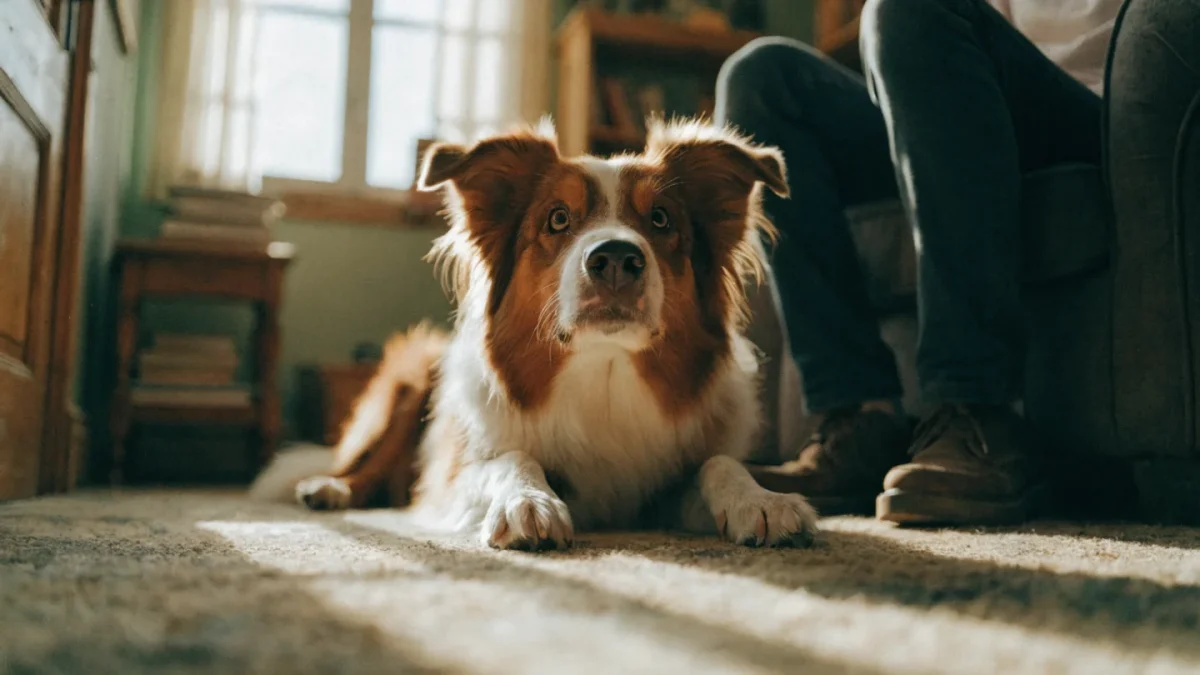
Can you handle a dog that watches you the way a working professional watches their most important client — constantly, attentively, reading every micro-expression for information about what comes next?
Because that's what living with an Australian Shepherd actually is. Not "energetic" — you knew that. Not "smart" — everyone says that. The thing most people underestimate is the surveillance. The Aussie has made you its project. It clocks when your posture changes near the door, when you reach for your keys versus your wallet, when the quality of your attention shifts from "home" to "going somewhere." Kit, my Brittany, watches me like this during hunts — absolutely locked in, waiting for any signal. But Kit has an off switch. She comes home and she's done. An Australian Shepherd doesn't fully have that off switch. They are working when you don't think they're working.
Understanding australian shepherd temperament personality means understanding why that quality exists, what it demands from an owner, and what happens when the dog can't find an outlet for it. The separation anxiety, the herding of children and cats and guests — it's all the same mechanism, searching for direction when the person it's oriented toward isn't there or isn't communicating clearly enough.
The Handler Bond
The first thing most new Aussie owners notice isn't the energy. It's the eye contact.
Australian Shepherds watch their people with a focus that borders on surveillance. They track your movements between rooms. They register when you shift your weight toward the door. They learn your daily patterns — when you reach for your shoes, when you pick up your keys, when you open the drawer where the leashes are stored — and they respond to those precursors before you've made a conscious decision to act.
This handler awareness has deep functional roots. Herding dogs work in partnership with a human, reading subtle physical cues across distances where voice commands don't carry. A slight hand gesture means flank left. A raised arm means hold. The dog has to watch constantly, interpret accurately, and respond instantly. That cognitive architecture doesn't retire when the dog moves from a ranch to a living room.
For the Australian Shepherd as a complete breed, this handler focus defines the ownership experience more than any other trait. The dog is attuned to your emotional state, your energy level, and your routines with a fidelity that many owners describe as uncanny. Some find it deeply rewarding — a level of connection that other breeds simply don't offer. Others find it suffocating.
Velcro, Not Clingy — The Distinction Matters
The "Velcro dog" label is accurate but often misunderstood. There's a difference between a dog that follows you because it's anxious without you and a dog that follows you because monitoring you is its job.
Healthy Australian Shepherd attachment looks like a dog that stays in your general vicinity, checks in visually, and settles when you settle. The dog might lie in the doorway of whatever room you're in, repositioning when you move. It watches you, but it's calm. It's working — processing your behavior, predicting your next action — but it's not distressed.
Unhealthy attachment looks different. Pacing when you leave the room. Vocalizing when you close the bathroom door. Destructive behavior when you leave the house. That's separation anxiety, and Australian Shepherds are among the breeds most prone to developing it. The line between the two isn't always obvious, and the transition from healthy bond to anxious dependency can happen gradually, especially if the dog spends its formative months with constant human access and then suddenly faces extended alone time.
The practical takeaway: Australian Shepherds need to learn to be alone. This isn't natural for them, and it requires deliberate, graduated training from puppyhood. Owners who are home constantly during the first year and then return to a regular work schedule often discover the problem too late.
Reserved, Not Shy — Stranger Behavior
Golden retrievers greet strangers like long-lost family. Australian Shepherds do not.
The typical Aussie response to an unfamiliar person is watchful assessment. The dog notices the stranger, evaluates them from a distance, and waits. It may approach eventually, or it may not. This isn't fear. It's discernment. Australian Shepherds were working ranch dogs in environments where unfamiliar people and animals needed to be assessed before interaction, and that wariness remains in the breed's behavioral template.
Well-socialized Aussies warm up once they've evaluated the situation. Poorly socialized Aussies can become shy or reactive — backing away from new people, barking at unfamiliar situations, or refusing to settle in novel environments. The breed's natural reserve requires dedicated socialization during the critical period of 3 to 14 weeks, and continued exposure throughout adolescence. Without it, that discernment hardens into something less manageable.
Compare this to a Labrador, which tends to approach everyone with identical enthusiasm, or a beagle, whose pack-bred sociability makes it equally friendly with strangers and family alike. The Aussie's selectivity is part of its character, not a flaw — but it requires more social investment from the owner to prevent it from becoming problematic.
The Herding Brain Never Clocks Out
Australian Shepherds think in terms of movement control. Where are things going? Can I influence their trajectory? Should I intervene?
In a working context, this manifests as a dog that circles livestock, pushes them into formation, and holds them in place through a combination of positioning, eye contact, and occasional physical contact. It's beautiful to watch — precise, intelligent, collaborative.
In a household, the same instinct applies to whatever is moving. Children running through the backyard become stock to be gathered. The cat crossing the living room becomes a wayward animal to redirect. Joggers passing the fence become escaped charges to manage. The nipping that accompanies this behavior — a quick heel-grab that's effective on sheep and alarming on humans — is one of the most common complaints from first-time Aussie owners.
This isn't behavior you can train away entirely. You can redirect it. You can manage it. You can provide appropriate outlets — herding lessons, structured games with rules, treibball — that give the dog sanctioned targets for its drive. But the underlying instinct is always present, and owners who expect it to disappear with training are misunderstanding the breed at a fundamental level.
Sensitivity: The Double-Edged Trait
Australian Shepherds are emotionally sensitive dogs. They read human moods accurately and respond to them. A stressed owner will have a stressed Aussie. A frustrated handler will see the dog shut down or become avoidant. A calm, confident leader will see a focused, willing partner.
This sensitivity makes them remarkably responsive to positive training methods. They learn quickly, retain well, and adjust their behavior based on subtle feedback. A gentle verbal correction carries more weight with most Aussies than a sharp physical one does with a harder breed.
It also makes them vulnerable to harsh handling, inconsistent rules, and chaotic household environments. An Australian Shepherd in a loud, unpredictable home with unclear boundaries is a dog that will develop anxiety-related behaviors — obsessive circling, excessive barking, self-directed behaviors like flank-sucking or tail-chasing. These aren't personality defects. They're a sensitive animal's response to an environment it can't process.
Do They Have an Off Switch?
Sometimes. It depends on the dog and, critically, on whether the dog's needs have been met.
An Australian Shepherd that has had adequate exercise, meaningful mental work, and quality handler interaction can absolutely settle down in the evening. Many experienced Aussie owners describe a rhythm: high engagement during the active parts of the day, followed by a calm period where the dog relaxes near its person. The "off switch" exists, but it's not a default setting. It's the result of needs met.
An Aussie whose needs haven't been met doesn't have an off switch. It has an escalation pattern. Pacing, whining, bringing toys, staring, nipping, barking — the dog runs through its repertoire of attention-seeking behaviors with increasing intensity until either something happens or the owner loses patience. Both outcomes reinforce the wrong patterns.
The most effective strategy is front-loading engagement. Meet the dog's needs early and thoroughly, and the calm evening follows naturally. Try to skip the investment, and the evening becomes a negotiation you'll lose.
The Right Temperament Match
Australian Shepherd temperament is not for everyone, and that's fine. These dogs thrive with handlers who appreciate intensity, who enjoy having a working partner rather than a casual companion, and who are willing to invest the daily mental and physical engagement that keeps the dog balanced. Owners weighing herding breeds against each other will find the Border Collie temperament and intelligence profile a useful parallel study — the two breeds share handler obsession and drive while differing significantly in energy ceiling and management demands.
They struggle with passivity. If your vision of dog ownership involves a relaxed animal that amuses itself while you go about your day, an Australian Shepherd will prove that vision wrong within the first week. The dog's temperament isn't adjustable to your lifestyle. Your lifestyle has to accommodate the dog's temperament — or the match won't work for either of you.