

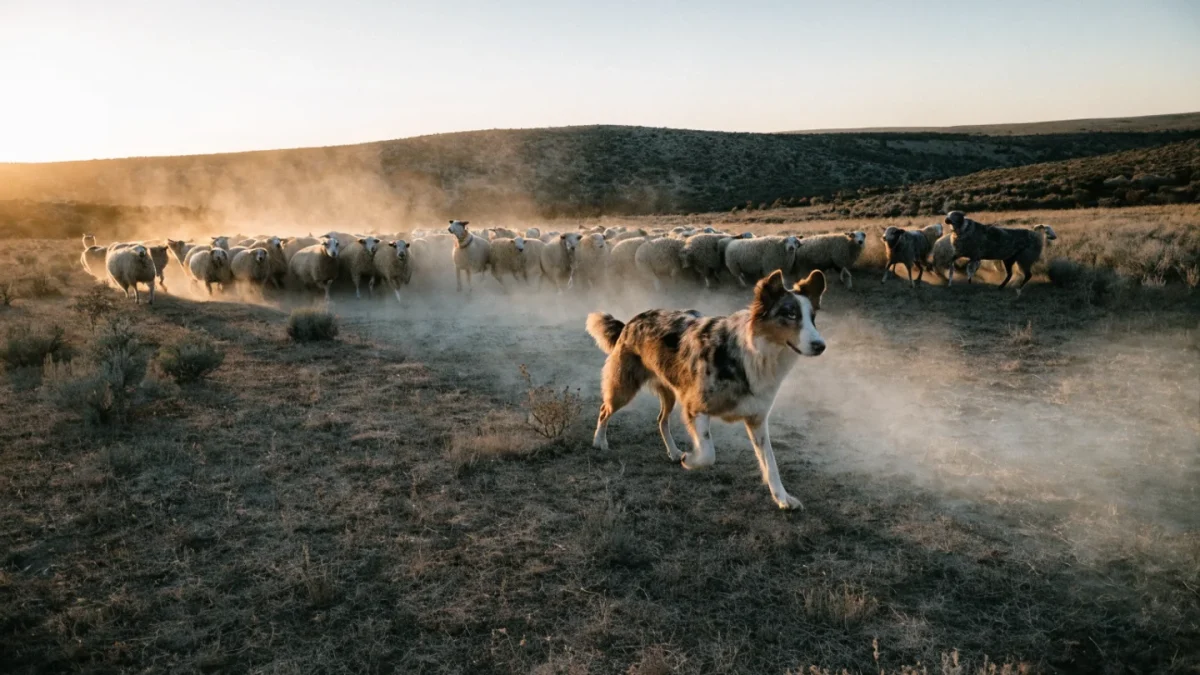
In the late 1950s, a dog named Stubby performed a trick routine at a rodeo in Boise, Idaho, that included catching multiple Frisbees mid-air, walking on his hind legs, and jumping rope. The crowd had no idea what breed he was. His owner, rancher Jay Sisler, told them: Australian Shepherd. Most had never heard the name. Within a decade, Sisler's dogs had appeared on television, performed at halftime shows, and been featured in a Disney film. The breed that had spent a century as an anonymous ranch worker became a national sensation — and nothing about its story was what the name suggested.
Australian shepherd history origins begin not in Australia, but in a mountainous region straddling modern-day Spain and France, with a people whose shepherding traditions predated written European history.
The Basque Connection
The Basque people — the Euskaldunak in their own language — are one of Europe's oldest identifiable populations. Their territory, Euskal Herria, occupies the western end of the Pyrenees on both the Spanish and French sides of the border. Their language, Euskara, is unrelated to any other known language. And for thousands of years, shepherding was central to their economy and culture.
Basque shepherds developed working dogs suited to the Pyrenean terrain — agile, weather-tough animals capable of managing flocks over mountain passes and through valleys. These weren't a standardized breed in the modern sense. They were functional types, selected for working ability over appearance, with considerable regional variation.
When Basque emigrants left Europe in the 1800s, they brought their dogs. The emigration pattern that matters for australian shepherd history origins basque runs through a specific sequence: Basque Country to Australia, then Australia to the American West.
The Australian Transit
Australia's wool industry expanded massively in the early-to-mid 1800s. The country needed experienced shepherds, and Basque stockmen were among the most skilled in the world. Significant numbers emigrated to Australia during this period, bringing their herding dogs with them. In Australia, those dogs likely crossed with local working stock, including dogs of British collie origin and other herding types present in the Australian pastoral landscape.
When the California Gold Rush began in 1848, and as the American West opened to large-scale ranching in the decades that followed, a second migration wave carried Basque shepherds from Australia to the United States. They arrived with sheep — many of them Australian breeds like Merinos — and dogs that had been shaped by both Pyrenean and Australian working conditions.
American ranchers saw Basque handlers arriving from Australia with effective herding dogs and Australian sheep. The logical conclusion, however inaccurate, was that the dogs were Australian. The name stuck because it was simple, because nobody corrected it, and because the dogs' actual origin story — Basque mountain shepherds transiting through a British colonial sheep industry before settling in the American West — didn't fit on a registration form.
Ranch Dogs of the American West
By the late 1800s, the dogs that would become Australian Shepherds were established throughout the ranching regions of the western United States — California, Colorado, Wyoming, Montana, Idaho, and the Pacific Northwest. They worked cattle and sheep on terrain that ranged from high desert to mountain pastures, and ranchers valued them for qualities that remain the breed's signature traits: versatility, endurance, intelligence, and an almost obsessive work ethic.
These weren't pampered dogs. They lived outdoors, worked from dawn until the stock was settled, and were expected to make independent decisions when out of the handler's sight. A dog that couldn't manage a balky cow, navigate rough terrain, or work in extreme weather didn't stay in the breeding program. The selective pressure was entirely functional.
There was no breed registry, no written standard, and no formal name that everyone agreed on. "Australian Shepherd," "Spanish Shepherd," "Bob-tail," "California Shepherd," and "New Mexican Shepherd" all circulated in different regions. The dogs varied in appearance — coat length, color, size — because nobody was breeding for a look. They were breeding for the capacity to work.
The complete Australian Shepherd breed guide covers the physical variation that persists in the breed today, reflecting this legacy of function-first breeding.
Jay Sisler and the Rodeo Revolution
The Australian Shepherd might have remained an obscure regional working breed indefinitely if not for Jay Sisler. A rancher from the area around Boise, Idaho, Sisler was also a gifted animal trainer who recognized that his ranch dogs had a performing ability that went far beyond livestock management.
Starting in the early 1950s, Sisler trained his Australian Shepherds — most famously Shorty, Stub, and Queenie — to perform elaborate trick routines. The dogs jumped rope, walked on hind legs, performed synchronized catches, and executed sequences that showcased the breed's intelligence, agility, and handler focus. Sisler and his dogs performed at rodeos across the western states, then nationally, eventually reaching television audiences.
In the 1960s, Walt Disney featured Sisler's dogs in films including Stub: The Best Cowdog in the West and Run, Appaloosa, Run, introducing the breed to a mainstream audience beyond the rodeo circuit. The dogs' combination of intelligence, trainability, and striking appearance — particularly the merle coat patterns and blue eyes that Sisler's dogs often carried — created an immediate public fascination.
The rodeo performances and Disney films did more to establish the Australian Shepherd as a recognized breed than any breeding program or registry. They proved that these anonymous ranch dogs had capabilities and appeal that extended far beyond livestock work.
Formal Organization
The Australian Shepherd Club of America (ASCA) was established in 1957, becoming the first organization dedicated to the breed. ASCA created a breed registry, developed a written breed standard, and began sanctioning competitions — including herding trials, obedience, and conformation shows. The early standard reflected the breed's working heritage, emphasizing structural soundness, athletic ability, and functional traits over cosmetic refinement.
ASCA's stewardship shaped the modern breed in fundamental ways. The registry documented bloodlines, the standard provided breeding targets, and the competition programs created venues for evaluating dogs against consistent criteria. By the 1970s and 1980s, the Australian Shepherd had grown from a regional ranch dog to a nationally recognized breed with a dedicated and organized community.
The temperament profile that defines the breed today — the handler focus, the herding drive, the intensity of the human-dog bond — was already firmly established during this period. ASCA's standard codified traits that working ranchers had been selecting for decades.
The AKC Question
The American Kennel Club recognized the Australian Shepherd in 1993, but the path to recognition was contentious. A significant faction within the ASCA community opposed AKC recognition, arguing that the AKC's emphasis on conformation showing would redirect breeding priorities away from working ability and toward appearance. The concern wasn't hypothetical — other herding breeds had split into distinct show and working lines after AKC recognition, with working ability sometimes declining in conformation-bred stock.
The debate split the breed community. ASCA ultimately maintained its own independent registry and competition programs separate from AKC, and many working-dog breeders continued to register exclusively with ASCA. The AKC established its own parent club, the United States Australian Shepherd Association (USASA). The result was two parallel organizational structures for the same breed — an unusual arrangement that persists today.
The practical impact on the breed is debatable. Show and working lines have diverged to some degree — conformation-bred dogs tend toward heavier bone, fuller coats, and more refined heads, while working-bred dogs remain leaner, rangier, and selected primarily for herding ability. Whether this divergence represents a problem or simply reflects different legitimate priorities depends on who you ask. What's undeniable is that the tension between working heritage and show-ring aesthetics remains a defining dynamic in the breed community.
From Ranch to Everywhere
The Australian Shepherd's trajectory from anonymous western ranch dog to one of the most popular breeds in multiple countries took roughly sixty years — from Sisler's first rodeo performances in the 1950s to the breed's consistent top-15 placement in registration rankings by the 2010s.
That popularity carries the usual consequences. Higher breeding volume produces greater variation in quality. More owners means more who chose the breed for appearance without understanding its behavioral demands. Breed-specific rescue organizations report consistent intake of young Aussies surrendered by owners who expected the beautiful coat and didn't anticipate the relentless herding brain underneath.
The history of the Australian Shepherd is, at its core, the story of a functional dog developed by practical people to solve real problems. The Basque shepherds who shaped these dogs didn't care what they looked like. They cared whether they could work. That working capacity — the intelligence, the drive, the handler partnership — is the breed's most valuable inheritance, and it's worth understanding where it came from before deciding whether it belongs in your home. For readers interested in how a different herding tradition shaped a different breed, the Border Collie origins and herding breed development traces a parallel journey from working farms to the modern show ring.