

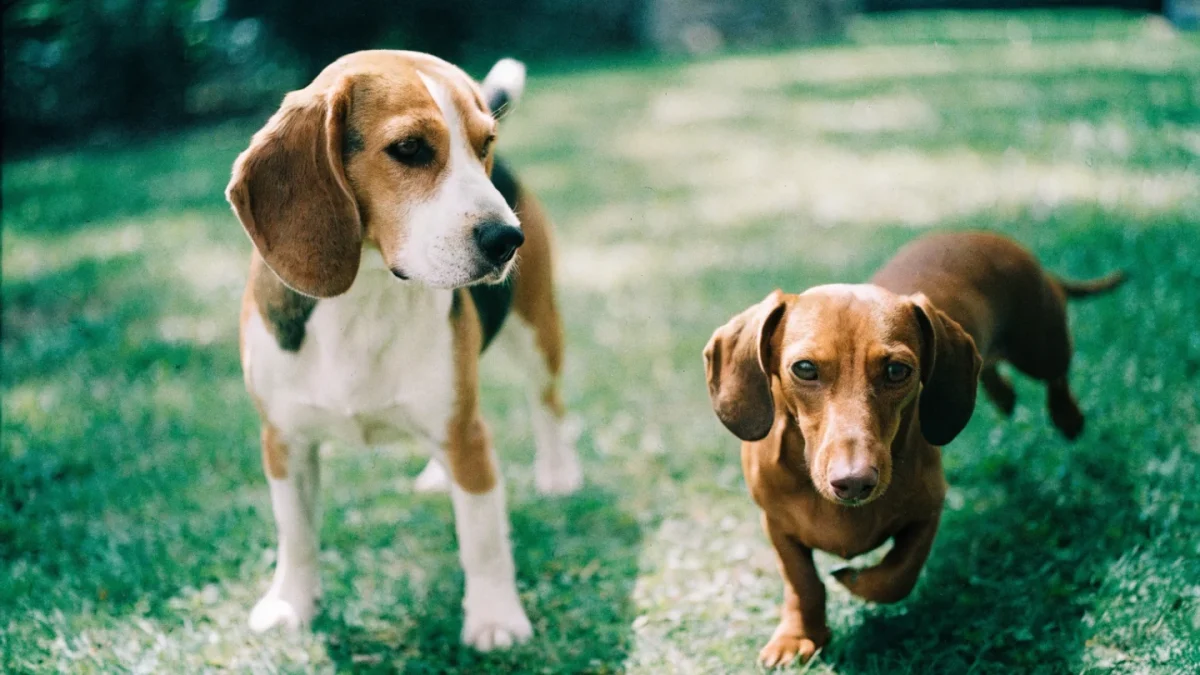
The Beagle has existed in some form in England since at least the 1400s — small pack hounds used for rabbit hunting by people who followed on foot rather than horseback. The Dachshund was developed in Germany beginning in the 15th century with a very specific job: to follow badgers into underground burrows and either flush them out or hold them at bay. One breed worked in packs above ground. The other worked alone underground. Those origins shaped two fundamentally different dogs that happen to be roughly the same size.
Both are hounds. Both have strong prey drive. Both are stubborn enough to make an experienced trainer question their life choices. But the daily experience of living with each diverges considerably.
Size and Build
| Trait | Beagle | Dachshund (Standard) |
|---|---|---|
| Height | 33-41 cm | 20-23 cm |
| Weight | 9-11 kg | 7-14 kg |
| Build | Compact, muscular, balanced | Long body, short legs, deep chest |
| Varieties | Two sizes (13-inch, 15-inch) | Standard, miniature; smooth, wire, long coat |
The Dachshund's elongated body is the most consequential physical feature in this comparison. That shape — roughly twice as long as it is tall — was essential for entering narrow badger setts. It's also the direct cause of the breed's most serious health vulnerability.
Temperament
Beagles are pack animals. They're social by default, friendly with other dogs, welcoming to strangers, and generally excellent with children. That pack mentality means they don't do well alone — a solitary Beagle left for hours will vocalize. And when Beagles vocalize, they don't bark. They bay. The Beagle bay is a sound that carries across remarkable distances, which was useful for hunters tracking rabbits across English countryside and is significantly less useful in a suburban neighborhood at 6 AM.
Dachshunds are braver than any dog their size has a right to be. That courage is a job requirement when your breed was designed to confront an angry badger in a confined tunnel. In a domestic setting, that bravery translates to a dog that's bold, opinionated, and not easily pushed around. Dachshunds bond strongly to their household but often fixate on one family member. They can be suspicious of strangers and territorial about their space — traits that make them surprisingly effective watchdogs.
Both breeds are stubborn. Not unintelligent — both are perfectly capable of learning commands. They simply evaluate whether compliance is in their interest before executing. Hound independence is a feature, not a bug, but it tests patience during training.
Exercise Needs
Beagles need 60 minutes or more of daily exercise. They were bred to run all day following scent trails, and that energy has to go somewhere. Walks should include opportunities to sniff — a Beagle on a walk is processing the world primarily through its nose, and denying that input is like asking a person to walk through an art museum with their eyes closed.
Dachshunds need 30 to 45 minutes for standards, 20 to 30 for miniatures. Moderate walks and indoor play suit them. The critical exercise rule for Dachshunds: avoid activities that stress the spine. Jumping on and off furniture, running up and down stairs repeatedly, and roughhousing with larger dogs all increase the risk of disc injury. Ramps instead of stairs, controlled play, and maintaining a healthy weight are not suggestions — they're medical necessities.
Grooming
Beagles have short, dense, weather-resistant double coats. They shed moderately year-round with heavier shedding in spring. Weekly brushing manages the coat. Their ears need regular cleaning — those long, droopy ears trap moisture and are prone to infection.
Dachshunds come in three coat varieties: smooth (minimal grooming, light shedding), wire-haired (hand-stripping or clipping twice yearly, moderate shedding), and long-haired (regular brushing two to three times weekly, feathering tangles). Grooming demands depend entirely on which coat type you choose.
Health Concerns
Beagles are generally a healthy breed with relatively few genetic predispositions compared to many purebreds. Epilepsy, hypothyroidism, hip dysplasia, and cherry eye are the primary concerns. Musladin-Lueke syndrome (a connective tissue disorder) is breed-specific and testable via DNA. Obesity is a major risk — Beagles are food-obsessed and will eat without self-regulation. Average lifespan: 12 to 15 years.
Dachshunds face intervertebral disc disease (IVDD) as a defining health risk. The breed's chondrodystrophic (dwarf) build predisposes them to disc herniation, which can cause pain, mobility loss, or paralysis. Studies estimate that 19 to 24% of dachshunds show clinical signs of IVDD during their lifetime, with the Standard Smooth-Haired variety affected at the highest rate — up to 24.4% (Packer et al., Canine Genetics and Epidemiology, 2016). Dachshunds face a relative IVDD risk 10 to 12 times higher than other breeds. Patellar luxation, progressive retinal atrophy, and obesity compound the spinal risk — every extra gram increases load on those vulnerable discs. Average lifespan: 12 to 16 years.
Living Situation
Both breeds adapt to apartment living, but with caveats.
Beagles in apartments need committed exercise routines and understanding neighbors. The baying is the dealbreaker for shared-wall living. A tired, well-exercised Beagle is quieter, but you'll never fully silence the instinct.
Dachshunds are quieter overall and handle smaller spaces well. Their lower exercise needs make apartment routines more manageable. The main accommodation is preventing spinal stress — no high jumps, ramps for furniture access, and avoiding obesity.
Both breeds have strong prey drive. Dachshunds will dig after burrowing animals in a yard. Beagles will follow a scent trail over a fence and across three counties without looking back. Secure fencing matters for both.
Who's the Right Fit
The Beagle suits active households that want a social, pack-oriented dog and can manage the noise. Families with children and other dogs often find the Beagle integrates seamlessly. You'll need to lock the garbage, monitor food intake, and accept that your walks will involve a lot of standing still while the dog investigates invisible scent trails.
The Dachshund suits someone who appreciates independence in a small package, can commit to spinal health management, and wants a loyal companion with genuine personality. Dachshund owners often say no other breed has quite the same combination of stubbornness, charm, and absurd courage.
For more breed matchups, see our dog breed comparisons guide. For dedicated breed profiles, the Beagle complete breed guide covers the breed's 600-year pack-hunting history and the Dachshund complete breed guide details the spinal anatomy that defines the breed's health story.