

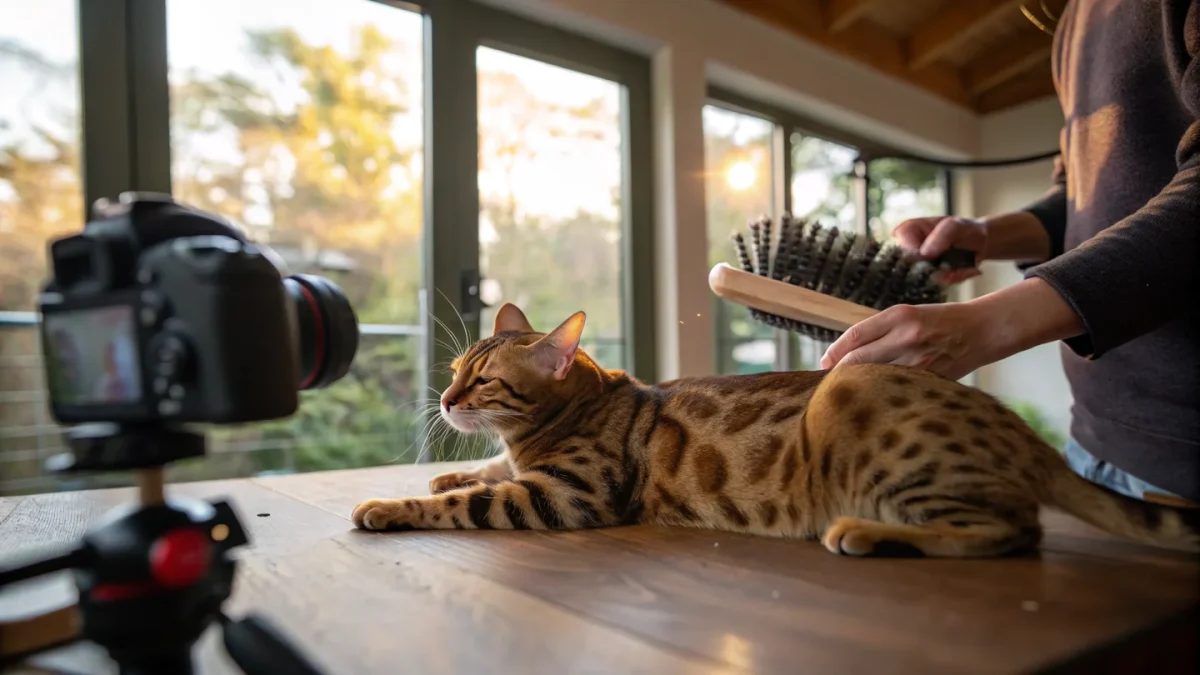
People who encounter a Bengal coat in person are often surprised by how it feels. It's dense and short, almost pelted — the individual hairs close together, lying very flat, with a texture that's somehow simultaneously soft and resilient. In direct light, the glitter effect creates a metallic shimmer across the surface. It looks like it should require elaborate maintenance.
It doesn't. The Bengal coat is one of the lower-maintenance coats in domestic cats, for reasons that have everything to do with its structure.
The Coat: Why It's Easier Than It Looks
Bengal coat genetics come directly from Asian leopard cat ancestry. ALC coats evolved for function, not show — dense, close-lying, and very short, suited to an active cat that moves through vegetation and near water. The domestic Bengal has inherited this functional structure.
Because the hairs lie so flat and the coat has minimal undercoat compared to longhaired breeds (or even double-coated shorthairs), loose hairs tend to stay within the coat rather than distributing widely around the house. Bengals do shed — all cats do — but the experience of finding Bengal hair on furniture is generally less intense than with many other breeds.
The glitter effect is structural to the individual hair shaft — cells that refract light are embedded in the hair itself. It doesn't wash out, fade with standard care, or require special products to maintain. You cannot enhance the glitter with grooming products, and you won't damage it with normal brushing.
Brushing: Once a Week Is Fine
Weekly brushing with a soft rubber brush or grooming glove is sufficient for most Bengals. This removes loose hairs, distributes skin oils, and provides a sensory experience many Bengals enjoy — the social contact of grooming tends to be welcome.
Some Bengals enjoy brushing more than others. Cats introduced to brushing as kittens tend to accept it more readily as adults. If your Bengal is resistant, keep sessions brief and positive, ending before the cat signals discomfort. Forced grooming with a resistant cat produces a cat that is progressively harder to groom.
A damp chamois or microfiber cloth can be used to buff the coat after brushing, which enhances the glitter effect and removes any remaining loose hair. This step is optional, but the result is satisfying.
Nail Trimming
Bengals tend to be vigorous scratchers. They should have appropriate scratching surfaces (posts, boards, horizontal scratchers) to wear and condition nail sheaths naturally, but indoor Bengals still need regular nail trimming — typically every 2–3 weeks.
Given the Bengal's activity level and athleticism, keeping nails at a reasonable length also reduces the damage to furniture and to their owners during play sessions. Bengal play is more vigorous than most domestic cat play, and claws make contact.
Standard cat nail clippers work well. Trim just the clear tip, keeping away from the pink quick. Starting this during kittenhood makes adult nail trimming far less confrontational.
Dental Care
Bengal care commitments that go beyond the coat include dental health — something most new Bengal owners don't immediately consider.
Bengal jaw structure is more moderate than Siamese, but dental disease is common across all cat breeds, and Bengals are no exception. Plaque and tartar buildup leads to periodontal disease that affects systemic health significantly.
The most effective prevention is brushing — a small-headed toothbrush and cat-appropriate paste, built up gradually to a routine the cat accepts. Dental treats and water additives provide supplementary support but don't replace mechanical cleaning. Annual veterinary dental checks catch early buildup before it requires significant intervention.
Ear Care
Check ears weekly. A healthy Bengal ear is pale pink with minimal wax and no odor. Bengals are not especially prone to ear problems, but regular checking catches mite infestations, infections, and debris buildup early.
If cleaning is needed, use a cotton pad dampened with appropriate ear cleaning solution for the visible outer portion only. Don't probe the ear canal. Any persistent dark debris, unusual discharge, or odor warrants a vet visit.
Bathing
Bathing a Bengal is less traumatic than bathing most cats. Many Bengals are actually water-interested, and with early acclimatization, many accept bathing without the sustained protest typical of less aquatically inclined breeds.
Routine bathing isn't necessary — the coat stays reasonably clean through self-grooming. If a bath is needed (after getting into something, or for a cat with skin issues), use cat-appropriate shampoo, rinse thoroughly, and dry quickly in a warm environment. The Bengal's dense, flat coat dries faster than longhaired breeds.
Building the Grooming Routine
Establish grooming habits early. A Bengal kitten introduced to paw handling, ear checks, mouth examination, and brushing during the first months of its life accepts these routines as an adult with minimal resistance. A Bengal that first encounters nail clipping at two years old requires patient, gradual re-training.
Keep grooming sessions brief, calm, and consistent. The Bengal's intelligence means it adapts quickly to recurring routines — including grooming — once it has been established as a normal part of its week.