

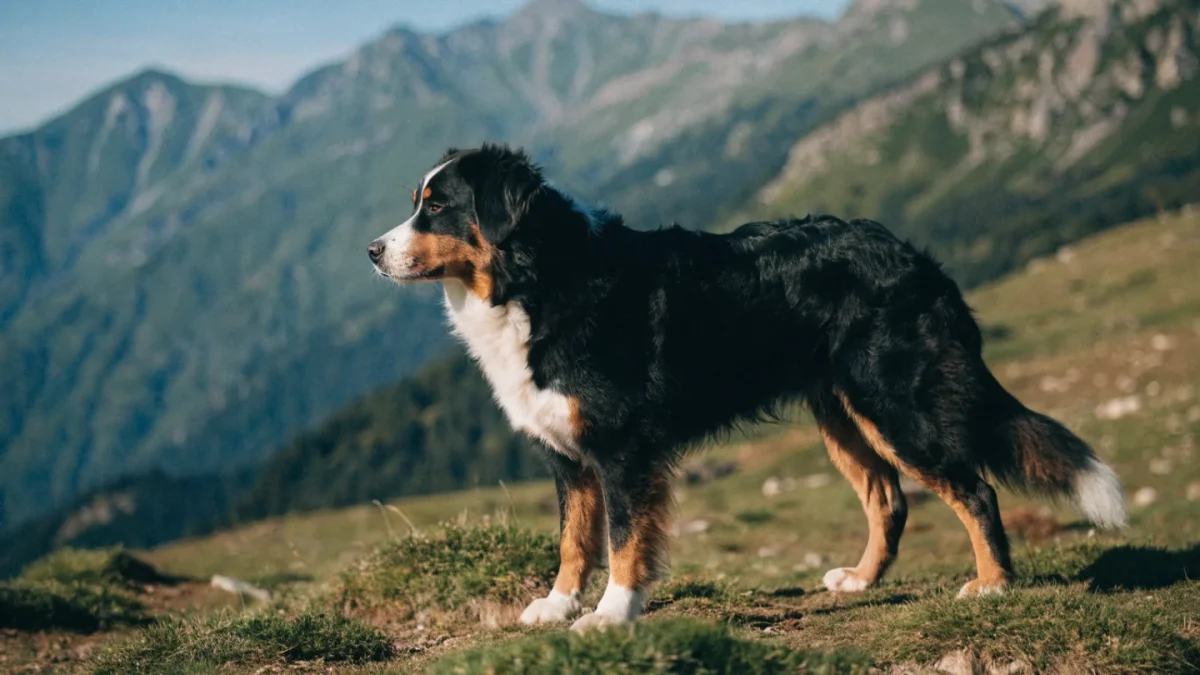
Every Bernese mountain dog alive today descends from a remarkably small group of founding dogs registered in Switzerland in the early 1900s. That narrow genetic base — the consequence of a breed rescued from near-extinction with limited breeding stock — is the starting point for understanding nearly every health challenge the breed faces, from the devastating cancer rates to the orthopedic conditions that compound an already shortened lifespan.
The genetics of the Bernese mountain dog are, in many ways, the genetics of a bottleneck. And the consequences of that bottleneck are still playing out in veterinary oncology clinics around the world.
The Founder Effect
When the Bernese mountain dog was formalized in the early 1900s, breeders worked from a small pool of farm dogs in the canton of Bern. The history of the Bernese mountain dog tells the rescue story. The genetic consequence is what matters here: a small founder population means limited allelic diversity, with harmful recessive alleles carried forward at frequencies far higher than in a genetically diverse population.
The problem was compounded by the popular-sire effect — breeding disproportionately from a few successful males, each contributing to hundreds of offspring and further narrowing the gene pool. By the time the breed expanded internationally, the genetic damage was embedded.
Histiocytic Sarcoma: The Central Problem
Histiocytic sarcoma is a cancer of histiocyte-origin cells — cells derived from the immune system. In Bernese mountain dogs, it occurs at rates dramatically higher than in any other breed — a 2009 study in the Journal of Heredity put the frequency at roughly 25% of the breed, and found that despite Bernese mountain dogs making up under 2% of registered dogs in France, they accounted for 80% of the country's reported histiocytic sarcoma cases. Flat-coated and golden retrievers develop it too, but typically the contained, localized form rather than the disseminated version that dominates in Berners. The disease is aggressive, metastasizes rapidly, and has a very poor prognosis. Median survival time after diagnosis is typically measured in months, not years.
The genetics of histiocytic sarcoma susceptibility in Berners appear to be complex — involving multiple genes rather than a single Mendelian locus. Genome-wide association studies have identified several chromosomal regions linked to the disease, but no single causative mutation has been isolated. A 2021 PLOS Genetics study pinned the primary locus to chromosome 11, in the CDKN2A-MTAP region, with additional risk loci on chromosomes 5, 14, 2, and 20 — dogs carrying risk alleles across the three main loci (11, 5, and 14) faced meaningfully higher odds of developing the cancer.
This complexity means there is currently no DNA test that can predict whether an individual Bernese mountain dog will develop histiocytic sarcoma. Breeding decisions must rely on pedigree information — longevity data from ancestors — rather than direct genetic screening. This is imprecise, but it's the best tool available.
Other Cancer Types
Beyond histiocytic sarcoma, Berners are overrepresented in lymphoma, mast cell tumors, and osteosarcoma. The cumulative effect is a breed where cancer-related mortality runs higher than the "roughly half" figure that gets repeated casually — a 2016 Swiss study tracking 381 Bernese mountain dogs found neoplasia responsible for 58.3% of deaths, among the highest cancer mortality rate documented in any breed.
Lifespan Research
Multiple studies across different countries consistently place the Bernese mountain dog's median lifespan at 7 to 8 years — significantly below both the general dog population and other breeds of comparable size. Breed health surveys conducted by national breed clubs track longevity and cause of death, providing longitudinal data on whether breeding decisions are shifting outcomes.
European breed club surveys — Switzerland's tracking is the most rigorous, putting median life expectancy at 8.4 years — sometimes get read as showing marginally better longevity than North American figures. Treat that comparison skeptically. Different populations, different data collection standards, and no study has directly put the two continents head to head.
Color Genetics
The Bernese mountain dog's distinctive tricolor pattern — black, rust (tan), and white — involves the interaction of several well-characterized genetic loci:
The rust markings come from the a^t (tan point) allele at the agouti locus — the same mechanism behind tan points in Rottweilers and Dobermans. Berners carry E/E or E/e at the extension locus, allowing full eumelanin (black) expression, and k^y at the K locus, which permits the agouti pattern to show through. The white markings — blaze, chest, feet, tail tip — result from the S locus (Irish spotting pattern), with individual variation explaining why some Berners have wider blazes or more prominent chest markings.
All four Sennenhund breeds share this genetic configuration, which is why the tricolor pattern breeds true. Occasional puppies with atypical markings result from rare recessive combinations, not outcross contamination.
Available DNA Tests and Current Research
While no test exists for histiocytic sarcoma, clinically useful DNA tests are available for degenerative myelopathy (the SOD1 mutation), von Willebrand disease Type I, and certain forms of progressive retinal atrophy. Ophthalmologist examinations remain important alongside genetic screening, since not all PRA forms found in Berners are covered by available tests.
Research into histiocytic sarcoma genetics is active at several institutions, with whole-genome sequencing of affected and unaffected dogs underway. Breed-specific biobanks are collecting tissue samples, and health registries track longevity data across generations. The practical goal: give breeders tools to select against cancer susceptibility without further narrowing an already limited gene pool. That balance is the central challenge for the breed's future.
The broader picture — temperament, daily care, and lifestyle fit — is covered in the Bernese mountain dog breed guide.
Frequently Asked Questions
Is there a DNA test for histiocytic sarcoma in Bernese mountain dogs?
No. As of 2026, no commercially available DNA test can predict histiocytic sarcoma in individual dogs. The disease appears to involve multiple genetic loci with complex inheritance, making a simple genetic test elusive. Pedigree longevity data — knowing how long ancestors lived and what they died of — remains the most practical tool for estimating risk.
Can breeding practices reduce the cancer rate?
In theory, yes — selecting breeding pairs with above-average pedigree longevity can shift the population toward lower cancer susceptibility over generations. In practice, this is slow and imprecise. The gene pool is already limited, and overly aggressive selection could reduce diversity further. Responsible breeding in Berners is a balancing act.
Why are Bernese mountain dogs tricolored?
The tricolor pattern results from the interaction of the agouti (tan point), extension, and spotting loci. All four Sennenhund breeds share this configuration, suggesting it was fixed long before formal breeding programs began.