

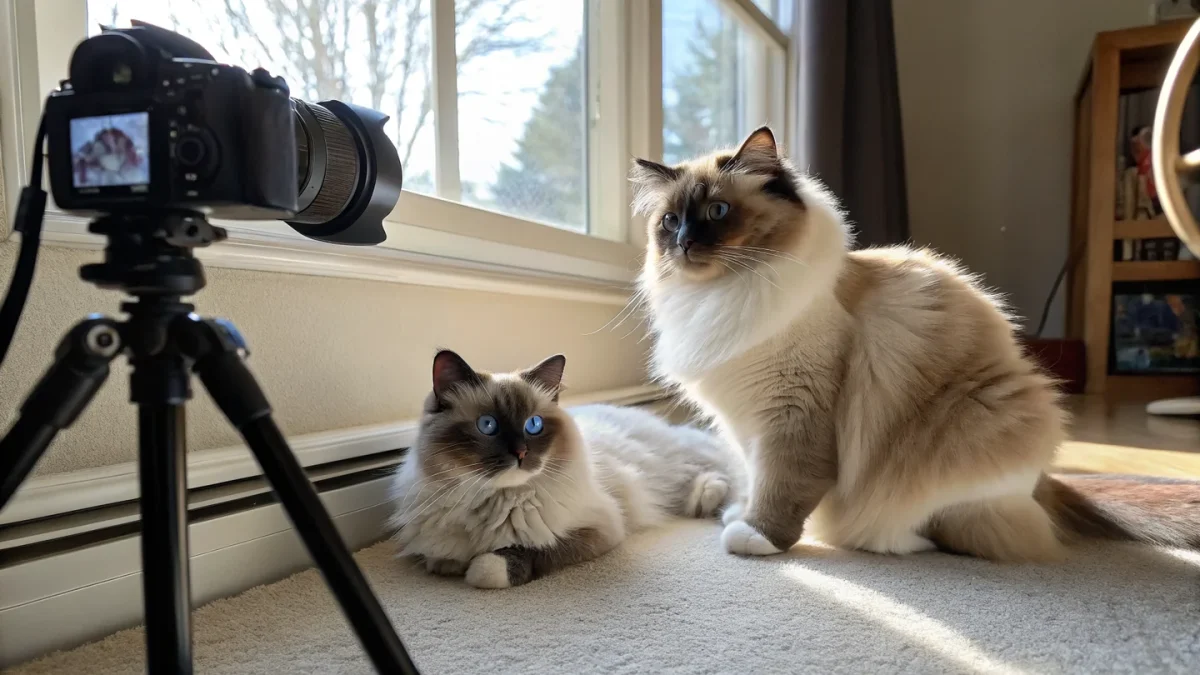
The Birman and Ragdoll occupy overlapping territory in the cat world: both are large, semi-longhaired, blue-eyed cats with pointed coloration and reputations for gentle, family-friendly temperament. The confusion between them is understandable. The distinction, once you know it, is real and practically meaningful for choosing between them.
Origins
The Birman's formal breed history begins in France in the 1920s, with the origin before that point genuinely uncertain. The Ragdoll is a much more recent breed — developed in California in the 1960s by breeder Ann Baker, with documented foundation animals and a specific breeding program. The Ragdoll was named for the notable tendency of early specimens to go relaxed and limp when picked up, a trait that has been maintained in the breed.
Both breeds have the pointed color pattern (darker extremities against a lighter body). Both have blue eyes. Both have semi-long, relatively non-matting coats. These similarities are why the confusion is so common.
Physical Differences
The most immediate physical difference is size. The Ragdoll is one of the largest domestic cat breeds — adult males frequently reach 7 to 9 kilograms, with some exceptional individuals heavier. Birmans are medium-large cats that top out significantly lower, typically 4 to 6 kilograms for males. A side-by-side comparison makes this difference immediately apparent; in photographs alone, it can be harder to judge without scale reference.
The white gloves. The Birman's white paws are a breed-defining characteristic — a required feature of the standard. The symmetrical white gloves on the front feet and gauntlets on the hind feet are what distinguishes the Birman visually from any other pointed cat. Ragdolls have no white paw requirement; they come in pointed, bicolor (with white areas), and mitted (some white) pattern variations, but none of these produce the specific, symmetrical white gloves of the Birman.
Head structure. The Birman has a rounded, moderately broad head with a somewhat medium-length nose. The Ragdoll's head is large and broad, with a more strongly modified wedge shape and a relatively flat profile. Side by side, the Ragdoll reads as more massive, broader, and less refined in its proportions.
Coat. Both coats are semi-long and silky without heavy undercoats. The Ragdoll's coat is typically silkier and lies flatter; the Birman's has slightly more body. Both are relatively tangle-resistant compared to Persians.
Temperament
This is where the breeds converge most, and where the differences are subtle but real.
Both breeds are gentle, people-oriented, and good with families. Both handle multi-pet households reasonably well. Both are more interactive than Persians but less demanding than Burmese or Sphynx.
The Ragdoll's defining behavioral trait — the limpness when held — is real in well-bred individuals but variable. A well-bred Ragdoll does go significantly more relaxed when picked up than most cats. This makes them particularly comfortable to handle and partly explains the breed's popularity with families. Birmans are tolerant of handling but do not have this characteristic limpness.
The Ragdoll tends to be slightly more placid overall — some describe it as the most relaxed and undemanding of the large gentle breeds, to the point of being described as almost dog-like in its following behavior combined with its acceptance of handling. The Birman is similarly gentle but somewhat more independently mobile — it moves on its own schedule rather than simply going where it's placed.
| Feature | Birman | Ragdoll |
|---|---|---|
| Size (adult male) | 4–6 kg | 7–9 kg |
| Origin | France (1920s) | United States (1960s) |
| White paws | Required by standard | Not a defining feature |
| "Goes limp" when held | No | Characteristic of well-bred specimens |
| Coat texture | Silky, slight body | Very silky, flat |
| Temperament | Gentle, moderately social | Placid, highly tolerant of handling |
Which Is Right for You?
If size genuinely matters to you — if you want a very large, impressive cat — the Ragdoll wins comfortably.
If the white-gloved paw aesthetic is specifically what you're drawn to, the Birman is the only choice; this feature is distinctive to the breed.
If you want the most placid, tolerant, go-with-the-flow cat in the gentle-giant category, many owners find the Ragdoll edges ahead.
If you want a large, gentle cat without the extreme size and with a slightly more active presence, the Birman is the match.
The Birman breed guide covers the full picture if you're leaning toward the Birman. Both breeds are excellent choices for the households they suit — the difference is in the specific priorities that make one a better fit than the other.