

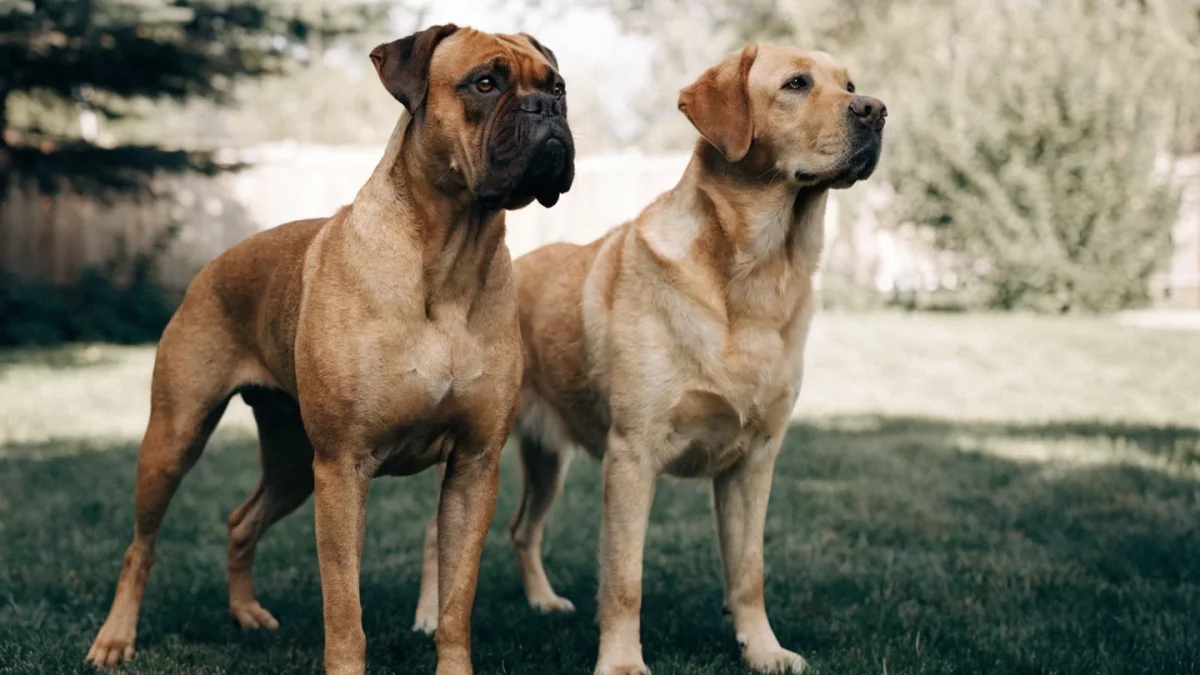
The Boxer was developed in Munich during the 1890s by crossing the now-extinct Bullenbeisser with English Bulldogs. The Labrador Retriever traces to 1830s Newfoundland, where St. John's water dogs retrieved fish and nets for cod fishermen. Two entirely different jobs produced two dogs that both ended up on "best family breed" lists — but the daily reality of living with each is more different than most people expect.
Both breeds land in the medium-large category and both demand active owners. That's roughly where the similarities end. If you're weighing a Boxer against a Lab, the right choice comes down to your climate, your tolerance for shedding, and what kind of personality you actually want sharing your couch.
Size and Build
| Trait | Boxer | Labrador Retriever |
|---|---|---|
| Height (male) | 57-63 cm | 57-62 cm |
| Height (female) | 53-60 cm | 55-60 cm |
| Weight (male) | 27-32 kg | 29-36 kg |
| Weight (female) | 25-29 kg | 25-32 kg |
| Build | Square, muscular, deep-chested | Sturdy, otter tail, broad skull |
They're comparable in height, but Labs tend to carry more mass. Boxers are leaner and more angular — built for agility rather than endurance swimming. The Boxer's brachycephalic (short-nosed) face is the most consequential physical difference and affects everything from exercise in heat to breathing under anesthesia.
Temperament
Boxers are clowns with a security system. They'll invent games out of nothing, bounce around the house like they've forgotten gravity exists, and then go dead serious the moment a stranger approaches the property. That protective streak is instinctive — Boxers were bred for guarding and later served as military messenger dogs in both world wars.
Labs have no security system. They greet everyone. The postal carrier, the burglar, the neighborhood cat — all receive the same enthusiastic full-body tail wag. Labs were bred to work cooperatively with humans on fishing boats and in hunting blinds, and that cooperative wiring runs deep. They want to please, and they want to eat. In roughly that order.
Both breeds are affectionate with families and good with children. Boxers tend to be more patient with rough play from kids — they're physically tough and don't overreact to being bumped or grabbed. Labs are gentle but can be bowling balls during their first three years, knocking small children over with sheer enthusiasm rather than intent.
Exercise Needs
Both need a minimum of 60 minutes of structured daily exercise. The critical difference is heat tolerance.
Labs handle warm weather better than Boxers do. The Boxer's shortened airway limits efficient panting, making them vulnerable to heat exhaustion during vigorous exercise in hot or humid conditions. If you live somewhere with long, hot summers, this isn't a minor inconvenience — it's a legitimate safety concern that restricts when and how your dog can exercise for several months each year.
Labs are water dogs to their core and will swim in anything wet. Boxers generally enjoy water but aren't natural swimmers the way Labs are. The Boxer's muscle density and front-heavy build make swimming harder work.
Grooming
This one is straightforward. Boxers have short, tight coats that shed moderately. A weekly brushing keeps things manageable. Labs have dense double coats that shed constantly and blow out twice a year in spectacular fashion. If you dislike finding fur in your coffee, on your dress clothes, and woven into your car upholstery, the Lab will test your patience.
Neither breed requires professional grooming. Both need regular nail trims and dental care. Labs need their ears checked routinely — those folded ears trap moisture after swimming and create a hospitable environment for infections.
Health Concerns
Both breeds face serious health predispositions, but the profiles are different.
Boxers have one of the highest cancer rates among all breeds. Mast cell tumors, lymphoma, and brain tumors appear at elevated frequencies. Boxers are also predisposed to aortic stenosis, dilated cardiomyopathy, hip dysplasia, and degenerative myelopathy. Their brachycephalic anatomy adds respiratory compromise that worsens with age, obesity, or both. Average lifespan: 10 to 12 years.
Labs face hip and elbow dysplasia, progressive retinal atrophy, exercise-induced collapse (a genetic condition testable via DNA), and obesity — Labs are among the breeds most prone to weight gain. Cancer occurs but at rates below what Boxers experience. Average lifespan: 10 to 12 years, with some individuals reaching 14.
Living Situation
Both breeds adapt to apartments if exercise needs are met, but both prefer homes with yard access. Boxers are more sensitive to temperature extremes — they overheat in summer and get genuinely cold in winter due to their thin coat. Labs handle cold weather comfortably thanks to that double coat.
Boxers are quieter dogs on average. They bark with purpose, not habit. Labs can be vocal, especially when bored or excited, and adolescent Labs left alone may vocalize extensively.
Who's the Right Fit
The Boxer suits you if you want a dog with a protective instinct, prefer minimal shedding, live in a moderate climate, and enjoy a breed that's simultaneously ridiculous and serious. You'll need to budget for cardiac screening and cancer monitoring.
The Lab suits you if you want maximum social friendliness, enjoy water activities, can tolerate heavy shedding, and want one of the most trainable, forgiving breeds available. You'll need to manage food intake vigilantly — an overweight Lab is not an "if" problem, it's a "when" problem.
Both are outstanding family dogs. The question isn't which is better — it's which matches your specific household, your climate, and your tolerance for fur. For more comparisons across popular breeds, see our dog breed comparisons guide. For dedicated breed profiles, the Boxer complete breed guide covers the breed's Munich working origins and cardiac health profile, while the Labrador Retriever complete breed guide traces the breed from Newfoundland fishing docks to its decades-long run as the world's most popular dog.